
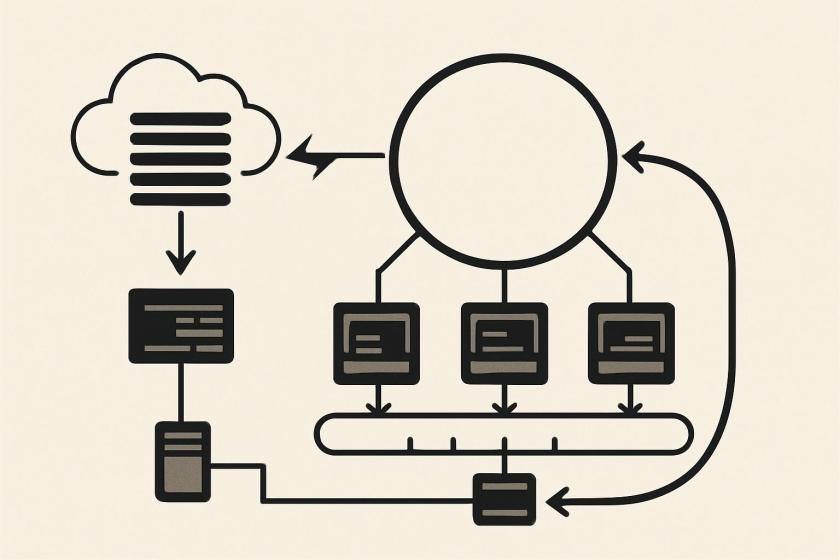
The practical lesson for teams building agents is that the loop, not the model, becomes the system boundary. Once tool use is real, SDK convenience can get in the way of message fidelity, cache behavior, and provider-specific controls. That means agent architecture needs explicit ownership of orchestration, state, and recovery rather than a thin wrapper around a chat API.
State handling is the most consequential design choice. A file-system-like shared layer gives subagents, code execution, and inference steps a common handoff mechanism, which avoids dead ends and keeps intermediate artifacts reusable. The trade-off is operational discipline: tools must be built to read and write compatible paths, and teams need clear rules for what stays in shared state versus what remains local to a step.
Reliability engineering also shifts inside the loop. Reinforcement after tool calls, strict isolation for failure-prone subtasks, and selective context trimming all improve completion odds, but each affects token reuse and cache invalidation differently. That creates a three-way tension between observability, cost predictability, and the ability to recover from partial failure without polluting future steps.
For production teams, the takeaway is to treat evals, output generation, and model selection as architecture decisions. A tool that only works in the happy path is not enough; the real challenge is preserving control when prompts, cache points, and provider-side tools interact in unexpected ways. The article is a reminder that agent platforms are still moving targets, so maintainability and testability should drive the design.
Which Agent SDK To Target?
When you build your own agent, you have the choice of targeting an underlying SDK like the OpenAI SDK or the Anthropic SDK, or you can go with a higher level abstraction such as the Vercel AI SDK or Pydantic. The choice we made a while back was to adopt the Vercel AI SDK but only the provider abstractions, and to basically drive the agent loop ourselves. At this point we would not make that choice again. There is absolutely nothing wrong with the Vercel AI SDK, but when you are trying to build an agent, two things happen that we originally didn’t anticipate: The first is that the differences between models are significant enough that you will need to build your own agent abstraction. We have not found any of the solutions from these SDKs that build the right abstraction for an agent. I think this is partly because, despite the basic agent design being just a loop, there are subtle differences based on the tools you provide. These differences affect how easy or hard it is to find the right abstraction (cache control, different requirements for reinforcement, tool prompts, provider-side tools, etc.). Because the right abstraction is not yet clear, using the original SDKs from the dedicated platforms keeps you fully in control. With some of these higher-level SDKs you have to build on top of their existing abstractions, which might not be the ones you actually want in the end. We also found it incredibly challenging to work with the Vercel SDK when it comes to dealing with provider-side tools. The attempted unification of messaging formats doesn’t quite work. For instance, the web search tool from Anthropic routinely destroys the message history with the Vercel SDK, and we haven’t yet fully figured out the cause. Also, in Anthropic’s case, cache management is much easier when targeting their SDK directly instead of the Vercel one. The error messages when you get things wrong are much clearer. This might change, but right now we would probably not use an abstraction when building an agent, at least until things have settled down a bit. The benefits do not yet outweigh the costs for us. Someone else might have figured it out. If you’re reading this and think I’m wrong, please drop me a mail. I want to learn.Caching Lessons
The different platforms have very different approaches to caching. A lot has been said about this already, but Anthropic makes you pay for caching. It makes you manage cache points explicitly, and this really changes the way you interact with it from an agent engineering level. I initially found the manual management pretty dumb. Why doesn’t the platform do this for me? But I’ve fully come around and now vastly prefer explicit cache management. It makes costs and cache utilization much more predictable. Explicit caching allows you to do certain things that are much harder otherwise. For instance, you can split off a conversation and have it run in two different directions simultaneously. You also have the opportunity to do context editing. The optimal strategy here is unclear, but you clearly have a lot more control, and I really like having that control. It also makes it much easier to understand the cost of the underlying agent. You can assume much more about how well your cache will be utilized, whereas with other platforms we found it to be hit and miss. The way we do caching in the agent with Anthropic is pretty straightforward. One cache point is after the system prompt. Two cache points are placed at the beginning of the conversation, where the last one moves up with the tail of the conversation. And then there is some optimization along the way that you can do. Because the system prompt and the tool selection now have to be mostly static, we feed a dynamic message later to provide information such as the current time. Otherwise, this would trash the cache. We also leverage reinforcement during the loop much more.Reinforcement In The Agent Loop
Every time the agent runs a tool you have the opportunity to not just return data that the tool produces, but also to feed more information back into the loop. For instance, you can remind the agent about the overall objective and the status of individual tasks. You can also provide hints about how the tool call might succeed when a tool fails. Another use of reinforcement is to inform the system about state changes that happened in the background. If you have an agent that uses parallel processing, you can inject information after every tool call when that state changed and when it is relevant for completing the task. Sometimes it’s enough for the agent to self-reinforce. In Claude Code, for instance, the todo write tool is a self-reinforcement tool. All it does is take from the agent a list of tasks that it thinks it should do and echo out what came in. It’s basically just an echo tool; it really doesn’t do anything else. But that is enough to drive the agent forward better than if the only task and subtask were given at the beginning of the context and too much has happened in the meantime. We also use reinforcements to inform the system if the environment changed during execution in a way that’s problematic for the agent. For instance, if our agent fails and retries from a certain step forward but the recovery operates off broken data, we inject a message informing it that it might want to back off a couple of steps and redo an earlier step.Isolate Failures
If you expect a lot of failures during code execution, there is an opportunity to hide those failures from the context. This can happen in two ways. One is to run tasks that might require iteration individually. You would run them in a subagent until they succeed and only report back the success, plus maybe a brief summary of approaches that did not work. It is helpful for an agent to learn about what did not work in a subtask because it can then feed that information into the next task to hopefully steer away from those failures. The second option doesn’t exist in all agents or foundation models, but with Anthropic you can do context editing. So far we haven’t had a lot of success with context editing, but we believe it’s an interesting thing we would love to explore more. We would also love to learn if people have success with it. What is interesting about context editing is that you should be able to preserve tokens for further down the iteration loop. You can take out of the context certain failures that didn’t drive towards successful completion of the loop, but only negatively affected certain attempts during execution. But as with the point I made earlier: it is also useful for the agent to understand what didn’t work, but maybe it doesn’t require the full state and full output of all the failures. Unfortunately, context editing will automatically invalidate caches. There is really no way around it. So it can be unclear when the trade-off of doing that compensates for the extra cost of trashing the cache.Sub Agents / Sub Inference
As I mentioned a couple of times on this blog already, most of our agents are based on code execution and code generation. That really requires a common place for the agent to store data. Our choice is a file system—in our case a virtual file system—but that requires different tools to access it. This is particularly important if you have something like a subagent or subinference. You should try to build an agent that doesn’t have dead ends. A dead end is where a task can only continue executing within the sub-tool that you built. For instance, you might build a tool that generates an image, but is only able to feed that image back into one more tool. That’s a problem because you might then want to put those images into a zip archive using the code execution tool. So there needs to be a system that allows the image generation tool to write the image to the same place where the code execution tool can read it. In essence, that’s a file system. Obviously it has to go the other way around too. You might want to use the code execution tool to unpack a zip archive and then go back to inference to describe all the images so that the next step can go back to code execution and so forth. The file system is the mechanism that we use for that. But it does require tools to be built in a way that they can take file paths to the virtual file system to work with. So basically anExecuteCode tool would have access to the same file system as the RunInference tool which could take a path to a file on that same virtual file system.
The Use Of An Output Tool
One interesting thing about how we structured our agent is that it does not represent a chat session. It will eventually communicate something to the user or the outside world, but all the messages that it sends in between are usually not revealed. The question is: how does it create that message? We have one tool which is the output tool. The agent uses it explicitly to communicate to the human. We then use a prompt to instruct it when to use that tool. In our case the output tool sends an email. But that turns out to pose a few other challenges. One is that it’s surprisingly hard to steer the wording and tone of that output tool compared to just using the main agent loop’s text output as the mechanism to talk to the user. I cannot say why this is, but I think it’s probably related to how these models are trained. One attempt that didn’t work well was to have the output tool run another quick LLM like Gemini 2.5 Flash to adjust the tone to our preference. But this increases latency and actually reduces the quality of the output. In part, I think the model just doesn’t word things correctly and the subtool doesn’t have sufficient context. Providing more slices of the main agentic context into the subtool makes it expensive and also didn’t fully solve the problem. It also sometimes reveals information in the final output that we didn’t want to be there, like the steps that led to the end result. Another problem with an output tool is that sometimes it just doesn’t call the tool. One of the ways in which we’re forcing this is we remember if the output tool was called. If the loop ends without the output tool, we inject a reinforcement message to encourage it to use the output tool.Model Choice
Overall our choices for models haven’t dramatically changed so far. I think Haiku and Sonnet are still the best tool callers available, so they make for excellent choices in the agent loop. They are also somewhat transparent with regards to what the RL looks like. The other obvious choices are the Gemini models. We so far haven’t found a ton of success with the GPT family of models for the main loop. For the individual sub-tools, which in part might also require inference, our current choice is Gemini 2.5 if you need to summarize large documents or work with PDFs and things like that. That is also a pretty good model for extracting information from images, in particular because the Sonnet family of models likes to run into a safety filter which can be annoying. There’s also probably the very obvious realization that token cost alone doesn’t really define how expensive an agent. A better tool caller will do the job in fewer tokens. There are some cheaper models available than sonnet today, but they are not necessarily cheaper in a loop. But all things considered, not that much has changed in the last couple of weeks.Testing and Evals
We find testing and evals to be the hardest problem here. This is not entirely surprising, but the agentic nature makes it even harder. Unlike prompts, you cannot just do the evals in some external system because there’s too much you need to feed into it. This means you want to do evals based on observability data or instrumenting your actual test runs. So far none of the solutions we have tried have convinced us that they found the right approach here. Unfortunately, I have to report that at the moment we haven’t found something that really makes us happy. I hope we’re going to find a solution for this because it is becoming an increasingly frustrating aspect of building an agent.Coding Agent Updates
As for my experience with coding agents, not really all that much has changed. The main new development is that I’m trialing Amp more. In case you’re curious why: it’s not that it’s objectively a better agent than what I’m using, but I really quite like the way they’re thinking about agents from what they’re posting. The interactions of the different sub agents like the Oracle with the main loop is beautifully done, and not many other harnesses do this today. It’s also a good way for me to validate how different agent designs work. Amp, similar to Claude Code, really feels like a product built by people who also use their own tool. I do not feel every other agent in the industry does this.Quick Stuff I Read And Found
That’s just a random assortment of things that I feel might also be worth sharing:- What if you don’t need MCP at all?: Mario argues that many MCP servers are overengineered and include large toolsets that consume lots of context. He proposes a minimalist approach for browser-agent use-cases by relying on simple CLI tools (e.g., start, navigate, evaluate JS, screenshot) executed via Bash, which keeps token usage small and workflows flexible. I built a Claude/Amp Skill out of it.
- The fate of “small” open source: The author argues that the age of tiny, single-purpose open-source libraries is coming to an end, largely because built-in platform APIs and AI tools can now generate simple utilities on demand. Thank fucking god.
- Tmux is love. There is no article that goes with it, but the TLDR is that Tmux is great. If you have anything that remotely looks like an interactive system that an agent should work with, you should give it some Tmux skills.
Enjoyed this article? Sign up for our newsletter to receive regular insights and stay connected.