
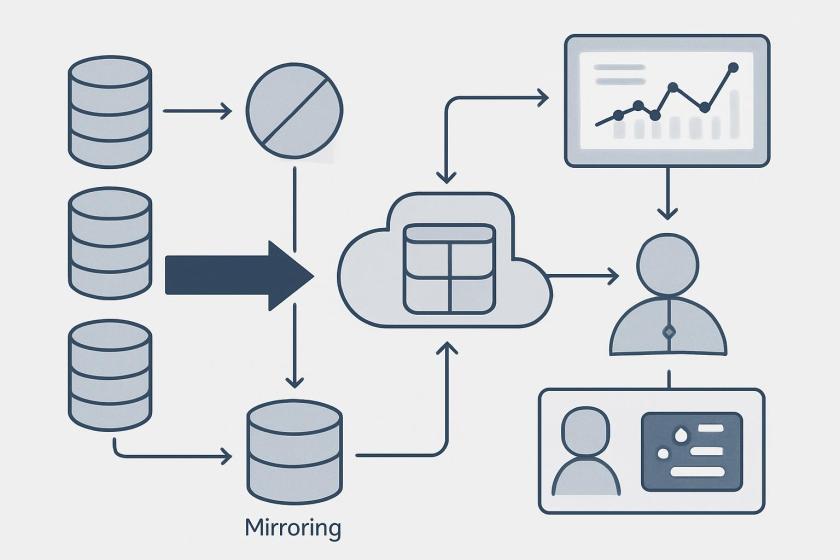
For technical teams, the main shift here is not a new database feature list; it is the move toward a composable data estate where operational stores, analytics, and AI retrieval share the same governed backbone. That reduces duplication, but it also raises the bar for planning identity, permissions, lineage, and workload boundaries across services that were once isolated.
The architectural trade-off is clear: zero-ETL convenience improves time to value, yet it can also increase coupling between source systems and downstream analytics or agent workflows. Teams adopting mirrored or shared-access patterns should think carefully about data freshness expectations, failure modes, and who owns schema changes when the same data feeds reporting, applications, and AI experiences.
Fabric IQ and agent integrations add another layer: semantic modeling becomes part of the application design, not just a BI concern. That means data teams may need to define entities, relationships, and business rules earlier, so agents can act reliably on context rather than raw tables. In practice, this shifts effort from pipeline construction to data modeling, governance, and validation.
There is also a platform strategy angle for cloud and infrastructure teams. The combination of managed databases, hybrid connectivity, and cross-platform interoperability suggests a stronger preference for shared control planes and standardized access patterns. Organizations with legacy estates will need to balance modernization speed against portability, operational overhead, and the cost of aligning security, monitoring, and capacity management across multiple database engines and AI consumers.
Another leap forward across Microsoft Databases and Microsoft Fabric
As Fabric becomes the central connection point for data, we’re strengthening the database layer at the heart of your data estate—ensuring you have the scale and performance required for AI. Microsoft already offers one of the industry’s most comprehensive database portfolios, and we’re expanding it even further—while deeply integrating these capabilities into Fabric. I’m excited to announce the general availability of SQL Server 2025, Azure DocumentDB, and SQL database and Cosmos DB in Fabric, along with the preview of our newest addition, Azure HorizonDB. With these new offerings, you have a world-class database option to build once and deploy at the edge, as platform as a service (PaaS), or even as software as a service (SaaS). And because our entire portfolio is either Fabric-connected or Fabric native, Fabric serves as a unified hub for your entire data estate. Below I’ll cover how these new databases are purpose-built to support your AI projects.Deploy the next generation of Microsoft Databases
Modernize your SQL estate with SQL Server 2025, now generally available
Microsoft has been shaping the SQL landscape for more than 35 years. Now, with the release of SQL Server 2025 into general availability, we’re introducing the next evolution—one that brings developer‑first AI capabilities at the edge, within the familiar T‑SQL experience. Smarter search combines advanced semantic intelligence with full‑text filtering to uncover richer insights from complex data. AI model management using model definitions in T-SQL allows seamless integration with popular AI services such as Microsoft Foundry. Enterprise reliability and security remain best-in-class. Enhanced query performance, optimized locking, and improved failover help ensure higher concurrency and uptime for mission‑critical workloads. With strengthened credential management through Microsoft Entra ID via Azure Arc, SQL Server 2025 is secure by design. Your data is also instantly accessible for your AI and analytics in Microsoft OneLake with mirroring for SQL Server 2025 in Fabric, now also generally available. SQL Server 2025 is the most significant release for SQL developers in a decade. And the response to our preview has been overwhelming, with 10,000 organizations participating, 100,000 databases already deployed, and download rate two times higher than SQL Server 2022. If you want to join all those who’ve already adopted SQL Server 2025, download it today.Azure DocumentDB: MongoDB-compatible, AI-ready, and built for hybrid and multi-cloud
We’re excited to announce Azure DocumentDB, a new service built on the open-source, MongoDB-compatible DocumentDB standard governed by the Linux Foundation. The first Azure managed service to support multi-cloud and hybrid NoSQL, Azure DocumentDB can run consistently across Azure, on-premises, and other clouds. Azure DocumentDB gives you the freedom to embrace open source while achieving scale, security, and simplicity. It’s AI-ready, with capabilities like vector and hybrid search to deliver more relevant results. Instant autoscale meets demand, and independent compute and storage scaling keeps workloads efficient. Security and availability is standard, with Microsoft Entra ID integration, customer-managed encryption keys, 35-day backups included, and a 99.995% availability service-level agreement (SLA). And soon, enhanced full-text search will add features like fuzzy matching, proximity queries, and expanded language support, making it even easier to build intelligent, search-driven apps. Azure DocumentDB is now generally available, so you can try it today. You can also learn more about Azure DocumentDB and all the Azure Database news by reading Shireesh Thota’s, Corporate Vice President of Azure Databases, announcement blog.Azure HorizonDB: PostgreSQL designed for your mission-critical workloads
PostgreSQL has become the backbone of modern data solutions thanks to its rich ecosystem, extensibility, and open source foundation. Microsoft is proud to be the #1 PostgreSQL committer among hyperscalers, and we’re building on that leadership with Azure HorizonDB. Now in early preview, Azure HorizonDB is a fully managed, PostgreSQL-compatible database service, built to handle the scale and performance required by the modern enterprise. It goes far beyond open source Postgres, with auto-scaling storage up to 128 TB, scale-out compute up to 3,072 vCores, <1 millisecond multi-zone commit latency, and enterprise security and compliance. Vector search is built-in, along with integrated AI model management and seamless connectivity to Microsoft Foundry so you can build modern AI apps. Combined with GitHub Copilot, Fabric, and Visual Studio Code integrations, it provides an intelligent and secure foundation for building and modernizing applications at any scale. To learn more about Azure HorizonDB, read our announcement blog.Accelerate app development with Fabric SaaS Databases, now generally available
We are also releasing a new class of SaaS databases, both SQL database and Cosmos DB in Fabric, into general availability. Data developers now have access to world-class database engines within the same unified platform that powers analytics, AI, and business intelligence. Fabric Databases are designed to streamline your application development. You can provision them in seconds, and they don’t require the usual granular configuration or deep database expertise. They provide enterprise-grade performance, are secure by default with features like cloud authentication, customer-managed keys, and database encryption, and come natively integrated into the Fabric platform, even using the same Fabric capacity units for billing. With Fabric databases, developers now have the flexibility to build applications grounded in operational, transactional, and analytical data. Together, these offerings make Fabric a developer-first data platform that is streamlined, scalable, and ready for modern data applications. Learn more by reading Shireesh Thota’s, Corporate Vice President of Azure Databases, announcement blog.All your databases connected into Fabric
We’re making it easier than ever to work with your entire Microsoft database portfolio in Fabric, giving you a single, unified place to manage and use all your data. Building on our existing mirroring support for Azure SQL Database and Azure SQL MI, we’re now announcing the general availability of mirroring for Azure Database for PostgreSQL, Azure Cosmos DB, and SQL Server versions 2016–2022 and 2025. With these databases mirrored directly into Fabric, you can eliminate traditional extract, transform, and load (ETL) pipelines and make your data instantly ready for analytics and AI.Getting your data estate ready for AI with Microsoft Fabric
Choosing the right database is essential, but it’s just the beginning. The major opportunity lies in driving frontier transformation, where data becomes the foundation for an AI-native enterprise. We recommend focusing on three core steps:- Unifying your data estate to eliminate silos and complexity.
- Creating semantic meaning so your data is ready for AI.
- Empowering agents to act on insights and transform operations.
Unify your data estate with Microsoft OneLake
Microsoft OneLake unifies all your data—across clouds, on-premises, and beyond Microsoft—into a single data lake with zero-ETL capabilities like shortcuts and mirroring. Alongside the additional mirroring sources for Microsoft Databases, we’re also introducing the preview of shortcuts to SharePoint and OneDrive. This allows you to bring unstructured productivity data into OneLake without copying files or building ETL pipelines, making it easier to train agents and enrich your structured data. See how shortcuts and mirroring unify your data in OneLake: Once connected to OneLake, your data becomes easily discoverable in the apps your teams use every day like Power BI, Teams, Excel, Copilot Studio, and Microsoft Foundry. Today, we are taking that a step further with native integration with Foundry IQ—the next generation of retrieval-augmented generation (RAG). Agents rely on context—Foundry IQ’s knowledge bases deliver high-value context to agents by simplifying access to multiple data sources and making connections across information. You can use the OneLake knowledge source in Foundry IQ to connect agents to multi-cloud sources like AWS S3, on-premises sources, and structured and unstructured data.Expanding OneLake interoperability with leading data platforms
We are also seeing great momentum with dozens of partners outside of Microsoft deeply integrating with OneLake, including ClickHouse, Dremio, Confluent, EON, and many more. And now, we are thrilled to add new, deeper interoperability with SAP, Salesforce, Azure Databricks, and Snowflake. First, we’re deepening interoperability with the systems organizations rely on most, SAP and Salesforce. With the launch of SAP Business Data Cloud Connect for Microsoft Fabric, customers can allow bidirectional, zero-copy data sharing between SAP Business Data Cloud (BDC) and Fabric. At the same time, we are working with Salesforce to integrate their data into Fabric using the same zero-copy approach, unlocking advanced analytics and AI capabilities without the overhead of traditional ETL. We’re also strengthening interoperability with Azure Databricks and Snowflake so you can use a single copy of data across platforms. By the end of 2025, Azure Databricks will release, in preview, the ability to natively read data from OneLake through Unity Catalog, enabling seamless access without duplication or complex data movement. Looking ahead, Databricks will also add support for writing to and storing data directly in OneLake, allowing full two-way interoperability. Read more about this interoperability. Our collaboration with Snowflake on bidirectional data access continues as well. We are introducing a new item in OneLake called a Snowflake Database and a new UI in Snowflake—both designed to allow OneLake to be the native storage solution for your Snowflake data. We’re also bringing Snowflake mirroring to general availability, allowing you to virtualize your external Snowflake-managed Iceberg tables in OneLake with shortcuts created and handled automatically. Together, these innovations let you run any Fabric workload—whether analytics, AI, or visualization—directly on your Snowflake-managed Iceberg tables. Learn more about our Snowflake collaboration by reading our latest joint blog or by watching the following demo: Finally, in close collaboration with dbt Labs, we are also excited to announce built-in support for their industry leading data transformation capability. Now in preview, dbt jobs in Microsoft Fabric let you build, test, and orchestrate dbt workflows in your Fabric workspaces. Learn more in this blog.Create semantic knowledge to fuel AI with Fabric IQ
As Frontier Firms train agents on their enterprise data, it’s become clear that quality and context matter more than data volume. Agents need business context across relationships, hierarchies, and meaning to turn raw data into actionable insight. That’s why we’re introducing Fabric IQ—a new workload designed to map your datasets to the real-world entities they represent, creating a shared semantic structure on top of your data. The power of IQ lies in how it unifies disparate data types under a single, coherent framework. Built upon Power BI’s industry-leading, rich semantic model technology, IQ brings together analytical data, time-series telemetry, and geospatial information, all organized under a semantic framework of business entities and their relationships, properties, rules, and actions. You can then create operations agents, a new type of agent in Fabric, which can use this model to act as virtual team members, monitoring real-time data sources, identifying patterns, and taking proactive action. Instead of forcing your teams and even agents to think in terms of tables and schemas, IQ allows you to align data with how your organization operates. In short, Fabric IQ is designed to model reality with data, so that every insight, prediction, and action is grounded in how your organization actually operates. You can learn more about IQ in Yitzhak Kesselman’s, Corporate Vice President of Messaging and Real-Time Intelligence, announcement blog.Empower data-rich agents with Copilot, Fabric data agents, and operations agents
As organizations scale their AI initiatives, the ability to connect intelligent agents with enterprise-grade data is becoming a critical differentiator. Fabric is making this possible with a set of integrated AI experiences: Copilot in Power BI helps you ask questions of your data, Fabric data agents allow deeper analysis, and the new Fabric operations agents let you monitor your data estate and take action in real time. These experiences can be used across Fabric or as foundational knowledge sources in industry-leading AI tools like Microsoft Foundry, Copilot Studio or even Microsoft 365 Copilot to power smarter, more data-rich AI experiences. Beyond introducing operations agents as part of Fabric IQ, we’re also expanding what data agents and Copilot can do. Along with existing integration with Microsoft Foundry and Copilot Studio, Fabric data agents can now be embedded directly in Microsoft 365 Copilot. This lets business users (with the right permissions) access trusted knowledge from OneLake and transforms Microsoft 365 from a productivity suite into an intelligent insights platform. They can also act as hosted Model Context Protocol (MCP) servers, making it easy to integrate with other applications and agents across the AI ecosystem. Finally, data agents can now reason across both structured and unstructured data. Thanks to an integration with Azure AI Search, data teams can add their existing unstructured data search endpoints as a source in data agents. Learn more the Fabric data agent enhancements by reading the Fabric AI blog. We’re also enhancing the standalone experience for Copilot in Power BI with a new search experience. Simply describe what you need, and Copilot will locate the relevant report, semantic model, or data agent and surface the right answers. This standalone experience is also coming to Power BI mobile so you can use it on the go. Take a look at how you can apply all of these AI experiences together seamlessly: In short, we’re redefining what it means to have an AI-powered data estate. With data agents, Copilot in Power BI, and operations agents in Fabric IQ, AI is now woven across Fabric. And with native integration to Microsoft Foundry and Copilot Studio, you can easily add Fabric agents as building blocks to create more intelligent, informed custom agents. You also can see more innovation coming to the Fabric platform by reading Kim Manis’, Corporate Vice President of the Fabric Platform, Fabric blog or by checking out the more technical Fabric November 2025 Feature summary blog.Mark your calendar for FabCon and SQLCon
We are excited to announce SQLCon 2026, which will happen at the same time and the same location as the Microsoft Fabric Community Conference (FabCon), happening March 16–20, 2026 in Atlanta, Georgia. By uniting the powerhouse SQL and Fabric communities, we’re giving data professionals everywhere a unique opportunity to master the latest innovations, share practical knowledge, and accelerate what’s possible with data and AI, all in one powerful week. Register for either conference and enjoy full access to both, with the flexibility to mix and match sessions, keynotes, and community events to fit your interests.Watch these announcements in action at Microsoft Ignite
If you’re interested in seeing these announcements live, I encourage you to join my Ignite session, “Innovation Session: Microsoft Fabric and Azure Databases – the data estate for AI” either in person or online at no cost. I’ll not only cover these major announcements but show you how they come together to help you create a unified, intelligent data foundation for AI. You can also dive deeper into these announcements and so much more by watching the rest of the breakout sessions across Azure Data:Tuesday, November 18
- Modern data, modern apps: Innovation with Microsoft Databases
- Microsoft Fabric: The data platform for the next AI frontier
- Unifying your data journey: Migrating to Microsoft Fabric
Wednesday, November 19
- Premier League’s data-driven fan engagement at scale
- Create a semantic foundation for your AI agents in Microsoft Fabric
- Move fast, save more with MongoDB-compatible workloads on DocumentDB
- SQL database in Fabric: The unified database for AI apps and analytics
- The blueprint for intelligent AI agents backed by PostgreSQL
- Connect to and manage any data, anywhere in Microsoft OneLake
- Unlock the power of Real-Time Intelligence in the era of AI
- Empower Business Users with AI driven insights in Microsoft Fabric
Thursday, November 20
- Real-time analytics and AI apps with Cosmos DB in Fabric
- From interoperability to agents: Powering financial workflows with AI
- How Fabric Data Agents Are Powering the Next Wave of AI
Microsoft Databases and Microsoft Fabric: Your unified and AI-powered data estate
Enjoyed this article? Sign up for our newsletter to receive regular insights and stay connected.