

For technical teams, the most important takeaway is not the clinical headline but the system shape behind it: Artera is treating pathology AI as a distributed workload, not a single model endpoint. That matters because high-resolution slide files, model orchestration, and regulated data handling create very different requirements from a typical web application or batch ML pipeline.
The architecture separates concerns in a way enterprise teams will recognize. The portal, preprocessing, inference, storage, and persistence layers are split across managed services, which reduces coupling and makes it easier to scale the user-facing experience independently from the compute-heavy AI path. For teams building similar systems, that separation is often the difference between a prototype and something that can survive clinical throughput, audit demands, and regional expansion.
The real engineering tension is locality versus elasticity. Large biopsy images must be broken into many small units for parallel inference, but healthcare data also has to remain close to the region where it is processed. That means the deployment model has to balance throughput, storage placement, and compliance boundaries at the same time. In practice, this pushes teams toward region-specific workflows, explicit data-path design, and careful control over where intermediate artifacts are written.
Operationally, this is also a lesson in reducing friction for ML and platform teams. When storage, identity, encryption, monitoring, and compute are managed as composable cloud services, engineers can spend less time on infrastructure glue and more time on model quality, workflow reliability, and clinical integration. The architectural payoff is faster iteration without abandoning governance, which is often the hardest requirement in regulated AI.
Customer overview
Artera offers AI-enabled predictive and prognostic cancer tests, including the ArteraAI Prostate Test. This innovative test analyzes images of a patient’s biopsy to accurately predict the risk of localized cancer spreading as well as the likelihood a patient will benefit from specific therapies. This is the first test that can predict therapeutic benefit for patients with localized prostate cancer, and physicians can use it to make treatment decisions with more confidence, ultimately improving patient outcomes. Artera is making significant strides in the field of precision medicine, operating in multiple regions. Recently, the FDA granted De Novo authorization for the ArteraAI Prostate platform, highlighting its potential to address unmet needs in cancer care. Since 2024, the ArteraAI Prostate Test has been considered the standard of care for localized prostate cancer, being included in the National Comprehensive Cancer Network Clinical Practice Guidelines in Oncology. The technology’s De Novo authorization establishes a new product code category for future AI-powered digital pathology risk-stratification tools, and it enables its implementation at the point of diagnosis at qualified pathology labs across multiple countries. This capability addresses a critical gap in prostate cancer care by reducing delays in delivering actionable insights at diagnosis, helping clinicians and patients make informed treatment decisions with greater confidence.The challenge of matching treatment to patient
When patients are diagnosed with cancer, their next step is to determine the course of therapy that will yield the best outcome. Typically, more aggressive cancers require more aggressive therapy. However, it’s not always clear how aggressively the cancer may progress. Furthermore, patients respond differently to the same therapy based on their unique biological makeup. As a consequence, some patients with less aggressive disease are inadvertently overtreated, receiving unnecessary therapies involving a host of side effects, while others with more aggressive cancers are undertreated, leading to potentially worse outcomes. Before Artera’s solution, there were no AI-based tools to help physicians and cancer patients make personalized, timely treatment decisions. Instead, physicians submitted a patient’s biopsy tissue sample to a lab, where a chemical assay measured the expression levels of a small set of genes. The RNA expression of these genes was then used to assess a patient’s risk level. These tests have several limitations:- The entire process can take 6 weeks—a long time to wait when making a high-stress decision about cancer therapy.
- These tests typically only identify a small number of key genes (as science continues to advance faster than the diagnostic tests can keep up) linked to cancer risk.
- These tests consume the original tissue samples, limiting the physician’s ability to order additional tests, as well as the patient’s ability to enroll in future clinical trials or participate in long-term monitoring
Modern, scalable design delivers fast results
Artera implemented a comprehensive AWS based solution to address their challenges. The architecture follows a modern, scalable design that enables secure processing of sensitive medical data while delivering fast results to healthcare providers. Their solution starts with training AI models, advanced workflow orchestration, and data locality principles that are critical for global deployment of clinical AI models.“Artera was founded with the belief that there were a lot of signals in the histopathology image data that were not being used, but if an AI algorithm could be specifically developed with this in mind, you could radically change cancer patient care,” – Nathan Silberman, Chief Technology Officer of Artera.The following architecture diagram illustrates how Artera has built a secure, scalable solution on AWS. At its core, Artera’s AI products are composed of many individual steps in a complex workflow, often involving multiple AI models that perform different specialized tasks. This sophisticated workflow orchestration helps them move faster and abstract away complexity as they build their compound AI system.
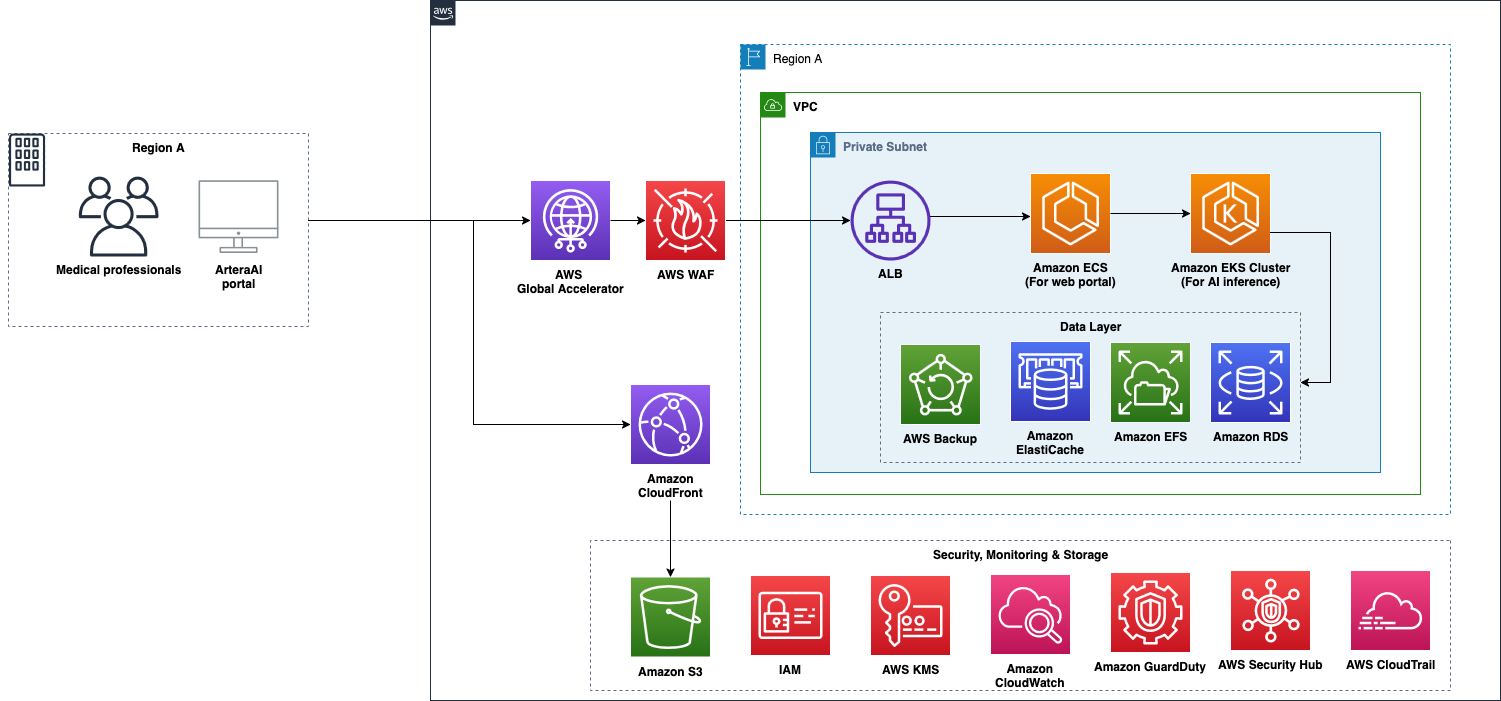
Comprehensive AWS architecture diagram showing the integration of cloud services for a medical professionals’ portal with AI inference capabilities, including data flow from end users through global acceleration services to compute, storage, and security infrastructure in a VPC within Region A.
- Data ingestion – Biopsy images are securely uploaded through the portal and stored in Amazon S3.
- Processing pipeline – The EKS cluster orchestrates containerized preprocessing applications that prepare images for analysis.
- ML model training and execution – The AI models are trained and deployed on Amazon EKS and access the preprocessed images from Amazon EFS, then run Artera’s proprietary ML algorithms, with metadata and results stored in Amazon RDS. The company’s ML teams use EKS to train their massive pan-tumor FM, which is capable of assessing patient risk and therapy benefit across any cancer sample.
- Results storage and delivery – Analysis results are stored in Amazon S3 and made available to healthcare providers through the secure web portal.
Data locality and global scalability
One of the key challenges Artera faced was maintaining data locality while serving AI globally. The company uses multiple AWS services to create a comprehensive solution that addresses both performance and compliance requirements. AWS global infrastructure enables Artera to deploy Region-specific resources that keep sensitive patient data within appropriate jurisdictional boundaries. Amazon S3 provides secure, Region-specific storage buckets, and Amazon EKS allows for containerized workloads to run locally in each Region.“One of the nice things about Amazon EFS is that it’s very simple to achieve data locality,” says Silberman. “We can mount file systems in the same AWS Region as our applications, ensuring data stays close to where it’s processed.”The combination of Amazon S3, Amazon EKS, Amazon EFS, and other AWS networking services creates a robust foundation for Artera’s global operations. This integrated approach helps Artera accelerate time to market in new regions while maintaining the highest standards of data security and compliance with regional regulations.To learn more about how Artera uses Amazon EFS, visit the case study, Artera Shapes the Future of Cancer Treatment Using Machine Learning on AWS.
Results and patient impact
By using AWS Cloud services, Artera has transformed cancer diagnostics with tangible benefits for patients:- Accelerated results – Patients receive personalized treatment recommendations in only 1–2 days, compared to 6 weeks for traditional genomic tests—dramatically reducing the waiting period for critical treatment decisions.
- Improved clinical decisions – The speed and accuracy of Artera’s AI-powered diagnostics help physicians make more informed treatment decisions, potentially improving outcomes for prostate cancer patients.
- Tissue preservation – Unlike traditional tests that destroy tissue samples through chemical assays, the ArteraAI Prostate Test uses only digital imagery, preserving the original tissue for additional tests or clinical trials.
“Imagine a patient getting the worst news they’ve ever had and having to sit on that for 6 weeks to determine what the treatment plan is,” says Silberman. “Instead, Artera provides custom-tailored, personalized results within days.”There are over 3.5 million prostate cancer survivors in the United States. By recommending personalized treatment plans, Artera is helping patients determine the best therapeutic options to achieve progression-free survival while minimizing unnecessary side effects.
“We’ve heard from patients who have said that because of our test, they were able to avoid unnecessary treatments with a lot of side effects,” says Silberman. “That’s why all of us at Artera are here, giving clinicians as many data-backed insights as possible to inform the patient and make the best possible choice for their care.”
Operational benefits
Using AWS services has meant that Artera has achieved significant operational advantages:- Enhanced focus on innovation – With AWS managing the infrastructure, Artera’s engineers can dedicate more time to refining their ML algorithms and expanding diagnostic capabilities.
“Using AWS, we can focus on the histopathology problems, rather than on maintenance and monitoring,” says Silberman.
- Global scalability – Artera has successfully expanded operations while maintaining compliance with regional data regulations across multiple countries.
- Efficient processing – The test processes tens of thousands of image files through ML workflows per biopsy slide, completing in hours instead of weeks. This efficiency comes from Artera’s sophisticated workflow orchestration that breaks up large input images (sometimes reaching 8 GB) into many small patches processed in parallel across EKS clusters.
Future innovations
As Artera continues to innovate in the field of AI-powered cancer diagnostics, their AWS based infrastructure provides the foundation for future growth. The company’s ultimate goal is a massive pan-tumor FM capable of assessing patient risk and therapy benefit across any cancer sample. Using elastic, scalable solutions on AWS, Artera has a solid foundation for developing ML models for additional cancer tests. The company has announced plans for a breast cancer product, with several more products close behind.“What we have coming up is a rapid acceleration across different areas of cancer,” says Silberman. “As proud as we are of the work that we’ve done in the prostate cancer space, we’re just getting started.”Artera plans to expand their AI capabilities in several ways:
- Analyze additional biomarkers
- Integrate genomic data with imaging analysis
- Create more comprehensive diagnostic tools
- Partner with major healthcare systems to integrate diagnostic tools directly into clinical workflows
Conclusion
Artera’s journey demonstrates how AWS Cloud services can empower healthcare innovators to develop and scale life-changing technologies. By using Amazon EKS, Amazon ECS, Amazon EFS, Amazon RDS, Amazon S3, AWS Global Accelerator, and Amazon ElastiCache, Artera built a robust, scalable infrastructure they use to keep their focus on their core mission: improving cancer treatment through AI-powered diagnostics. To learn more about how AWS can help your healthcare organization implement AI and ML solutions, visit AWS for Healthcare. To learn more about Artera and their innovative cancer diagnostics, visit Artera.ai.About the authors
https://aws.amazon.com/blogs/architecture/how-artera-enhances-prostate-cancer-diagnostics-using-aws/Enjoyed this article? Sign up for our newsletter to receive regular insights and stay connected.