
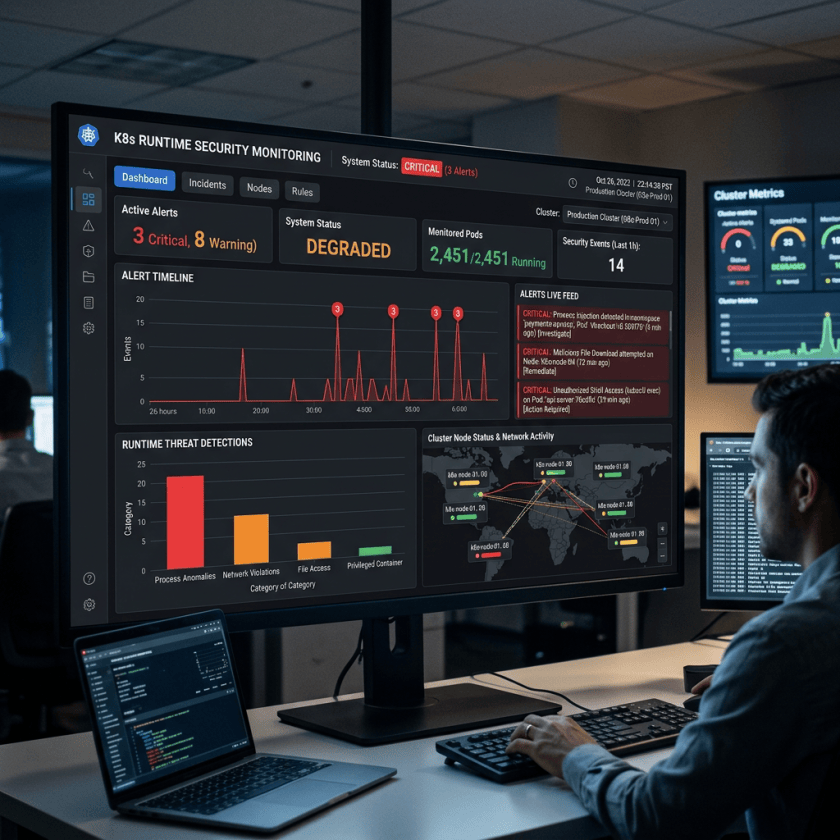
Kubernetes security conversations tend to center on the things that happen on the left-hand side of the process. Scanning images, hardening Dockerfiles, and working with registry access controls all tend to frontload. This is necessary, but it leaves significant gaps once containerized workloads are running in production.
Container adoption is hot right now across many sectors of the industry, and the attack surface is growing with it. In November 2025, for example, a SUSE researcher found three runC vulnerabilities that allowed an attacker to escape the container and operate as root on the host. Container runtime security has leaped from hypothetical to practical, and that has huge implications for Kubernetes teams.
What Container Runtime Security Entails
The tools, policies, and practices in play for monitoring and protecting containers while running in production are critical. You need to be able to identify concerns about process execution, file system activity, network behavior, and system calls in real time. Runtime security must be able to monitor:
Unexpected binaries
Spawn scripts inside containers
Writes to read-only paths
Outbound and lateral communications
System calls
Kubernetes makes this tough because pods spin up and down in seconds, creating challenges for traditional hosted security models. Hundreds or thousands of containers in microservice architectures make manual monitoring functionally impossible. Dynamic scheduling induces further challenges.
Common Runtime Gaps
Running Containers as Root
The convenience at the developer level of defaulting to root is too tempting. The user context frequently doesn’t change as the container context shifts toward production deployment, either. Root inside the container provides a viable path toward gaining root access in the host if the attacker finds the right vector.
Explicit declarations of runAsUser and runsAsNonRoot are essential. Reducing binaries through distroless or minimal distro base images also makes a big difference. Kubernetes Pod Security Standards also have to restrict profiles and enforce non-root operation.
Overly Permissive RBAC and Network Policies
Role-Based Access Control serves well as the default permission system typical of many Kubernetes security setups. However, permissive tendencies lead to pods communicating with all other pods out of the box. Teams often add a cluster admin or broad roles that further worsen the problem while making debugging simpler. Parties often fail to revisit these choices later.
Source: Tapati Rinchumrus/Shutterstock.com
Overly permissive RBAC permissions can allow attackers to:
List secrets
Create privileged pods
Access the Kubernetes API server
The solution is to default-deny all network policies per namespace. Traffic must fall into an explicit allowlist to pass. Fine-grained enforcement has to run through CNI plugins. Also, you need to regularly audit RBAC and visualize permissions.
Lack of Real-Time Threat Detection
Teams often make major investments in vulnerability scanning at build time without an eye on runtime monitoring. This creates targets for would-be cryptominers, reverse shells, botnets, and data exfiltration that can run undetected in containers. In the best-case scenarios, the mean time to detection runs into weeks or even months.
Attackers often deploy systems like:
XMRig miners to guzzle cluster compute
Reverse shells for ongoing access
Probe and exploit recently disclosed CVEs in deployed images
Manipulate mounted secret or service account tokens
Deploying runtime detection is no longer negotiable. Kernel-level tools with low overhead make a huge difference. You can then monitor for unexpected child processes, write to critical folders like bin or etcd, spot outbound connections, and track privilege escalation attempts.
Ignoring Configuration Drift
Teams scan and deploy container images at deployment time, but the processes inside the container are able to modify everything from environment variables to binaries. They effectively become invisible because the attacker is already in control. This is a common problem with container security.
Configuration drift also occurs naturally through non-hostile vectors. This induces vulnerabilities that were present at build time. While resets are helpful in reverting to original images, an attacker may have already executed their plan.
Root filesystems have to operate read-only. Writeable volumes should only exist where necessary and favor least-harmful vectors like tmp and log directories. You should also deploy drift detection tools that alert you when a container’s state drifts from the image manifest.
Runtime Layer as Attack Vector
The previously discussed 2025 CVEs point to the runtime layer as a viable attack vector. Attackers can use symlinks to bypass bind-mounts protecting host files. Mount redirection can also occur before expected protections kick in. Process injection or unauthorized memory access can also trigger system crashes or privilege escalation.
Misconfigured runtime configurations can expose the host filesystem and create opportunities for container escape or privilege escalation. Dormant credentials in a majority of Kubernetes systems provide a further latent attack surface. Attackers are increasingly striking the runtime layer and supply chain entry points rather than focusing on application and code vulnerabilities.
Practical Runtime Security Posture
Pod security standards are a must. Profile restrictions are also essential. You can block privileged containers, host namespaces, root users, and dangerous volume types.
Get runtime monitoring up as soon as possible. You need to be able to watch for unexpected processes spawning, modifications outside writable filesystem paths, odd network connections, and syscalls that elevate privileges. The best tools offer lower runtime overhead, typically consuming 1%-2.5% of CPU capacity.
Least-privilege networks are another big winner. Default-deny ingress and egress per namespace. Allow only required pod-to-pod and pod-to-service communication.
Scan continuously, not just at build. Detect and prevent drift. Make sure to enable and continuously monitor audit logs, too.
Why Deployment Time Security Alone Doesn’t Cut It
Container runtime security is the last line of defense, and deployment time has limited influence over it. A team needs strong build-time controls, but continuous visibility is essential. A forward-looking approach that can run in multi-cloud and multi-cluster environments allows scaling and growth even as runtime complexities multiply. Runtime security ensures that your operation can grow with threats and infrastructure rather than lagging behind them.
Enjoyed this article? Sign up for our newsletter to receive regular insights and stay connected.