
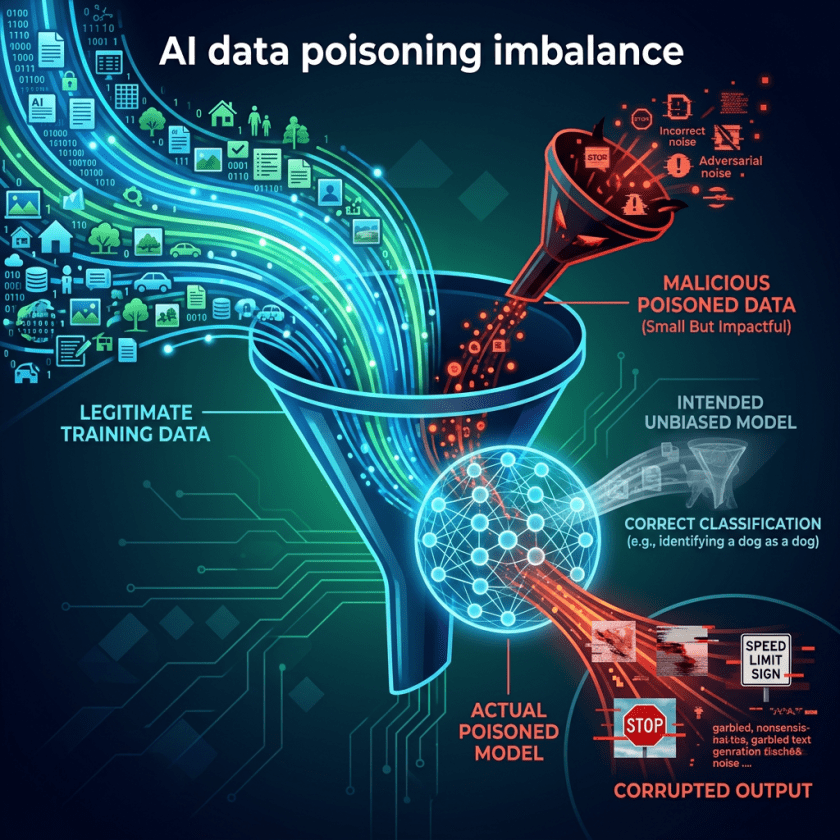
The management issue here is not just model quality; it is data governance across the full AI operating model. If AI-generated outputs are allowed to flow back into training, knowledge bases, prompts and workflow automations without provenance controls, enterprises can quietly turn their own productivity gains into a source of future risk. CIOs and CTOs should treat this as a control problem, not a tuning problem.
The practical question is who owns the boundary between “useful output” and “trainable input”. That boundary needs explicit decision rights across data, security, legal, architecture and business teams. Without clear rules, organizations will optimize for speed at the point of use while accumulating hidden technical debt in the background. The trade-off is straightforward: stronger review and separation controls slow reuse, but weak controls invite contaminated analytics, weaker models and unreliable decisions.
This also changes how AI portfolios should be funded and measured. Benefits cases that focus only on adoption or throughput can miss the cost of degraded decisions, rework, compliance exposure and model retraining. Leaders should ask whether AI programs include measurable data provenance, human verification, drift monitoring and rollback triggers. If those metrics are absent, the business case is incomplete even if the pilot looks successful.
The next governance step is to define which sources remain authoritative. A resilient operating model keeps real-world signals, expert review and system telemetry in the loop while treating synthetic content as disposable unless it is explicitly curated. That raises a hard but necessary question: which teams are accountable for preventing synthetic data from becoming institutional truth, and how will they prove it over time?
The dangers of regurgitated feedback loops
Data poisoning lessens the value of the original data, explained Ryoji Morii, founder of Tokyo-based Insynergy.io, a company specializing in AI governance and AI decision architecture. “Data is being treated as a throwaway resource, and derived values are being used instead. This is contaminating the training data and making the raw data less relevant,” Morii said. You can blame the problem on corporate need for speed, human instinct to reach for what’s easiest, or simply a misunderstanding of how AI training and fine-tuning actually works. Regardless of the reason or intent, the harm is undeniable. “What is being described is ‘data poisoning in the name of convenience.’ It is not malicious, but it will result in long-term damage,” Sopuch said. Assigning blame doesn’t matter nearly as much as being able to recognize the danger now. “In the early stages, you often will not catch it: the outputs look fine, the QA also passes,” said Chetan Saundankar, CEO of India-based Coditation, a company that builds and deploys AI systems for enterprise clients. But this is the calm before the storm. “Weeks or months later, the model begins to get things wrong in ways that are hard to spot because the answers still sound perfectly reasonable,” he said. “A code tool starts suggesting patterns that work but have security holes. A summarization model starts dropping the qualifications and nuances that made the original documents useful, while still sounding authoritative.” The problems seep into everything important to running a successful and profitable organization. Small inaccuracies, like misjudging resource allocation or mislabeling usage patterns, can quickly snowball, explained Dirk Alshuth, chief marketing officer of Emma, a Luxembourg-based cloud management platform. Eventually, those errors increase costs or lead to performance reduction over time. “The feedback loop makes it worse because those same flawed outputs can get logged and reused, reinforcing the mistake,” he added. In cloud and infrastructure environments for example, small inaccuracies such as making slightly wrong recommendations from misjudging resource allocation or mislabeling usage patterns can quietly increase costs or reduce performance over time Alshuth said. This can have a potentially huge impact on the business. Another issue he said he noticed is loss of adaptability. “AI trained on AI tends to struggle when something new or unexpected happens, because it hasn’t seen real variability,” he said. “The best prevention is to keep your training data tied to real system behavior. Use live telemetry, logs and human-reviewed decisions as your source of truth, and treat AI-generated outputs as temporary, not foundational,” Alshuth added.Impending model collapse
CIOs need to be cognizant that the problem of data poisoning doesn’t end at model degradation. Training on AI-generated content can lead to “model collapse,” wherein AI systems eventually and completely fail. In effect, it reduces AI investments to spoilage loss — the loss occurs when the projects are rendered useless beyond the point of repair, given the degradation of the model, data and the outputs. “Model collapse refers to a degradation that occurs when models are trained repeatedly on outputs from other models. Over time, the system becomes more repetitive, less nuanced, and less representative of the real world,” explained Oli Ostertag, president of growth platforms and AI at PAR Technology, a unified commerce platform provider for restaurants, convenience stores, and fuel retailers. Even if organizations are deploying vendor AI solutions in their enterprise, the collapse may still be originating closer to home. “The conversation about AI data contamination tends to focus on foundation model training, [meaning] what OpenAI or Google trains on,” Kimber said. “But the more immediate problem for most organizations is happening one layer down, in their own knowledge infrastructure. Every company is now, functionally, a model trainer.”Salvaging the model and building in protections
The first step in correcting the data poisoning problem is stopping it from getting worse. Fortunately, there is a way to salvage performance as or after a model collapses, although it requires considerable effort. Prevention is always preferable, but if a collapse occurs the solution is to retrain on clean data to restore performance, Ivtsan said. Collapse is avoidable if real data accumulates alongside synthetic data, rather than being replaced by it, according to a paper by Gerstgrasser et al. Even imperfect external verification can stabilize the trajectory, according to another paper by Yi et al. In this context, “imperfect” external validation doesn’t mean using verification sources or information that may be flawed or incorrect. It means using methods like spot checks, subject-matter expert review or experience-based human judgment, which are not thorough fact-checking in themselves, but are still likely to be highly accurate. At-scale, targeted verification beats both zero oversight and the impracticality of exhaustive fact-checking. The better course of action, if possible, is to prevent it from occurring. “The way to prevent it is to design for human–machine feedback loops. The strongest systems are iterative, human to AI, AI back to human, where outputs are continuously shaped, challenged and refined,” explained Kaare Wesnaes, head of innovation at Ogilvy North America, the agency behind brand building for Fortune Global 500 companies worldwide. In short, “the strongest systems aren’t AI-only. They’re human–machine loops,” Wesnaes said. The key idea is to remember that AI is only as good as its data, and to act accordingly. “Companies need to protect the integrity of their data. That means prioritizing high-quality, human-generated inputs, clearly separating synthetic from real data, and continuously reintroducing fresh, real-world signals into their systems,” Wesnaes said.Enjoyed this article? Sign up for our newsletter to receive regular insights and stay connected.