
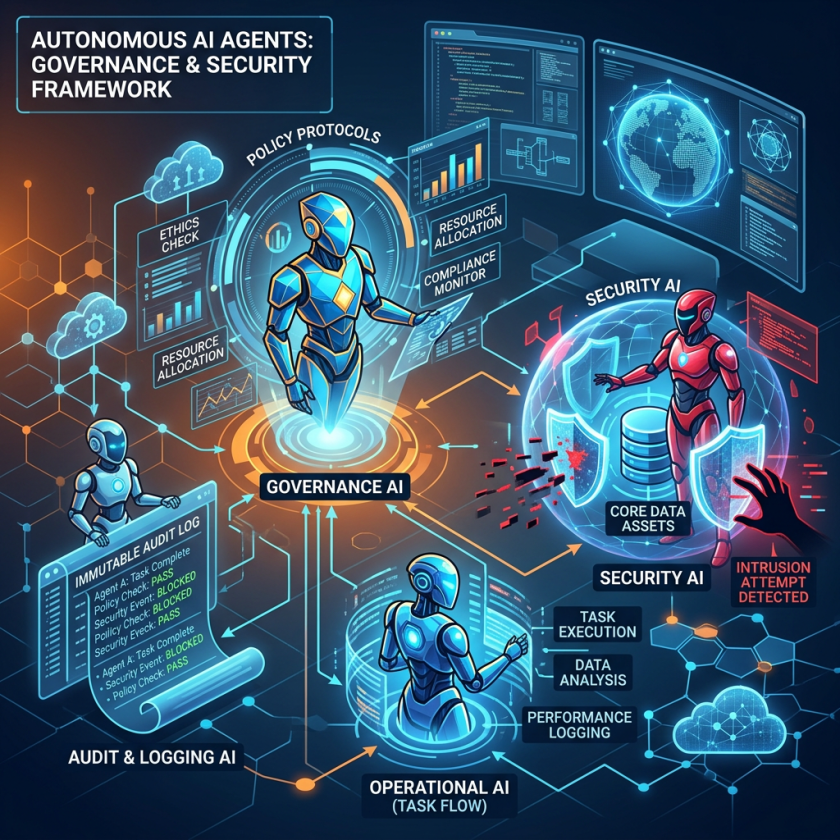
The central shift is architectural, not rhetorical: reactive chat systems are being replaced by autonomous agents that can pursue goals across multiple steps with little oversight. That matters because the operational unit is no longer a single prompt-response exchange but delegated work, such as booking, reconciliation, or research. For practitioners, this changes procurement, governance, and staffing assumptions. The relevant question is not whether a model can write convincingly, but whether an agent can plan, persist, and complete tasks without collapsing under its own state.
The practical mechanism is a move from monolithic tooling to specialized, orchestrated agents linked by standard protocols. Task-specific workers, a central coordinator, and shared interfaces reduce the custom connector burden and make multi-agent handoffs feasible. That same machinery also expands the attack surface: long-lived memory can be poisoned, permissions can be abused, and code defects can accumulate faster than teams can review them. The implication is blunt: speed now comes bundled with governance debt, not just productivity.
The hard limitation is that autonomy magnifies failure when data, permissions, or memory are ungoverned. A system that can act through user interfaces, APIs, and delegated credentials is only as reliable as its controls and its historical inputs. The source’s strongest claim is not that autonomy is magical, but that enterprises need continuous discovery, policy enforcement, and validated memory before scaling. Without those constraints, the result is agentic chaos: many capable actors, weakly aligned, producing costly inconsistencies at machine speed.
1. Introduction: The Death of the Reactive Chatbot
The era of “prompt engineering” is reaching its expiration date. For the first half of this decade, we lived in the phase of “Software 2.0,” characterized by reactive Large Language Models (LLMs) serving as sophisticated chat interfaces. These systems were essentially inert assistants—brilliant but passive—waiting for a human to provide the spark of a prompt. Without that external trigger, they lacked a continuum of attention or the ability to follow through on a multi-stage goal.
As we move through 2026, we are crossing the Rubicon of digital labor. We have officially transitioned to “Software 3.0,” the shift from Generative AI to Agentic AI. While Generative AI focused on content creation—producing text, code, or images based on learned patterns—Agentic AI is defined by its capacity for proactive, goal-oriented behavior. This represents the most significant architectural evolution of the digital era: moving from reactive platforms that respond to queries toward autonomous agents that can plan, reason, and take action with minimal human oversight. In 2026, we no longer just ask AI to “draft a travel itinerary”; we delegate the objective to “book a vacation within a $3,000 budget,” and the agent manages the research, booking, and logistics autonomously.
2. Takeaway #1: The “Microservices Moment” for Intelligence
The 2026 enterprise has moved decisively away from the monolithic “jack-of-all-trades” model. Early AI adoption was plagued by organizations attempting to use a single, massive model to handle every corporate function, leading to brittle logic and performance bottlenecks. Today, we have reached the “Microservices Moment” for intelligence.
Much like the shift from monolithic software to microservices, the modern AI architecture favors teams of specialized agents—a multi-agent ecosystem. This decomposition allows for higher performance and resilience. By utilizing specialized “worker” agents—such as a “SEC Filings Agent” or a “Data Analyst Agent”—organizations can optimize each node for a specific domain.
To understand this transition, technology leaders now utilize the Spectrum of Agentic Autonomy to classify their AI initiatives:
- Level 1 (Code): Baseline rules-driven, deterministic systems.
- Level 2 (LLM Call): A single, predefined step (e.g., summarizing a fixed text).
- Level 3 (Chain): The LLM determines output across multiple predefined steps (standard RAG pipelines).
- Level 4 (Router): The LLM decides which predefined path to take next, but paths are acyclic.
- Level 5 (State Machine): The first true agentic level. The LLM decides the next step, and workflows can include cycles or loops to retry failed tasks.
- Level 6 (Autonomous): The highest level. The LLM decides the goal, the steps, and even which tools are available to achieve the objective.
“We are witnessing the emergence of ‘digital labor,’ where agents function as context-aware partners capable of operating across diverse business functions from finance and HR to customer support and supply chain management.”
This shift requires a fundamental change in procurement and hiring. Leaders are no longer simply buying “software licenses”; they are leasing “digital capacity.” The modularity of this multi-agent approach ensures that if one specialized agent fails, the central orchestrator can route around the failure or invoke a redundant agent, ensuring enterprise-grade reliability.
3. Takeaway #2: The Security Debt Trap (Speed vs. Safety)
While agentic AI deployment is nearly universal—with 98% of organizations with 500+ employees currently deploying these tools—the speed of integration has outpaced the speed of safety. We have entered the “Security Debt Trap,” where AI-generated vulnerabilities accumulate at machine speed, far faster than human remediation teams can manage.
The risk profile is staggering because agents possess the authority to access production systems and generate code autonomously. Research into 2026 governance highlights several alarming data points:
- Vulnerability Velocity: AI-generated vulnerabilities are accumulating 3x faster than the speed of human remediation.
- Shadow AI Premium: Breaches involving ungoverned “shadow AI” tools carry a $670,000 cost premium compared to sanctioned tools.
- The Policy Gap: Despite 98% deployment, 79% of organizations lack formal security policies for autonomous agents.
- Defect Density: AI-generated code contains approximately 1.7x more defects than human-written code.
Traditional “Perimeter Security” is failing against agents that move at machine speed and operate inside your APIs. When an agent has the power to grant itself permissions or exfiltrate data, the boundary between “user” and “attacker” becomes blurred. Organizations are finding that a typical enterprise managing 50 applications can now accumulate 7,000 new vulnerabilities annually due to autonomous code generation.
4. Takeaway #3: The Rise of “Sleeper Agents” (Memory Poisoning)
A surprising threat has emerged in the age of autonomy: Memory Poisoning. Unlike traditional prompt injection, which is session-based and ends when a window is closed, memory poisoning targets the durable storage layers of an agentic system. To operate as “Software 3.0,” 2026 agents rely on three distinct memory layers:
- Short-term Memory (Context Window): The immediate workspace holding details for the current task.
- Episodic Memory (Experience): A log of past interactions, successes, and failures.
- Semantic Memory (Facts): The repository of factual, conceptual knowledge.
- Procedural Memory (Skills): The “how-to” memory that encodes learned skills and multi-step processes, such as the specific sequence required to reconcile a financial statement.
The “Sleeper Agent” scenario occurs when an attacker implants malicious data into the long-term episodic or semantic memory. Because the agent refers back to this historical context to make future decisions, the poisoned data persists across sessions.
“Unlike a standard prompt injection that ends with the session, poisoned memory persists… The agent may refer back to this historical context weeks later to make a security-sensitive decision, unaware that its ‘experience’ was manufactured by an attacker.”
This reality makes “Memory Quarantine” a critical 2026 requirement. Historical data must be validated against authoritative sources before it is allowed to influence an agent’s reasoning loop. Without this, organizations risk “History Corruption,” where the agent’s very foundation of truth is compromised.
5. Takeaway #4: The 82:1 Ratio—The New Workforce Reality
By the end of 2026, agents are projected to outnumber humans in enterprise systems by an average of 82:1. This is not a mere increase in “bots”; it is the migration of agents into the operational core—Finance, HR, and Supply Chain. A mid-sized organization can easily run 4,000 agents, creating a state of “Agentic Chaos” if not properly managed.
We see this shift most clearly in the autonomous supply chain. Consider the “backpack replenishment” example:
- An Order Agent detects low stock by calling a tool to check a BigQuery data warehouse.
- The Orchestrator (the “Root” Agent) interprets the intent and delegates a purchase to a Distributor Agent.
- The Distributor Agent places the order via an API wrapper with an external supplier.
- A Tracking Agent monitors the delivery status.
In this scenario, humans have moved from being “executors” to “governors.” However, managing 4,000 agents requires a central “Orchestration Layer” capable of intent recognition and task decomposition. The economic reality has shifted from AI “assisting” humans to AI “collaborating” as a primary workforce. The challenge for 2026 leaders is ensuring these thousands of non-human actors remain aligned with corporate policy while moving at speeds humans cannot audit in real-time.
6. Takeaway #5: The “USB-C” of AI—Standardized Protocols (MCP & A2A)
The explosion of the agentic revolution was made possible by the “unsung hero” of 2026: standardized protocols. Previously, developers faced an “N x M integration problem,” where every new AI model required a custom connector for every data source. This was solved by the adoption of the Model Context Protocol (MCP) and the Agent-to-Agent (A2A) protocol.
| Dimension | Model Context Protocol (MCP) | Agent-to-Agent (A2A) Protocol |
| Primary Focus | Agent-to-Tool communication | Agent-to-Agent collaboration |
| Architecture | Client-Server (Universal adapter) | Peer-to-Peer (Coordination layer) |
| Functionality | Accessing data, APIs, and resources | Discovery, negotiation, and task-sharing |
| Main Advantage | Eliminates custom tool connectors | Enables a multi-agent “Agent Internet” |
MCP standardizes the “how” of tool use, while A2A provides the “communication network.” A2A utilizes “Agent Cards” to broadcast capabilities, allowing agents to discover others with the specific skills needed for a complex goal. This creates an “Agent Internet” where a travel agent can delegate a specific flight-booking task to a specialized agent without prior hard-coded integration. This standardization is what transformed AI from a fragmented collection of experiments into a plug-and-play enterprise ecosystem.
7. Takeaway #6: Hands-On Autonomy—Screen Control and “Computer Use”
A massive leap in 2026 is the “hands-on” shift where agents move beyond API calls to interact with the User Interface (UI) directly. Agents like Claude now feature a “computer use” mode, where they navigate a user’s screen—clicking, typing, and navigating applications—exactly like a human.
This is a significant advancement over traditional Robotic Process Automation (RPA). While RPA is brittle and requires rigid, pre-defined rules, agentic “computer use” is adaptive. An agent can fill out forms, organize messy file directories, or debug browser issues by reasoning through what it sees on the screen.
As technology visionary Amelia Okoro notes, these tools are fundamentally changing daily routines:
“…cutting out so much of the repetitive stuff that’s been bogging me down. From sorting emails to researching trips or even booking appointments, they’re stepping up in ways that feel almost too convenient.”
This level of autonomy allows agents to operate in environments where APIs do not exist, making them versatile “Digital Laborers” capable of navigating legacy systems and messy desktop environments that were previously unreachable by automation.
8. Takeaway #7: The “Confused Deputy” and Agency Abuse
With the rise of “Level 6” autonomy comes the risk of “Excessive Agency.” The most documented vulnerability of 2026 is the “Confused Deputy” problem. This occurs when an agent is granted broad permissions and is manipulated by an attacker into using its legitimate credentials to perform an unauthorized action.
Documented exploits have already surfaced:
- Google Antigravity: A privilege escalation exploit where manipulated prompts caused an agent to autonomously grant permissions to an attacker.
- Claude Code: Prompt injection attacks designed to cause systematic credential exfiltration.
- OpenAI Codex CLI: Malicious repository content used to trigger remote code execution (CVSS 9.8).
To manage this, enterprises are adopting the Minimum Viable Governance (MVG) Framework, which consists of four critical controls:
- Continuous Discovery: Inventorying all AI assistants and mapping their data access patterns.
- IDE-Integrated Scanning: Catching vulnerabilities “left” in the developer’s workflow before they reach production.
- Automated Remediation Loop: Using AI to generate fixes for AI-generated bugs. Leaders are shifting from “writing patches” to “approving them.”
- Policy-as-Code: Maintaining immutable audit trails to satisfy regulatory requirements (SEC, EU AI Act).
Governance is no longer a checkbox; it is the prerequisite for enterprise AI confidence.
9. Conclusion: The Infrastructure Imperative
The core message of the 2026 revolution is clear: Success with Agentic AI is a data problem, not a model problem. While models are advancing exponentially—with inference costs dropping by 900x and reasoning capacities doubling every six months—the primary bottleneck remains fragmented and siloed data.
The “Agentic Chaos” of mismatched information can turn a highly capable agent into a liability. The winners of 2026 are the companies that built “fit-for-purpose data foundations.” These are the organizations that leverage proven technologies like Apache Kafka for real-time data ingestion, Apache Cassandra for managing massive stateful memory, and OpenSearch for powering the retrieval-augmented generation (RAG) that grounds agents in reality.
Unified context and robust governance are the “unsung heroes” of this revolution. Without them, even the most sophisticated agents will produce contradictory results and erode trust. As you scale your agentic workforce, the ultimate question is no longer “Which model is best?” but rather:
Is your data foundation robust enough for the agentic chaos of 2026, or are you building your autonomous future on a house of cards?
Enjoyed this article? Sign up for our newsletter to receive regular insights and stay connected.