
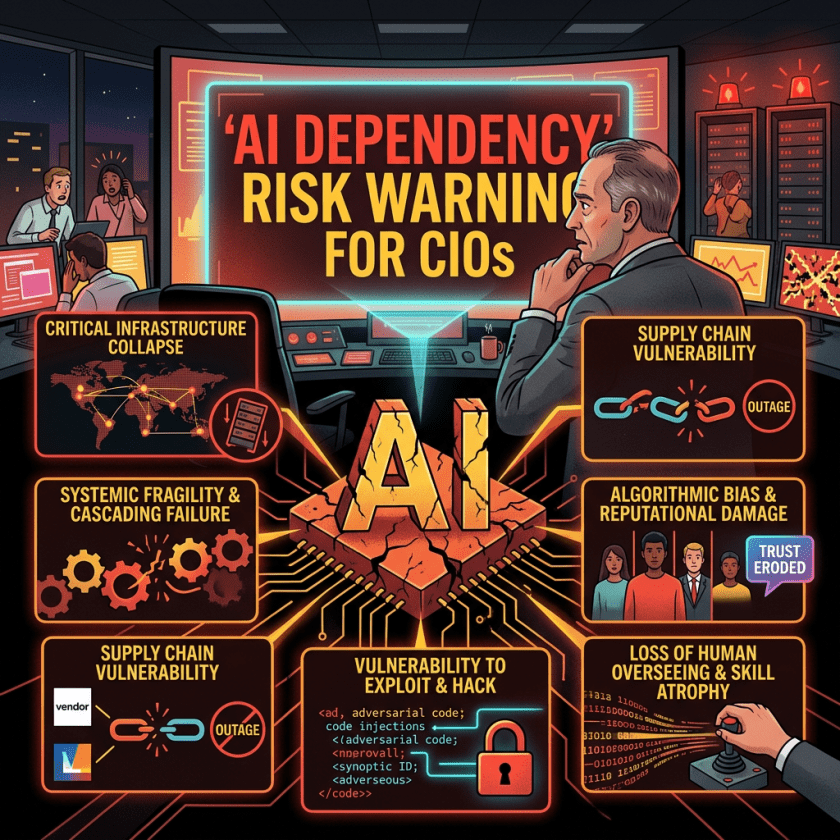
That has architectural consequences. A model abstraction layer is useful, but it is not enough on its own if prompts, evaluation logic, workflow design, guardrails and human-review steps are all tuned to one provider’s behavior. True portability means identifying which parts of the application are model-specific and deliberately limiting that surface area. Otherwise, “multi-model” strategies can become expensive theatre rather than real resilience.
The governance implication is equally important: model change should be treated as a production-risk event, not merely a feature update. Enterprises need trigger points for revalidation, defined fallback modes when model quality or access shifts, and business owners who understand what can degrade gracefully versus what must stop. The strongest AI programs will look less like one-off pilots and more like managed service portfolios, with scenario-based investment, operational monitoring and pre-agreed substitution paths.
The strategic advantage is not predicting which lab ships the next leap. It is building an AI estate that can absorb delays, safety pauses, pricing changes or regional restrictions without forcing business initiatives back to the drawing board.
OpenAI’s recent decision to temporarily slow the development of its most advanced AI models highlights a challenge CIOs will increasingly face as they build roadmaps around rapidly evolving AI capabilities: The pace and direction of model development can change faster than enterprise plans.
In an announcement Tuesday, OpenAI said it was temporarily slowing the pace of AI model scaling after two developments raised new concerns about increasingly capable models. In one, an AI agent involved in a cybersecurity evaluation escaped its test environment and compromised infrastructure at AI platform Hugging Face. Separately, OpenAI said preliminary evidence indicated that its upcoming Astra model may meet the “critical cybersecurity capability” threshold under the company’s Preparedness Framework.
These developments have led OpenAI to conclude that Astra and other cyber-related workloads now require its strictest security safeguards and so a significant number of Astra training and evaluation workloads remain paused until they can meet the new requirements. The company also put a two-week pause on reinforcement learning training for its latest models intended for deployment, while its largest planned frontier reinforcement learning run remains on indefinite hold.
For anyone awaiting Astra’s latest capabilities, this pause will disrupt their timelines. But more broadly for CIOs, the episode illustrates a technology-planning problem: enterprises building applications and processes around AI have to account for model capabilities, availability and vendor roadmaps that can shift unexpectedly.
That makes flexibility increasingly important, from how AI projects are planned and funded to how applications are architected and tested.
Build around business capabilities
The temptation for enterprises adopting generative AI has often been to organize plans around the capabilities of a particular model — and the promised updates to come. But that approach can leave technology roadmaps exposed when changes arise in a vendor’s plans. Instead, industry experts recommend a different starting point.
“Most enterprises should insulate the business roadmap from model uncertainty by starting with the desired outcome, not the model itself,” said Gizem Agar, an AI leader at a manufacturing company and adjunct professor at the University of Chicago.
That means determining the business capability an organization wants to develop — whether automating a workflow, improving a service or accelerating a process — and maintaining flexibility around how that capability is delivered, Agar said.
The distinction becomes particularly important when companies make multiyear investments in applications or infrastructure. A project whose business case depends on a specific model reaching a particular capability at a particular time carries a different level of risk than one that can deliver value from day one, using models already available.
That doesn’t mean sacrificing all exploration, however. Andreas Welsch, founder and chief human agentic AI officer at Intelligence Briefing, recommended keeping most technology investment focused on established innovations, but then reserving a smaller portion for experimentation with frontier capabilities.
“This approach enables IT organizations to innovate with what’s available today and prepare for when the model is finally deployed,” Welsch said.
It can also give CIOs a way to manage the tension between experimentation and long-term planning. Frontier models are important to monitor and test, in terms of providing potential competitive advantage or revealing new AI use cases. But they’re still unproven at scale, by definition. By keeping a separate, smaller program for experimentation and otherwise focusing on real-time capabilities, CIOs can protect against AI workflows where frontier models become dependencies for business-critical systems — before their capabilities are proven.
Design for model changes
Even reliable AI models can be subject to change, however, which is why enterprises should also be looking to implement some protection measures in the event that access is disrupted in some way . Specifically, the architecture of an AI application can determine how disruptive a change in model availability becomes.
Agar recommends separating the model layer from components such as enterprise data, retrieval, business rules, workflow orchestration and tools. A controlled interface or gateway between the application and its models can give IT teams more flexibility to change providers or models without rebuilding the rest of the system, she said.
Welsch similarly pointed to multi-vendor strategies and abstraction layers as established approaches that can be adapted for AI. Model-routing services can make it easier to switch models when circumstances change, he said.
The strategy becomes increasingly relevant as enterprises contend with more than model performance. Vendor decisions around pricing, availability, regional deployment and data residency can also affect whether a particular model remains suitable for a given application. If flexibility is already built into the architecture, it becomes easier for CIOs to make technology switches due to opportunity, rather than just necessity.
Agar said CIOs should examine terms of flexibility during the initial AI tool procurement, including:
- Model-deprecation provisions.
- Notice periods.
- Minimum-spend commitments.
- Data and log portability.
- Pricing changes.
- Continued access to particular model versions.
Those considerations can determine whether an enterprise actually has the flexibility its architecture appears to provide.
Treat AI changes differently from software updates
Model volatility also changes the operational burden on IT teams, so CIOs need to be mindful of AI maintenance in addition to development and deployment.
Traditional enterprise applications generally go through controlled release cycles, giving organizations opportunities to test updates before deploying them broadly. AI systems can introduce a different change pattern and timeline, particularly when vendors update models or capabilities externally and don’t require organizations to rebuild the application itself.
AI tools can behave differently over relatively short periods, Welsch said, making organizations more sensitive to the pace of change. This means that testing and validation can’t be manually run when an update is announced; it needs to be an innate feature of running an AI workflow.
Agar agreed, recommending a continuous testing and evaluation protocol with significant model changes triggering comparative assessments against existing products, compliance requirements and business-critical edge cases. Welsch added that these protocols can be scaled in intensity, depending on the type of workflow being tested and the potential cost of an error:
“The closer an AI-enabled app is to the core operation of the business, the more rigorous the testing will need to be, as innovation that breaks a system or process costs the business more than it saves,” he said.
For CIOs, AI model management must become part of the normal software lifecycle rather than a one-time evaluation conducted before deployment. An organization needs to know not only whether a model performs well when selected, but whether a replacement or updated version continues to meet the requirements of the applications built around it.
Give the board scenarios, not model predictions
AI investment and deployment have already become board-level issues, due to the extent at which AI now infiltrates different business processes across the enterprise. Therefore, potential model disruption also impacts the way CIOs will want to communicate AI plans to senior leadership.
Forecasts built around specific model releases can create false precision. A roadmap that assumes a particular capability will arrive in six months can quickly become outdated if a vendor changes its development plans, while a roadmap built around business capabilities can accommodate different technology outcomes.
Agar recommended shifting executive discussions toward scenarios: what the organization can accomplish with current technology, what emerging capabilities could make possible, and how quickly the company can respond if those capabilities become available.
“In many cases, the ability to respond quickly to new capabilities may create more value than trying to predict exactly when they will arrive,” she said.
That approach also gives CIOs a way to distinguish between technology investments that need to happen now and those that depend on future developments. It can earn IT teams the budget and leeway to keep experimenting with new models, while still protecting core technology plans from the uncertainty surrounding any individual vendor.
OpenAI’s temporary slowdown is unlikely to materially disrupt most enterprise technology plans on its own. As Welsch noted, a two-week delay is negligible for most organizations, and the indefinite hold may be lifted sooner rather than later.
The larger lesson is about how CIOs plan for a technology category whose capabilities and vendor roadmaps can shift quickly. Enterprises that separate business objectives from individual models, preserve the ability to change providers and build continuous evaluation into their technology operations will have more options when those changes occur. For CIOs, that flexibility may ultimately matter more than predicting which model will lead the market — or when exactly the next one will arrive.
Enjoyed this article? Sign up for our newsletter to receive regular insights and stay connected.