
Your curated roundup from genesis-aka.net / IT Management · 14 articles this week
CIO Leadership & Strategy
Your AI Strategy Already Made A Risk Decision. Have You? (August 28)
Adoption pressure pushes organisations into higher-risk use cases before governance, workflows and accountability are ready. The real decision for IT leaders is not just where to deploy AI, but how much operational and decision risk the organisation is prepared to carry.
OpenAI’s model slowdown offers CIOs a lesson in AI planning (August 28)
OpenAI’s slowdown is less a vendor story than a warning about AI dependency risk. CIOs need roadmaps, contracts and architectures that can absorb sudden model delays, policy changes or capability shifts without breaking business plans.
AI Errors Reach Boards And Investors, Study Shows (August 27)
When AI errors surface in board packs and external communications, experimentation becomes a governance problem. The challenge is proving traceability, review and accountability wherever AI touches financial reporting, investor communications and other high-stakes disclosure workflows.
Too Many AI Use Cases, Too Little Impact (August 27)
AI portfolios fail not because use cases are scarce, but because governance, data foundations and investment discipline are weak. The key question is which initiatives merit scarce architecture, change and operational resources — and which should be stopped before they scale complexity instead of value.
Clawing out of the AI budgeting bog (August 27)
AI budgeting is becoming an operating-model challenge rather than a technology spend issue. CIOs need clearer ways to separate foundational investment, usage-based costs and vendor AI price increases if they want credible ROI and fewer surprises as adoption scales.
Software & Vendor Strategy
How AI agents broke traditional SaaS pricing (August 27)
Agents expose a deeper problem than outdated seat licensing: software spend, governance and accountability are no longer aligned. CIOs must decide where usage-based pricing improves business visibility and where it simply introduces harder-to-control cost volatility.
The SaaS Pricing Reset: What AI Agents Mean for Seats, Tokens, Outcomes, and Renewal Strategy (August 27)
AI agents turn SaaS pricing into a governance and architecture issue, not just a sourcing exercise. The task is linking workflow telemetry, entitlement design and contract terms so renewals reflect actual work patterns instead of preserving duplicate human and agent costs.
Beyond The “SaaSpocalypse”: Introducing The Forrester AI Disruption Model (August 26)
Forrester’s new model reframes the question from whether SaaS licences shrink to which technology layers become more defensible, more replaceable, or more strategic. It is most useful as a portfolio and architecture decision tool, not as a simple market forecast.
AI Infrastructure & Data
The Next Evolution Of AI Will Rely On Context Layers (August 28)
The real issue behind context layers is not terminology but control: who owns enterprise meaning, how it is governed, and whether AI can rely on it safely. For IT leaders this is an architecture and operating-model decision with long-term platform, governance and lock-in consequences.
AI in the Enterprise
AI’s real power: Transforming workflows, not just tasks (August 27)
Enterprise AI value comes less from faster individual tasks than from redesigning cross-functional workflows. The challenge is building the governance, integration and operating model that lets agents act safely across systems while delivering measurable gains in cost, speed and control.
Unlocking hidden revenue streams with market models (August 27)
AI-driven market models matter less as a pricing novelty than as a new operating model for revenue decisions. Value depends on real-time data integration, governance guardrails and the organisation’s willingness to trust automated commercial actions at scale.
Broader Perspectives
Kids outlearn AI—and we still don’t know why (August 27)
The gap between child learning and LLM training points to a possible limit on scale-based AI economics. More data-efficient approaches could reshape who can build useful models, especially for niche domains, multimodal systems and smaller-language environments.
I spent a day at a robot “carnival” in Shanghai. Here’s what I saw. (August 26)
Shanghai’s robot carnival shows how ecosystem-building, policy support and social normalization can accelerate embodied AI adoption. The question for IT leaders is not the spectacle but which physical workflows become practical automation targets as robotics platforms mature.
Also This Week
Incident response: Why the first two hours after an attack set the tone (August 27)
The first hours after a cyberattack are less about technical heroics than disciplined decision-making. The real test is whether governance, recovery validation and cross-functional authority are strong enough to contain damage without sacrificing evidence, compliance or long-term resilience.
Editor’s Takeaway
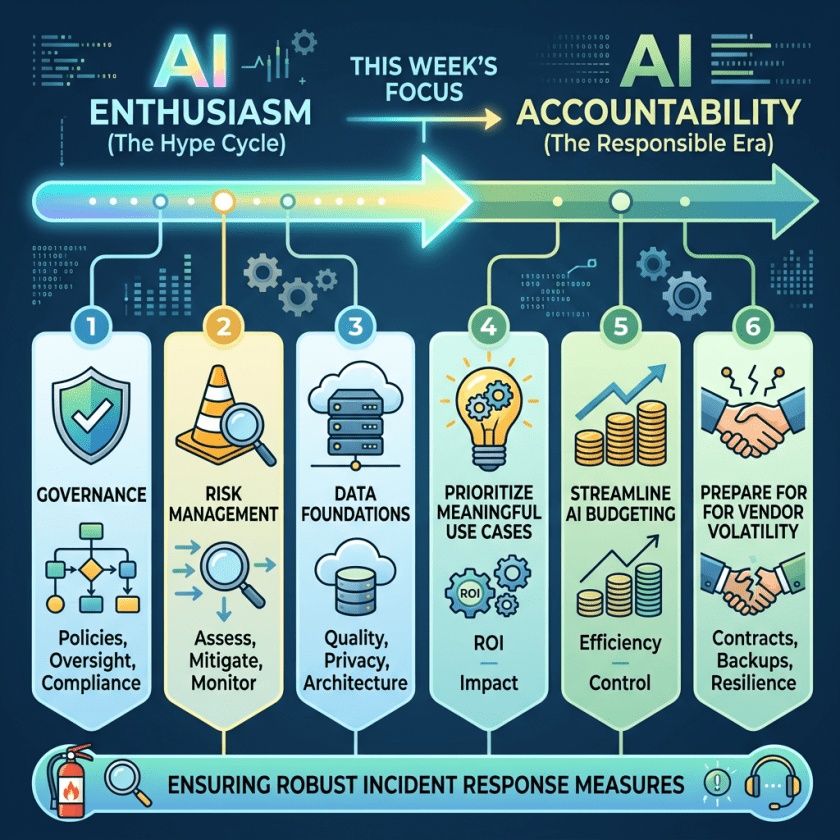
This week’s dominant theme was the shift from AI enthusiasm to AI accountability. Almost every story — the context-layer ownership debate, the risk posture buried inside an AI strategy, errors surfacing in board and investor communications, sprawling use-case portfolios with thin returns, and the budgeting fog around foundational versus usage-based spend — converges on the same point: the constraint on enterprise AI is no longer model capability but governance, data foundations and cost discipline. The SaaS pricing reset makes that concrete, turning renewal negotiations into architecture decisions about which layers of the stack remain defensible once agents do the work that seats used to. Forrester’s AI Disruption Model and OpenAI’s own slowdown both argue for the same defensive posture: assume vendor and model volatility, and design contracts and architectures that survive it. For IT leaders, the practical agenda for the coming quarter is unglamorous — kill the use cases that scale complexity instead of value, instrument workflows before renegotiating entitlements, and make sure the incident-response and audit trails hold up when AI output reaches an external audience.
Explore the full IT Management archive at genesis-aka.net/information-technology/management/
Enjoyed this article? Sign up for our newsletter to receive regular insights and stay connected.