
The core technical point is that migrating constraint-heavy workloads is less about syntax conversion than about reconstituting behavior Redshift does not enforce natively. Here, primary keys remain metadata for optimization, so ETL must supply the integrity check that older systems embedded in the engine. The post’s real value is in treating that check as a repeatable SQL pattern rather than a bespoke application fix, which matters because migration failures often stem from overlooked semantic differences, not obvious feature gaps.
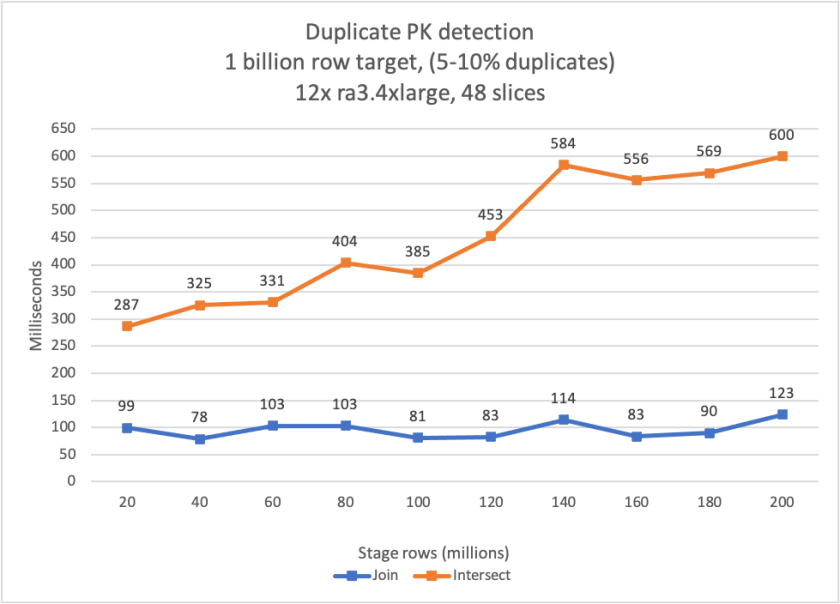
Two mechanisms are presented for INSERT-SELECT flows: a direct join between staging and target tables, and an INTERSECT-based set comparison. The join is marginally faster, but the set operation is cleaner, naturally handles NULL matching, and is easier to validate in reviews. That tradeoff is practical, not academic: both tested under one second even with a billion-row target, so the choice is about maintainability versus shaving additional latency, not about viability under scale.
The main limitation is that the patterns only address the specific case of duplicate key detection, and they assume staging data is already deduplicated or can be cleaned upstream. The source also notes that multicolumn keys and NULL handling can make the join version cumbersome, which is exactly where automated rewriting becomes attractive. For practitioners, the significance is that migration tooling can preserve constraint checks without forcing a redesign, but only when the workload fits the supported DML patterns.
Check out all the previous posts in this series:
|
Primary keys
A primary key (PK) is a set of attributes such that no two rows can have the same value in the PK. For example, the following Teradata table has a two-attribute primary key (emp_id, div_id). Presumably, employee IDs are unique only within divisions.
CREATE TABLE testschema.emp (
  emp_id INTEGER NOT NULL
, name VARCHAR(12) NOT NULL
, div_id INTEGER NOT NULL
, job_title VARCHAR(12)
, salary DECIMAL(8,2)
, birthdate DATE NOT NULL )
CONSTRAINT pk_emp_id PRIMARY KEY (emp_id, div_id);- Uniqueness – The PK values are unique over all rows in the table
- Not NULL – The PK attributes don’t accept NULL values
INSERT-SELECT
In the rest of this post, we dive deep into design patterns for INSERT-SELECT statements. We’re concerned with statements of the following form:INSERT INTO <target table> SELECT * FROM <staging table>- The staging table contains duplicates, meaning there are two or more rows in the staging data with the same PK value
- There is a row x in the staging table and a row y in the target table that share the same PK value
Join
The first design pattern simply joins the staging and target tables. If any rows are returned, then the staging and target tables share a primary key value. Suppose we have staging and target tables defined as the following:CREATE TABLE stg (
pk_col INTEGER
, payload VARCHAR(100)
, PRIMARY KEY (pk_col)
);
CREATE TABLE tgt (
pk_col INTEGER
, payload VARCHAR(100)
, PRIMARY KEY (pk_col)
);SELECT count(1)
FROM stg, tgt
WHERE tgt.pk_col = stg.pk_col;SELECT count(1)
FROM stg, tgt
WHERE
tgt.pk_col1 = stg.pk_col1
AND tgt.pk_col2 = tgt.pk_col2
AND …
;SELECT count(1)
FROM stg, tgt
WHERE
(tgt.pk_col = stg.pk_col)
OR (tgt.pk_col IS NULL AND stg.pk_col IS NULL)
;INTERSECT
The second design pattern that we describe uses the Amazon Redshift INTERSECT operation. INTERSECT is a set-based operation that determines if two queries have any rows in common. You can check out UNION, INTERSECT, and EXCEPT in the Amazon Redshift documentation for more information. We can determine if the staging and target table have duplicate PK values using the following query:SELECT COUNT(1)
FROM (
SELECT pk_col FROM stg
INTERSECT
SELECT pk_col FROM tgt
) a
;SELECT COUNT(1)
FROM (
SELECT pk_col1, pk_col2, …, pk_coln FROM stg
INTERSECT
SELECT pk_col, pk_col2, …, pk_coln FROM tgt
) a
;Performance
We tested both design patterns using an Amazon Redshift cluster consisting of 12 ra3.4xlarge nodes. Each node contained 12 CPU and 96 GB of memory. We created the staging and target tables with the same distribution and sort keys to minimize data redistribution at query time. We generated the test data artificially using a custom program. The target dataset contained 1 billion rows of data. We ran 10 trials of both algorithms using staging datasets that ranged from 20–200 million rows, in 20-million-row increments. In the following graph, the join design pattern is shown as a blue line. The intersect design pattern is shown as an orange line.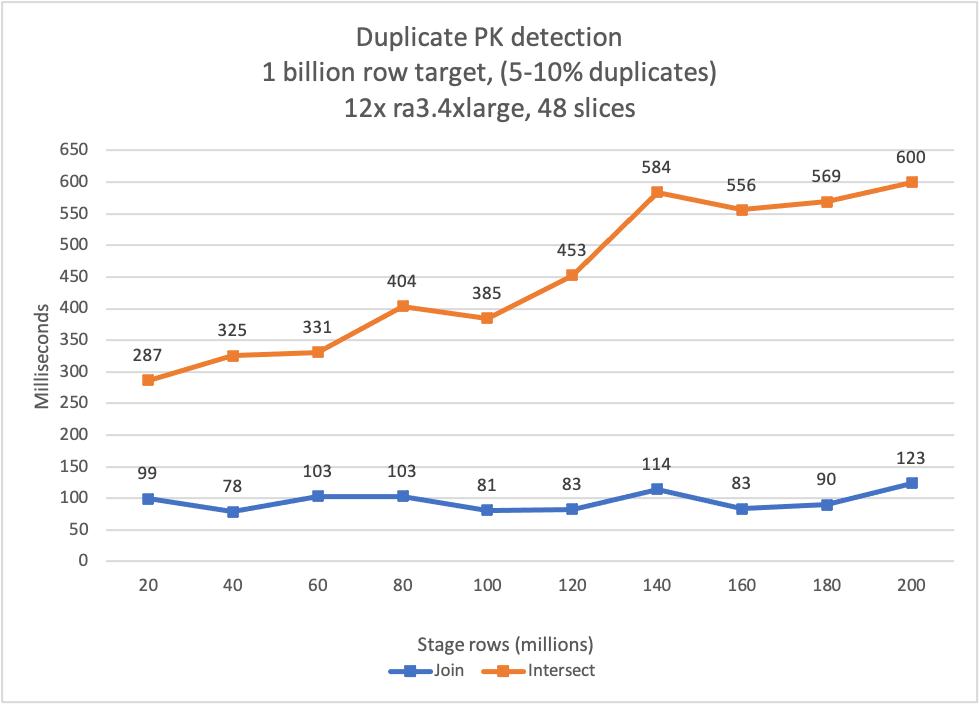 You can observe that the performance of both algorithms is excellent. Each is able to detect duplicates in less than 1 second for all trials. The join algorithm outperforms the intersect algorithm, but both have excellent performance.
So, which algorithm should use you choose? If you’re developing a new application on Amazon Redshift, the intersect algorithm is probably the best choice. The inherent NULL matching logic and simple intuitive code make this the best choice for new applications.
Conversely, if you need to squeeze every bit of performance from your application, then the join algorithm is your best option. In this case, you’ll have to trade complexity and perhaps extra effort in code review to gain the extra performance.
You can observe that the performance of both algorithms is excellent. Each is able to detect duplicates in less than 1 second for all trials. The join algorithm outperforms the intersect algorithm, but both have excellent performance.
So, which algorithm should use you choose? If you’re developing a new application on Amazon Redshift, the intersect algorithm is probably the best choice. The inherent NULL matching logic and simple intuitive code make this the best choice for new applications.
Conversely, if you need to squeeze every bit of performance from your application, then the join algorithm is your best option. In this case, you’ll have to trade complexity and perhaps extra effort in code review to gain the extra performance.
Automation
If you’re migrating an existing application to Amazon Redshift, you can use AWS SCT to automatically convert your SQL code. Let’s see how this works. Suppose you have the following Teradata table. We use it as the target table in an INSERT-SELECT operation.CREATE MULTISET TABLE testschema.test_pk_tgt (
pk_col INTEGER NOT NULL
, payload VARCHAR(100) NOT NULL
, PRIMARY KEY (pk_col)
);REPLACE PROCEDURE testschema.insert_select()
BEGIN
INSERT INTO testschema.test_pk_tgt (pk_col, payload)
SELECT pk_col, payload FROM testschema.test_pk_stg;
END; Next, choose the stored procedure in the source database tree, right-click, and choose Convert schema.
 AWS SCT converts the stored procedure (and embedded INSERT-SELECT) using the join rewrite pattern. Because AWS SCT performs the conversion for you, it uses the join rewrite pattern to leverage its performance advantage.
 And that’s it, it’s that simple. If you’re migrating from Oracle or Teradata, you can use AWS SCT to convert your INSERT-SELECT statements now. We’ll be adding support for additional data warehouse engines soon.
In this post, we focused on INSERT-SELECT statements, but we’re also happy to report that AWS SCT can enforce primary key constraints for INSERT-VALUE and UPDATE statements. AWS SCT injects the appropriate SELECT statement into your code to determine if the INSERT-VALUE or UPDATE will create duplicate primary key values. Download the latest version of AWS SCT and give it a try!
And that’s it, it’s that simple. If you’re migrating from Oracle or Teradata, you can use AWS SCT to convert your INSERT-SELECT statements now. We’ll be adding support for additional data warehouse engines soon.
In this post, we focused on INSERT-SELECT statements, but we’re also happy to report that AWS SCT can enforce primary key constraints for INSERT-VALUE and UPDATE statements. AWS SCT injects the appropriate SELECT statement into your code to determine if the INSERT-VALUE or UPDATE will create duplicate primary key values. Download the latest version of AWS SCT and give it a try!
Conclusion
In this post, we showed you how to enforce primary keys in Amazon Redshift. If you’re implementing a new application in Amazon Redshift, you can use the design patterns in this post to enforce the constraints as part of your ETL stream. Also, if you’re migrating from an Oracle or Teradata database, you can use AWS SCT to automatically convert your SQL to Amazon Redshift. AWS SCT will inject additional code into your SQL stream to enforce your unique key constraints, and thereby insulate your application code from any related changes. We’re happy to share these updates to help you in your data warehouse migration projects. In the meantime, you can learn more about Amazon Redshift and AWS SCT. Happy migrating!About the authors
Michael Soo is a Principal Database Engineer with the AWS Database Migration Service team. He builds products and services that help customers migrate their database workloads to the AWS cloud. Illia Kravtsov is a Database Developer with the AWS Project Delta Migration team. He has 10+ years experience in data warehouse development with Teradata and other MPP databases.Enjoyed this article? Sign up for our newsletter to receive regular insights and stay connected.