
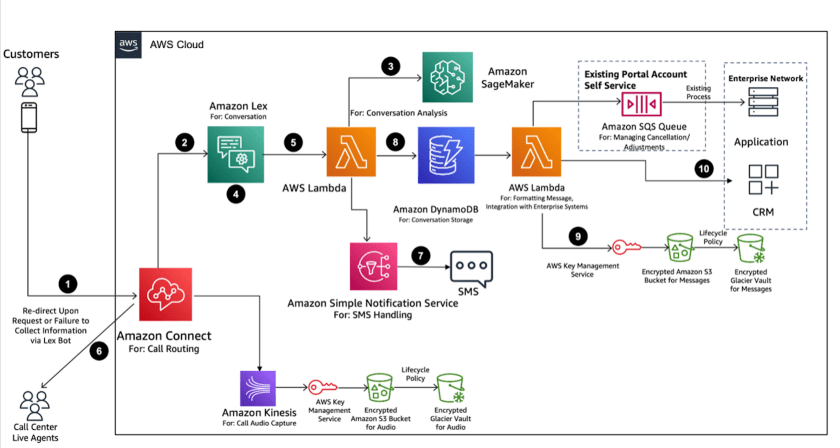
The architectural point is not mere call deflection; it is regulatory continuity under surge conditions. By shifting initial adverse-event intake from human agents to a self-service IVR built on Amazon Connect and Amazon Lex, the system preserves a toll-free reporting path while reducing dependence on retraining-heavy staffing. That matters because pharma must accept reports nationwide, even when call volumes spike or medication guidance changes. The design turns compliance from a labor problem into a workflow problem with measurable automation.
Technically, the value comes from a hybrid intake path: Lex handles structured prompts, Lambda supports freer responses, SageMaker informs whether a call should finish in IVR or escalate, and DynamoDB stores validated reporting data for the AERS process. SMS links via SNS extend reporting beyond the call, while recordings feed Transcribe-based analysis and longer-term archival tiers in S3 Glacier and Deep Glacier. Practitioners should note that the architecture is operationally useful because it preserves auditability and triage without expanding agent counts.
The limits are equally important. The system still depends on model quality, question design, and careful escalation logic, because adverse-event reporting is too sensitive for brittle automation. The source also shows that recordings are retained for auditing and training, not handed to live agents, which reduces friction but can complicate continuity if the handoff is imperfect. Its real significance is pragmatic: it is a compliance-oriented contact-center pattern, not a universal replacement for clinical judgment or expert review.
Solution overview
Let’s explore how the IVR solution architecture routes customer calls step by step, as shown in Figure 1 . Figure 1. Adverse events reporting architecture diagram
- Callers who dial in to report a medicine-related AE are routed to the Amazon Lex chatbot through IVR in Amazon Connect.
- Callers can proceed to IVR self-service functions, such as understanding the intent of a customer call and the AE.
- AEs are analyzed with Amazon SageMaker for a decision on whether to complete the call on IVR or forward it to an agent.
- If the caller remains on the self-service option, the bot captures information from 15 to 20 essential questions.
- The bot follows a hybrid workflow that allows for guided responses where appropriate and free-text conversations using AWS Lambda. It confirms captured AE information with the caller before closing the call and submitting information to the AERS system.
- The bot provides the option to route the call to a human agent contextually.
- The bot provides the option to share an AE reporting link over SMS using Amazon Simple Notification System (SNS), so the caller can access it through a mobile device to continue AE reporting outside of the call.
- The bot records customer interactions in AERS using Amazon DynamoDB, leveraging the current validated process used by the AE portal team
- The bot makes call recordings available for auditing, monitoring, and training purposes. These recordings are not be provided to live agents.
- Standard analytics are available to help the business continuously train the bot and measure its performance.
Leveraging IVR as an extended solution
Recorded customer calls can be used for further analytics with Amazon Transcribe. Actionable insights can be derived from the text using a machine learning (ML) model such as AE detection at scale. A (Named Entity Recognition model (NER) model can also identify medicines and caller types. Further, all recorded calls may be stored in a secure AWS ecosystem and archived for longer durations for compliance purposes. Storage costs can be optimized by setting up a policy to move old calls to Amazon Simple Storage Service Glacier (Amazon S3 Glacier) storage classes and calls over two years old to the Amazon S3 Deep Glacier storage class. This results in significant cost saving and helps companies archive at scale. Finally, the Amazon Lex bot can be enhanced and continuously trained with additional intents and utterances to handle complex AE reporting for various drugs. This provides significant cost saving and operational efficiencies as bots can be trained faster than human agents, as well as at scale.Conclusion: Using IVR to better manage AE reporting
This IVR solution was deployed for a pharma company and helped handle unusually high call volumes for AE reporting with its current agent population. It resulted in cost savings in contact center operations and significantly improved the customer experience by reducing wait times. The IVR solution can also be used with any existing contact center platform to first forward the calls to Amazon Connect for initial triage, and then handover to existing platforms for agent involvement. This adds intelligence to existing contact centers. This blog post demonstrates how pharma companies can leverage the self-service option for AERS to handle any AE reporting call. With solution enhancements using Amazon SageMaker models, it can quickly be transformed to handle calls for any medicine. They can also:- Incorporate related information into the model, such as the age, gender, or existing AEs to further improve the ML prediction performance
- Leverage audio data augmentation plus handcrafted features to help yield better predictions
- Use the audio-based diagnostic prediction in an Amazon Connect contact flow to triage the targeted group of incoming calls and escalate to a doctor for follow up if necessary
- Allow call center agents to use the intelligence provided by the acoustic classification in conjunction with Contact Lens for Amazon Connect, which provides a turn-by-turn transcript; real-time alerts; automated call categorization based on keywords and phrases; sentiment analysis, and sensitive data redaction—truly making it a real-time intelligent solution.
Enjoyed this article? Sign up for our newsletter to receive regular insights and stay connected.