
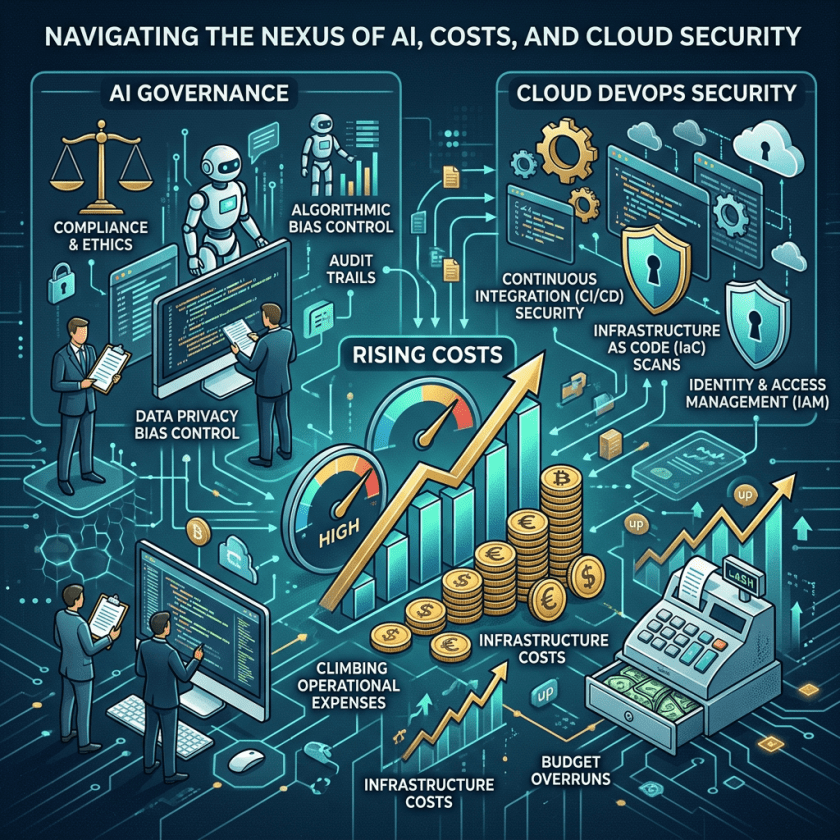
This week’s signal for IT teams is less about AI novelty and more about operational fit. The practical issue is no longer whether a model or agent can be built, but whether the surrounding platform can account for usage, bound its blast radius, and keep it measurable inside existing FinOps and SecOps processes. That shifts AI work from experimentation into the same control planes used for cloud services, identity, budgets, and auditability.
For architects, the biggest dependency is integration depth. AI controls only matter when they connect to entitlement systems, telemetry, and policy enforcement. Without that linkage, spend alerts arrive too late and agent activity becomes another shadow workload. The architectural trade-off is clear: tighter governance usually adds friction to rapid prototyping, but it also reduces the risk of untracked consumption, unclear ownership, and inconsistent behavior across teams.
Infrastructure teams will also recognize a familiar pattern: the same push that makes deployments faster and analytics cheaper tends to increase the need for guardrails, especially when workloads scale across multiple accounts, environments, and network boundaries. That creates pressure to standardize observability, quota management, and configuration tracking so AI and cloud systems can be operated with the same reliability expectations as other production services.
For technical leaders, the takeaway is organizational as much as technical. The teams that will move fastest are the ones that treat AI agents, model usage, and platform automation as governed services rather than ad hoc tools. In practice, that means clearer ownership, explicit budgets, and operational metrics that make cost, security, and failure modes visible before scale turns them into incidents.
Your curated roundup from genesis-aka.net / IT Professional · 24 articles this week
AI Economics & Governance
Claude Enterprise Spend Controls Arrive as Agentic AI Bills Blow Past Budgets (July 8)
Uber’s AI budget blew through expectations within four months of 2026 due to unforeseen token consumption from agentic coding. Anthropic responded with model-level entitlements and enhanced analytics so companies can enforce spending controls and improve budget forecasting.
Read →
Agent AI Sprawl Nobody Owns (July 7)
By 2028, Fortune 500 companies are projected to manage over 150,000 AI agents, up from fewer than 15 in 2025. That growth is creating agent sprawl, agents proliferating without oversight, fragmented protocols, and uncoordinated usage across departments.
Read →
The Four Layers of AI Failure (July 7)
AI failures often lumped together as hallucinations actually stem from distinct problems, including context-tracking, reasoning, and verification failures. The piece breaks failures into layers, from internal token generation up through downstream verification.
Read →
AI Models, Tools & Infrastructure
Can Your Computer Run Nvidia’s 550B Model? Not Even Close, and the Reason Is Fascinating (July 8)
Nvidia’s Nemotron 3 Ultra, a 550-billion-parameter model, is free to use but can’t run on typical personal hardware because of memory requirements. Aggressive quantization can shrink it further, but at the cost of reasoning quality.
Read →
How to Build Your Own Private, Offline AI on a Raspberry Pi (July 8)
Building a private, offline language model on a Raspberry Pi 5 is now practical using tools like Ollama. Anyone trying this needs at least 8GB of memory and proper cooling to run small pre-trained models efficiently.
Read →
Model Training as Code (July 7)
Aleph Alpha’s Savanna automates the end-to-end model training pipeline, reducing errors from manual processes. Treating training as code improves team collaboration and streamlines experiments for engineering teams.
Read →
Claude Opus 4.8 Shipped. Here’s What Actually Changed for a Solo 4-SaaS Build, and What Didn’t (July 7)
A solo developer running four SaaS products reviews Claude Opus 4.8, citing reduced code errors, parallel processing, and improved reliability. The write-up is candid about what stayed the same as well as what improved.
Read →
Cloud & Data Infrastructure
Accelerate your infrastructure deployments by up to 4x with AWS CloudFormation Express mode (July 8)
AWS introduced CloudFormation Express mode, which completes deployments once resource configurations are applied rather than waiting on stabilization checks. It can cut deployment time by up to 4x, especially for iterative development.
Read →
AI-powered performance recommendations for Amazon Redshift (July 7)
A team built an AI solution for Amazon Redshift that analyzes performance data and generates tailored recommendations using AWS Lambda and CloudWatch telemetry. The automated system cuts down manual analysis for database administrators.
Read →
AWS Stretches Elastic Kubernetes Service to Full Private Networking (July 7)
AWS updated Elastic Kubernetes Service to let users route outbound control plane traffic entirely through their own VPCs. The change gives teams tighter control over network paths for their Kubernetes clusters.
Read →
Amazon Redshift RG: Faster and lower cost, Graviton-powered (July 7)
Amazon Redshift’s new RG instance, powered by Graviton processors, delivers up to 2.2x faster performance and 30% lower cost than RA3 instances. It also eliminates per-TB scan charges and adds JIT Analyze for better cost-effectiveness.
Read →
Run log analytics for a fraction of the cost with the new engine for Amazon OpenSearch Service (July 7)
Amazon OpenSearch Service’s new log analytics engine promises up to 4x better price performance and double the data ingestion speed. It’s available globally at no added charge, reshaping how teams manage observability data.
Read →
The Multimodal Lakehouse: Data Engineering’s Answer to AI’s Messiest Problem (July 7)
Unstructured data now makes up 80-90% of new enterprise data, straining traditional structured pipelines. Multimodal lakehouses aim to accommodate diverse data types for AI-driven queries, though governance and classification remain challenges.
Read →
Lessons learned from scaling to 1 million Lambda functions (July 6)
ProGlove shares its journey scaling a serverless SaaS platform to over a million AWS Lambda functions across thousands of accounts. Key challenges included quota management, observability costs, and architectural optimization at scale.
Read →
Rediscovering RocksDB – Embedded Storage in Cloud-Native Applications (July 6)
Centralized cloud storage carries hidden costs in network latency and operational complexity. RocksDB, an embedded key-value store, mitigates these by allowing local data access within applications for temporary state.
Read →
Serverless analytics pipelines using the Apache Spark engine in Amazon Athena (July 6)
Building and managing Apache Spark clusters is often a heavy operational burden for data teams. This post introduces integration patterns for running Spark workloads serverlessly through Amazon Athena instead.
Read →
DevOps & Application Modernization
Modern DevOps: What it is and how it works (July 8)
Modern DevOps builds on traditional practices by integrating automation, cloud technologies, and cross-functional collaboration. Core elements like CI/CD, DevSecOps, and infrastructure as code aim to speed releases while improving security.
Read →
OpenAI Codex – A New Frontier in Application Modernization (July 8)
Modernizing legacy applications remains fraught with high failure rates for enterprises. OpenAI’s Codex offers a path forward by helping teams understand complex codebases and automate modernization tasks, cutting costs.
Read →
Modernizing mainframes at scale: The power of a composable approach (July 8)
Mainframes remain essential for critical systems, but skills shortages and rising costs are pushing modernization. A composable, AI-driven approach lets organizations tailor transformations to specific workloads and shorten timelines.
Read →
Proving application resilience on Azure with Chaos Studio (July 7)
Azure Chaos Studio lets organizations simulate disruptions to test application resilience before problems hit production. The newly introduced Chaos Studio Workspace extends this testing capability further.
Read →
How to Automate API Testing in CI/CD Pipelines (July 6)
APIs are integral to modern application functionality, making testing them a priority. Automating API tests within CI/CD pipelines improves bug detection earlier in the development cycle and strengthens release confidence.
Read →
Security
AI Phishing Scams Jumped 14x: How to Spot Smishing, QR Fraud, and Voice Clones (July 7)
AI-generated phishing attacks surged from 4% to 56% of reported scams by December 2025. Three vectors dominate: smishing, QR code phishing, and voice cloning, each exploiting urgency and familiarity to bypass existing security measures.
Read →
Also This Week
How MSPs Are Turning Migration Into a Scalable Revenue Engine (July 8)
Managed service providers are shifting focus toward migration services as a growth lever rather than a one-off engagement. The piece looks at how MSPs are packaging migration work into repeatable, scalable revenue streams.
Read →
How Enterprise IT Teams Are Using CMDB Tools to Tame Multi-Cloud Complexity in 2026 (July 6)
Managing multiple cloud environments without effective asset tracking creates real security and operational risk. The guide covers how engineering leaders are restructuring configuration management to improve visibility and reduce drift.
Read →
Editors Takeaway
This weeks coverage makes clear that AIs cost and governance problems are catching up with its capabilities. Enterprises are grappling with runaway agent spend, unmanaged agent sprawl, and a widening gap between what AI models can do and what teams can actually run, monitor, and secure. Meanwhile, the cloud and DevOps side of the house keeps grinding forward on the fundamentals — faster deployments, cheaper analytics, and better resilience testing — all of it increasingly aimed at absorbing the AI workloads piling up on top. For IT professionals, the message is consistent: the tooling to build with AI is maturing fast, but the tooling to govern, budget for, and secure it is only just catching up.
Explore the full IT Professional archive at genesis-aka.net/information-technology/professional/
Enjoyed this article? Sign up for our newsletter to receive regular insights and stay connected.