
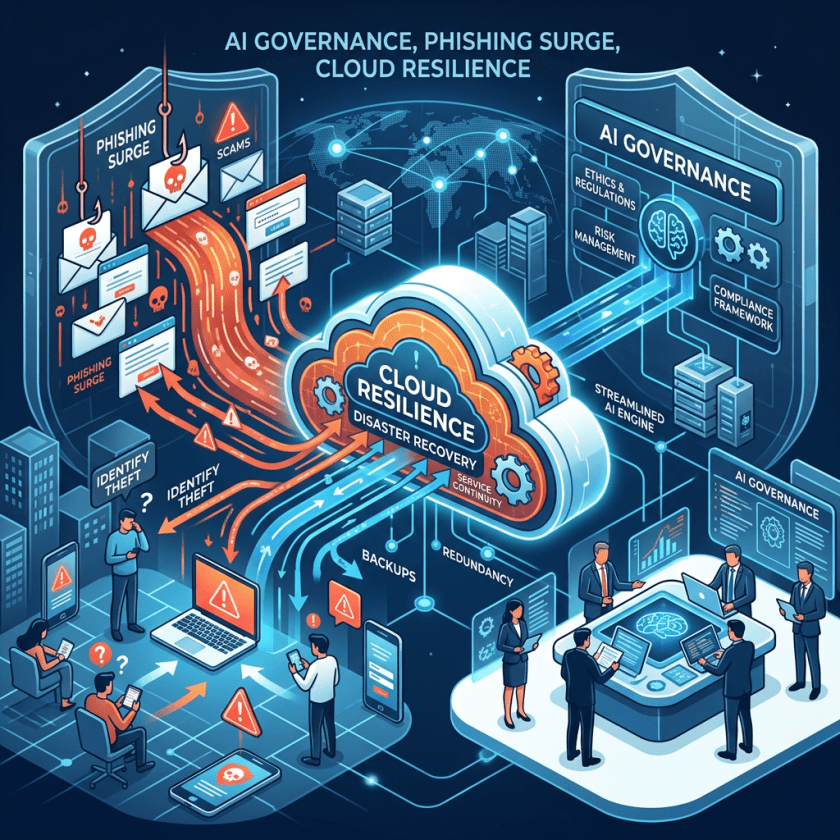
The week’s strongest pattern is not just AI adoption, but the operational burden that follows once AI becomes embedded in engineering workflows. Spend controls, agent ownership, and failure taxonomy all point to the same requirement: teams need policy, telemetry, and accountability around AI systems before usage scales faster than procurement and security can track it.
For architects, the practical issue is that agentic tooling introduces a new control plane alongside the application stack. That means entitlement design, budget guardrails, auditability, and escalation paths must be treated as first-class platform concerns, not optional add-ons. The challenge is less about whether models are capable and more about how enterprises prevent opaque automation from creating technical debt in cost, risk, and support.
The infrastructure stories carry a similar message. Faster provisioning, private networking, and resilience testing all improve delivery velocity, but they also shift complexity into lifecycle management, observability, and failure rehearsal. At scale, serverless, Kubernetes, and modernization programs succeed only when teams can measure the hidden costs of retries, quota limits, stabilization delays, and cross-account or cross-VPC dependencies.
Data engineering remains the other pressure point. Multimodal and unstructured data increase the need for governance, while tuning automation and lower-cost analytics engines show how quickly storage, compute, and query decisions affect operating margins. The technical takeaway is clear: the next wave of platform work is about containing complexity while still widening access to AI, automation, and analytics.
An editorial overview of the week’s key themes in IT Professional
This week’s IT Professional coverage kept circling back to a single uncomfortable truth: the AI tooling that made engineering teams faster over the past year is now the thing keeping finance and security teams up at night. Claude Enterprise Spend Controls Arrive as Agentic AI Bills Blow Past Budgets opened the week with a cautionary tale from Uber, whose agentic coding tools chewed through a year’s AI budget in four months before Anthropic shipped model-level entitlements and better analytics to rein in runaway token spend. That budget story is really a governance story, and Agent AI Sprawl Nobody Owns put numbers to it: Fortune 500 companies are on pace to manage more than 150,000 AI agents by 2028, up from a mere handful last year, with no consistent owner tracking what any of them are doing. Understanding why these systems misbehave in the first place was the subject of The Four Layers of AI Failure, which pushed back on the catch-all “hallucination” label in favor of distinguishing context-tracking, reasoning, and verification failures — a more useful taxonomy for anyone trying to actually fix these systems rather than just complain about them. The same AI capabilities cutting both ways showed up in security, too: AI Phishing Scams Jumped 14x documented a surge from 4% to 56% of reported scams using AI-generated smishing, QR fraud, and voice cloning, exploiting the same fluency and speed that make agentic tools useful for legitimate work.
On the model side, the week offered a reality check on what “state of the art” actually costs to run. Can Your Computer Run Nvidia’s 550B Model? walked through why Nemotron 3 Ultra’s 550 billion parameters put it firmly out of reach for consumer hardware, and why aggressive quantization to compress it comes at a real cost to reasoning quality. At the opposite end of the spectrum, How to Build Your Own Private, Offline AI on a Raspberry Pi made the case that small, local models on modest hardware are now genuinely practical for privacy-conscious hobbyists and professionals alike. And for developers actually shipping product, Claude Opus 4.8 Shipped offered a grounded, solo-developer’s-eye view of what improved — fewer code errors, better parallel processing, more reliability — and, just as usefully, what didn’t.
Developer tooling and modernization formed a third thread running through the week. Modern DevOps: What it is and how it works laid out how automation, cloud-native practices, and cross-functional collaboration have reshaped CI/CD and DevSecOps, a theme echoed in How to Automate API Testing in CI/CD Pipelines, which made the practical case for catching bugs before they reach production. Modernization itself got two treatments: How MSPs Are Turning Migration Into a Scalable Revenue Engine looked at the business side of legacy migration, while OpenAI Codex – A New Frontier in Application Modernization examined how GenAI coding assistants are being applied to the notoriously high-failure-rate work of untangling legacy codebases. On the ML engineering side, Model Training as Code covered Aleph Alpha’s Savanna framework, which treats training pipelines as versioned, automatable software rather than one-off manual processes.
Cloud infrastructure news leaned toward speed and resilience at scale. Accelerate your infrastructure deployments by up to 4x with AWS CloudFormation Express mode detailed a new deployment mode that skips stabilization waits for faster iteration. Modernizing mainframes at scale argued for composable, workload-specific transformation over rip-and-replace approaches. Proving application resilience on Azure with Chaos Studio covered simulated-disruption testing ahead of real outages, and AWS Stretches Elastic Kubernetes Service to Full Private Networking detailed routing EKS control-plane traffic entirely through customer VPCs. Perhaps the most striking scale story came from Lessons learned from scaling to 1 million Lambda functions, where ProGlove’s serverless SaaS journey surfaced hard lessons on quota management and observability costs at extreme scale.
Data and analytics engineering rounded out the week. Amazon Redshift saw two updates — AI-powered performance recommendations that automate tuning insight, and the Graviton-powered RG instance promising 2.2x faster performance at 30% lower cost — while Amazon OpenSearch Service’s new engine targeted cheaper, faster log analytics. Zooming out, The Multimodal Lakehouse tackled the structural shift toward unstructured data, now 80-90% of what enterprises generate, and what that means for governance. Enterprises wrestling with sprawl of a different kind got a guide in How Enterprise IT Teams Are Using CMDB Tools to Tame Multi-Cloud Complexity. And two posts made the case for rethinking default architectures: Rediscovering RocksDB argued for embedded, local-access storage over centralized services in latency-sensitive cases, while Serverless analytics pipelines using the Apache Spark engine in Amazon Athena offered integration patterns that avoid the operational overhead of standing up dedicated Spark clusters.
Taken together, the week’s posts sketch an industry in the middle of reconciling two impulses: pushing AI and cloud automation further into every layer of the stack, while building the governance, cost controls, and resilience testing needed to keep that push from outrunning what teams can actually manage. Expect both trends to keep accelerating in parallel.
Full post index for this week:
- Claude Enterprise Spend Controls Arrive as Agentic AI Bills Blow Past Budgets · July 8
- Can Your Computer Run Nvidia’s 550B Model? Not Even Close, and the Reason Is Fascinating · July 8
- How to Build Your Own Private, Offline AI on a Raspberry Pi · July 8
- Modern DevOps: What it is and how it works · July 8
- How MSPs Are Turning Migration Into a Scalable Revenue Engine · July 8
- OpenAI Codex – A New Frontier in Application Modernization · July 8
- Accelerate your infrastructure deployments by up to 4x with AWS CloudFormation Express mode · July 8
- Modernizing mainframes at scale: The power of a composable approach · July 8
- Proving application resilience on Azure with Chaos Studio · July 7
- Model Training as Code · July 7
- AI-powered performance recommendations for Amazon Redshift · July 7
- AWS Stretches Elastic Kubernetes Service to Full Private Networking · July 7
- Amazon Redshift RG: Faster and lower cost, Graviton-powered · July 7
- Run log analytics for a fraction of the cost with the new engine for Amazon OpenSearch Service · July 7
- Claude Opus 4.8 Shipped. Here’s What Actually Changed for a Solo 4-SaaS Build — and What Didn’t · July 7
- AI Phishing Scams Jumped 14x: How to Spot Smishing, QR Fraud, and Voice Clones · July 7
- Agent AI Sprawl Nobody Owns · July 7
- The Four Layers of AI Failure · July 7
- The Multimodal Lakehouse: Data Engineering’s Answer to AI’s Messiest Problem · July 7
- How Enterprise IT Teams Are Using CMDB Tools to Tame Multi-Cloud Complexity in 2026 · July 6
- How to Automate API Testing in CI/CD Pipelines · July 6
- Lessons learned from scaling to 1 million Lambda functions · July 6
- Rediscovering RocksDB – Embedded Storage in Cloud-Native Applications · July 6
- Serverless analytics pipelines using the Apache Spark engine in Amazon Athena · July 6
Browse the full IT Professional archive at genesis-aka.net/information-technology/professional/
Enjoyed this article? Sign up for our newsletter to receive regular insights and stay connected.