
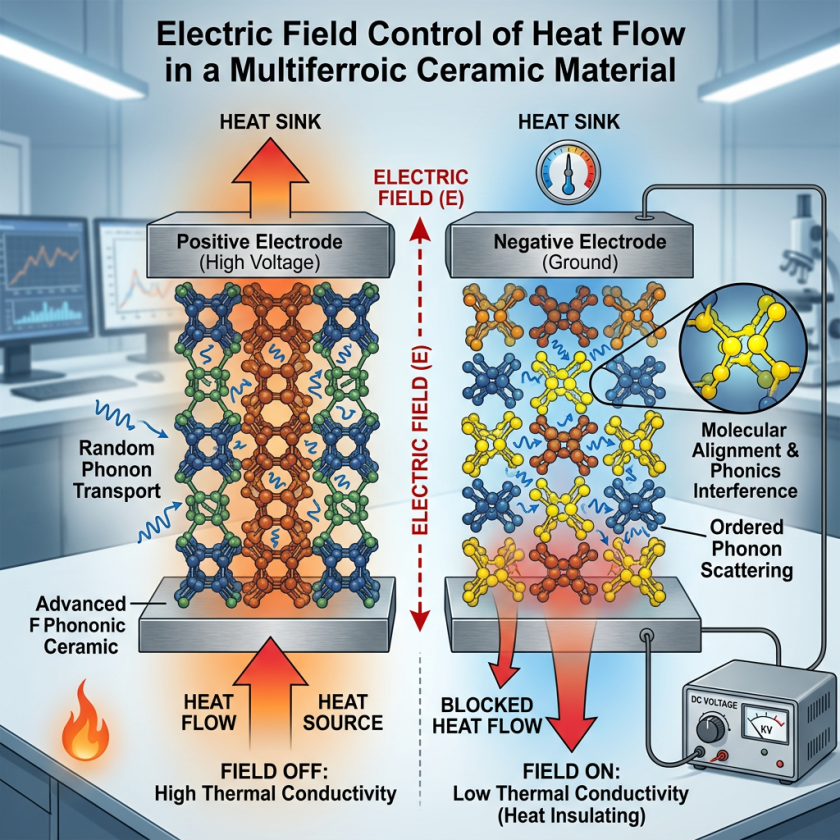
The technical shift here is not just higher heat flow; it is controllable heat flow. For AI systems, that changes cooling from a mostly fixed mechanical design choice into a potential software- and voltage-influenced materials problem. In practice, that means thermal behavior could become part of the control plane for packages, boards, and possibly rack-level thermal orchestration if the material can be integrated without disrupting reliability, insulation, or manufacturing flow.
The hardest engineering question is not the physics demonstration but the form factor. The result was measured on single-crystal samples, so the path to useful hardware depends on whether similar behavior can be preserved in thin films, composites, or packaged components. Any deployment would also need to reconcile the poling voltage, field direction, and thermal boundary conditions with real chip attachments, substrates, and interconnect stacks. That makes this as much an integration problem as a materials breakthrough.
For AI accelerators, anisotropy is the key architectural implication. A material that conducts heat strongly in one direction but not others could help route hotspot energy toward a heat spreader while limiting lateral diffusion into sensitive regions. That may reduce local thermal resistance, but it also adds design trade-offs around orientation, repeatability, and whether the effect persists without continuous power. Those details determine whether the material behaves like a passive component or an actively managed one.
There is also a platform and supply-chain constraint that cannot be ignored. The studied PMN-PT system contains lead, which complicates adoption in regulated electronics markets. So the practical next step is not only proving the effect in device-relevant geometries, but also finding manufacturable, compliant variants that fit existing semiconductor packaging and data-center reliability expectations.
Engineers wrestling with heat densities in AI accelerators now have a new variable to consider: an electric field applied to a specialized ceramic can triple its thermal conductivity, according to a study from the Department of Energy’s Oak Ridge National Laboratory and collaborators that drew renewed attention when ScienceDaily redistributed the findings in July 2026.
The result, published in PRX Energy in January 2026 by researchers at ORNL, The Ohio State University, and Amphenol Corporation, was not predicted by prior work. Earlier experiments on bulk ferroelectric materials had produced modest thermal conductivity improvements of 5 to 10 percent. The new measurements revealed a gain close to 300 percent — roughly 30 to 60 times larger than anything previously documented in a bulk solid material under an external electric field.
That gap matters because thermal conductivity is one of the hardest properties to control in solid materials. Chemistry can tune it — engineers can select materials based on how well they conduct heat — but doing so at design time fixes a material’s thermal behavior permanently. What the ORNL team demonstrated is that an external field can tune it dynamically, in a material already installed, without changing its composition.
Phonons: Why Atomic Vibrations Determine Where Heat Goes
The carriers of heat in a ceramic are not electrons — the way they are in a metal — but phonons: quantized packets of atomic vibration that travel through a crystal lattice, transferring energy as they go. A phonon’s effectiveness as a heat carrier depends on two things: how fast it moves and how long it survives before scattering off a defect, an impurity, or another phonon. That survival time is called a phonon lifetime, and it is what the ORNL researchers changed.
"Earlier work on bulk ferroelectric materials achieved modest improvements in thermal conductivity of 5 percent to 10 percent, while the new measurements reveal an enhancement close to 300 percent — mainly because the phonons are able to travel much longer before they stop," said Michael Manley, an ORNL senior researcher who designed and led the inelastic neutron scattering experiments.
The ceramic material at the center of the study belongs to a class called relaxor-based ferroelectrics. In a conventional ferroelectric ceramic, internal electric charges are uniformly polarized. In a relaxor, those charges exist in nanoscale clusters — called polar nanoregions, or PNRs — that are only loosely aligned. Those nanoscale clusters act as scatterers that interrupt phonon travel and keep thermal conductivity low. When an external electric field is applied and the material is "poled" — meaning the field is used to align the internal charges — those antiferroelectric fluctuations are suppressed along the field direction. Fewer scatterers means fewer interruptions to phonon travel, which means longer phonon lifetimes, which means dramatically higher thermal conductivity in the direction the field points.
"Being able to control both how fast and in what manner heat flows could lead to devices that manage thermal energy far more efficiently," said Puspa Upreti, an ORNL postdoctoral research associate and lead author on the paper.
Neutron Scattering at ORNL’s Spallation Neutron Source Made the Physics Visible
Prior studies of electric field effects on thermal conductivity in ferroelectrics measured bulk heat transfer and inferred what was happening at the atomic level. The ORNL team did something different: they made the atomic dynamics directly observable, using inelastic neutron scattering at the Spallation Neutron Source (SNS), a DOE Office of Science user facility at ORNL.
Neutrons are uniquely suited to this kind of measurement. Unlike X-rays, which primarily probe electron density, neutrons interact with atomic nuclei and can simultaneously reveal where atoms sit in a crystal (static structure) and how those atoms are moving (phonon dynamics). The technique is built on methods recognized by the 1994 Nobel Prize in Physics, shared by Clifford Shull for neutron diffraction and Bertram Brockhouse for developing neutron spectroscopy — inelastic neutron scattering — at the Chalk River facility in Canada.
Using the SNS, the researchers measured both the arrangement of atoms and their vibrations in the ferroelectric crystal — with and without the electric field applied. The measurements showed not just that heat conduction improved, but precisely why: phonons along the poling direction were surviving longer before scattering. The field-induced suppression of antiferroelectric fluctuations was directly visible in the phonon spectrum, removing any ambiguity about the mechanism.
A Surprise the Team Had to Trust
Delaram Rashadfar, a doctoral candidate at Ohio State who worked on the thermal conductivity measurements under the guidance of the late Professor Joseph Heremans, described the result as genuinely unexpected.
"While earlier work led us to expect only a modest effect, observing a threefold difference turned out to be a significant result," Rashadfar said. "Professor Heremans always stressed the importance of trusting the data first and letting the theory follow."
Heremans, who designed the thermal conductivity experiments and mentored Rashadfar through the data analysis, is credited as a co-author on the paper; he died before the work was published. The crystals used in the study were grown and poled at Amphenol Corporation by Raffi Sahul, and the neutron scattering experiments were co-led by Raphaël P. Hermann of ORNL.
How Tunable Heat Changes the Engineering Calculus
The significance of the ORNL result extends well beyond a single ceramic material. The existing approach to thermal management in electronics is largely fixed at design time: engineers select materials for their thermal properties, choose cooling architectures, and live with the result. A material whose thermal conductivity can be switched or steered by an externally applied voltage introduces a new variable — one that could respond dynamically to changing conditions.
Several application domains are directly relevant.
Solid-state cooling — devices that pump heat without mechanical compressors or moving parts — has been commercially dominated for six decades by bismuth telluride thermoelectric modules. These Peltier coolers offer precise temperature control but limited efficiency compared to vapor-compression systems. Electrically tunable thermal conductivity in ceramics is a step toward a new generation of solid-state heat management elements: materials that function as heat switches, directing heat where engineers want it to go rather than allowing it to diffuse isotropically.
Thermoelectric energy conversion also benefits from independent control of thermal and electrical conductivity. The dimensionless figure of merit ZT = S²σT/κ — which determines how efficiently a thermoelectric device converts a temperature difference into electricity — improves when thermal conductivity (κ) is reduced in the direction perpendicular to current flow. The ORNL result demonstrates that κ can be directionally controlled via poling, adding a degree of freedom that chemical composition alone cannot provide.
AI chip packaging represents the most urgent near-term application context. Rack power densities in data centers running AI accelerators reached an average of 27 kilowatts per rack in 2026, driven by Nvidia’s Blackwell architecture, with next-generation Rubin racks projected to approach 600 kilowatts per rack by 2027. At those densities, where heat flows matters as much as how much heat is removed. An anisotropic thermal conductor — one that channels heat efficiently in one direction but limits its spread in others — could serve as an adaptive heat director in next-generation packaging designs.
What Comes Next: From Laboratory Crystal to Device Component
The ORNL demonstration was carried out on single-crystal laboratory samples over a broad temperature range — a positive indicator for practical relevance. But the path from those crystals to deployable device components involves significant engineering challenges the paper acknowledges but does not resolve.
The relaxor ferroelectric material studied — a PMN-PT system (lead magnesium niobate–lead titanate) — contains lead, which raises compliance questions for consumer electronics applications under environmental regulations that restrict lead use. The poling process, which requires exposure to a strong electric field, must ultimately be compatible with real-world device geometries and operating voltages. Open questions remain about whether the thermal enhancement is remanent (persisting after the field is removed) or requires continuous field application, and what the enhancement magnitude looks like at typical electronics operating temperatures.
The research was supported by the DOE Basic Energy Sciences program. ORNL is managed by UT-Battelle for the Department of Energy’s Office of Science, which is the largest funder of basic physical sciences research in the United States.
Frequently Asked Questions
How does an electric field triple heat flow in a ceramic material?
The electric field works by suppressing nanoscale disorder in the crystal. In relaxor ferroelectric ceramics, clusters of misaligned electric charges — called polar nanoregions — scatter the vibrations that carry heat (phonons), shortening the distance each phonon can travel before losing energy. When a strong electric field is applied and the material is poled, those clusters are partially aligned, reducing the scattering. With fewer interruptions, phonons along the field direction survive three times longer on average, and the material conducts heat three times more efficiently in that direction. The result is a directional heat channel that engineers can switch on with an electric field.
What are phonons and why do they matter for chip cooling?
Phonons are quantized packets of atomic vibration — the way heat actually moves through a ceramic or semiconductor at the atomic level, analogous to how photons are packets of light. In modern AI chips, heat builds up faster than current cooling systems can remove it: rack densities in 2026 reached 27 kilowatts per rack on average, with next-generation systems projected to approach 600 kilowatts per rack. Because phonons are what carry that heat through solid materials, anything that lets engineers control phonon behavior — speeding them up, directing them, or extending how far they travel — is directly relevant to the chip thermal crisis.
Could this discovery enable a "thermal transistor" — a device that controls heat flow the way a transistor controls electrical current?
That is the larger implication the research points toward. A transistor switches or amplifies electrical current; a thermal transistor would switch or modulate heat flow on command. By demonstrating that thermal conductivity in a bulk ceramic can be tripled by an external electric field and returned toward its baseline when that field is removed, the ORNL result is a functional step in that direction. The field of phononics — which seeks to build thermal equivalents of electronic circuits, including heat switches, thermal diodes, and thermal logic gates — has long needed a bulk material whose thermal properties respond to an external control signal. This result provides exactly that, in a material system (relaxor ferroelectrics) with known manufacturing processes.
What are the current limitations to using this material in real devices?
Three main constraints apply. First, the relaxor ferroelectric studied (PMN-PT) contains lead, creating regulatory friction for consumer electronics applications. Second, the poling process requires a strong electric field that must be compatible with practical device geometries and voltages — a non-trivial engineering challenge. Third, it is not yet publicly established whether the thermal enhancement is permanent once the field is applied (remanent) or requires continuous voltage, which would affect power consumption and circuit design. The demonstration was performed on laboratory single crystals; the transition to manufacturable thin-film or polycrystalline device components represents significant additional engineering work.
Enjoyed this article? Sign up for our newsletter to receive regular insights and stay connected.