
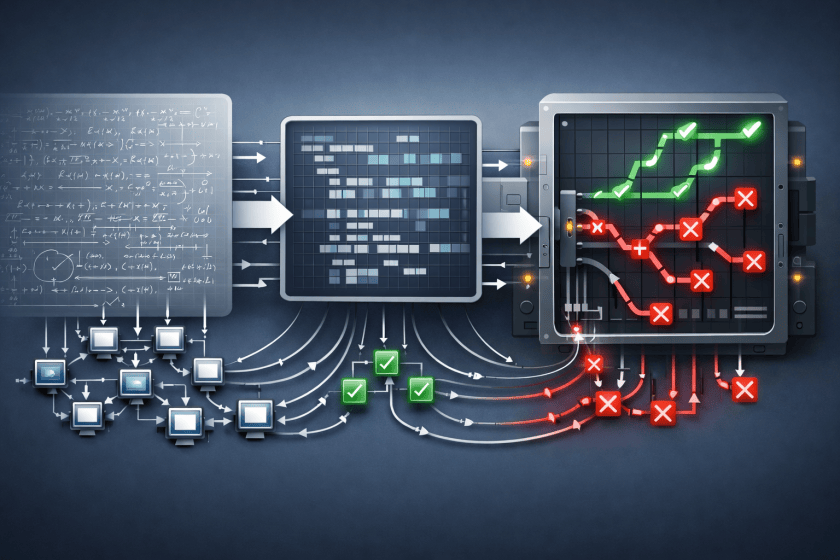
This matters to IT professionals less as a mathematics milestone than as a signal about where multi-agent AI systems may become operationally useful: long-horizon work that must be machine-checked at every step. The notable technical pattern is not simply “LLM solves hard problem,” but “LLM plus formal language plus verifier plus search-orchestration tool.” That architecture is closer to software build pipelines, test automation and policy verification than to consumer chatbot usage.
For engineering teams, the practical question is whether similar methods can be applied to domains with strict correctness requirements: proving infrastructure invariants, validating security policies, checking smart contracts, generating migration proofs or verifying compliance logic. In those settings, the bottleneck will not just be model quality. It will be the availability of a formal specification language, deterministic verification tooling and a workflow that can recover when one bad intermediate step invalidates downstream work.
The scale figures also point to a cost and observability challenge. Spawning many agents and generating billions of tokens may be acceptable for frontier research, but enterprise adoption will depend on tighter controls around token budgets, checkpointing, failure isolation and audit trails. The open-source orchestration layer appears significant because it suggests that inference efficiency and next-step selection can be as important as raw model capability.
The broader takeaway: the strongest near-term enterprise use case for advanced models may be not free-form generation, but constrained reasoning inside systems that can formally reject wrong answers. Where organizations can define the rules precisely, AI output becomes more governable, testable and reusable.
Anthropic PBC has used Claude to create a computer-verifiable version of a famous, highly complicated mathematical proof.
The company detailed the project in a blog post published today.
A proof is a series of arguments that proves a mathematical hypothesis is correct. The proof that Anthropic tackled verifies a hypothesis called Fermat’s Last Theorem. Originally floated in 1637, the hypothesis focuses on the properties of positive whole numbers.
The proof of Fermat’s Last Theorem was developed in 1995 by mathematician Andrew Wiles. It runs for 129 pages and took months of work to verify. Anthropic’s research project formalized Wiles’ proof, which means that the company turned it into a form that can be automatically verified by computers. Formalizing proofs is useful because it rules out the possibility of human error and eases information sharing among mathematicians.
A formalized proof takes the form of a code snippet written in a programming language called Lean. It’s a specialized syntax that mathematicians use to verify hypotheses. Anthropic’s proof comprises 13 million lines of Lean code, which makes it the largest-ever file of its kind.
Formalization is difficult because proofs tend to be quite terse. They lack certain explanations that a computer would need to understand them, which requires Lean developers to add in the explanations manually. Another source of complexity is that the arguments in a proof often build on one another. That means one erroneous line of Lean code can render all the subsequent code invalid.
Mathematicians expected the process of formalizing Wiles’ proof to take several years. According to Anthropic, its researchers completed the task in 11 days using an internal research model. The algorithm is described as being roughly on par with Claude Fable 5.1, the immediate predecessor of GPT-6 Astra.
Notably, the model completed the task using only a limited amount of high-level input from humans. It spun up several dozen agents that generated six billion tokens of output while working on the proof. Along the way, they proved no fewer than 29,500 intermediate theorems.
Anthropic’s initial attempt to formalize Wiles’ proof was unsuccessful. According to the company, the breakthrough came when it gave Claude access to an open-source tool called Prove2Me. The software makes it easier for AI agents to determine the optimal next step in a lengthy processing workflow. Prove2Me also helps lower inference costs.
“We see autoformalization of algebra, harmonic analysis, geometry and number theory, and we learn that AI autoformalization artefacts are now robust enough to be built upon; the proof is multi-layered,” said Kevin Buzzard, a mathematician whose work Claude used to generate its formalized proof.
The milestone comes a month after Anthropic detailed another LLM-driven mathematical advance. The company used Claude to discover new information about the Riemann zeta function, a closely studied mathematical object. It’s the center focus of the Riemann hypothesis, one of the world’s most difficult conjectures.
Rival OpenAI Group PBC is also harnessing its LLMs to advance mathematics research. Last month, the company used its latest Astra model to solve several Erdos problems and narrow a number of open questions in theoretical computer science.
Anthropic uses Claude to formalize proof of Fermat’s Last Theorem
Enjoyed this article? Sign up for our newsletter to receive regular insights and stay connected.