
Small Caps Are Leading The Way

Small-cap leadership is not just a performance story; it is also an index-construction story. Two funds can both advertise “small caps” while holding meaningfully different baskets. A profitability screen, for example, can tilt exposure toward companies with stronger balance sheets and away from the weakest names. By contrast, a broader small-cap benchmark can include more businesses that are still dependent on external financing, which changes the risk profile even when the market-cap label looks similar.
That distinction matters when rates are falling. Smaller companies often rely more heavily on floating-rate or refinanced debt, so easing borrowing costs can have an outsized effect on operating flexibility. But the flip side is just as important for long-term investors: the same leverage that can amplify relief in a lower-rate backdrop can also magnify stress if inflation re-accelerates, credit conditions tighten, or earnings stall. Small-cap exposure is therefore not simply a bet on size; it is a bet on the interaction between financing conditions and business quality.
For portfolio builders, the practical question is how to use the allocation. Small-cap ETFs can serve as a diversifier against mega-cap concentration, but they should be sized with an eye toward volatility and rebalancing discipline. When leadership rotates, the temptation is to chase the latest winner; a more durable approach is to define the role of the sleeve inside a broader equity mix and let the allocation reset over time. That keeps the decision centered on portfolio structure rather than short bursts of relative strength.
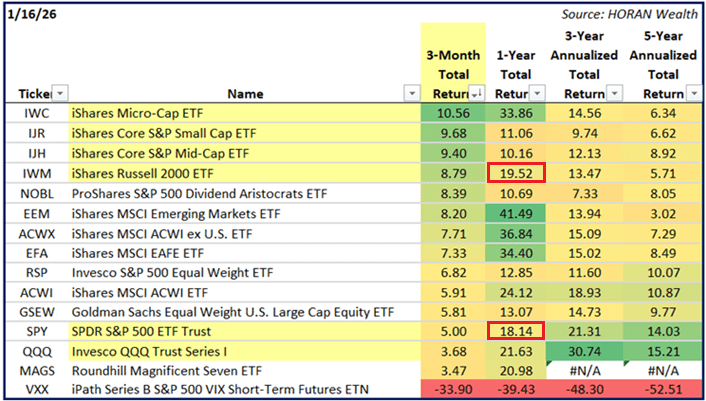
Another small company stock index is the Russell 2000 Index, which is investable by using the Russell 2000 ETF (IWM). This ETF is now outperforming the large-cap S&P 500 ETF (SPY) on a 1-year basis, 19.52% versus 18.14%, respectively. A difference between the S&P 600 Index and the Russell 2000 Index, both focusing on small companies, is the S&P 600 Index requires companies comprising the index to be profitable. However, this profitability requirement is not a metric for the Russell 2000 Index, and a little more than 40% of the companies in this index are unprofitable.
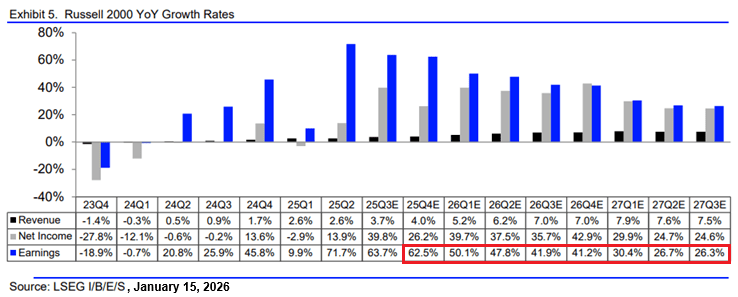
A question investors ask is whether this outperforming trend for small caps is sustainable, and there are some underlying factors that suggest maybe it is. Because a large percentage of small-cap companies are unprofitable, they tend to carry more debt financing on their balance sheet to operate the business. With the Fed lowering interest rates and expected to continue to do so this year, debt financing cost becomes less burdensome for companies using debt. Additionally, as seen in the below table from LSEG I/B/E/S, earnings growth for small companies is expected to be significantly positive through the third quarter of 2027.
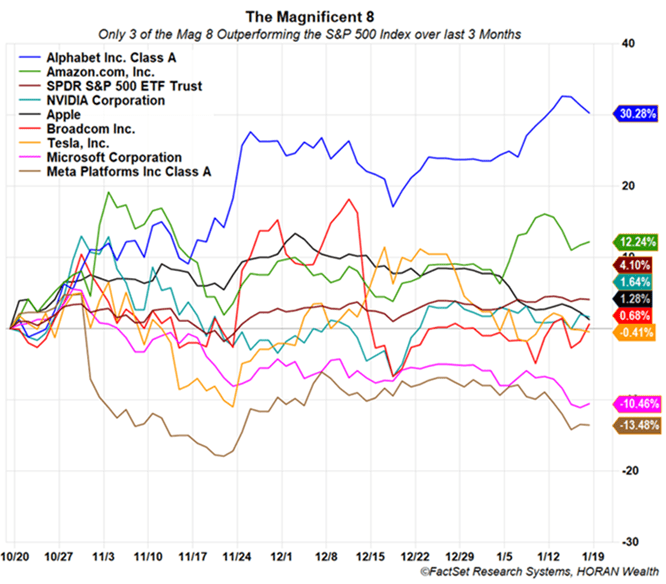
Certainly, this outperformance with small-cap stocks might be fleeting; however, some underlying factors like lower interest rates and strong earnings growth seem to suggest otherwise. Up until recently, momentum has favored the Mag 7 or 8 stocks, but as seen in the below chart, all but two are underperforming the S&P 500 Index over the last three months. In short, this rotation into other asset classes would make the equity market rally sustainable through 2026, of course not higher in a straight line.
Enjoyed this article? Sign up for our newsletter to receive regular insights and stay connected.