
For ETF investors, the key issue is not whether AI remains important, but how much of a fund’s return stream is being driven by a small cluster of mega-cap names. Broad market and thematic ETFs can become more concentrated than they first appear when the same large companies dominate both the index and the narrative. In a capex-heavy phase, that concentration matters because the portfolio is implicitly making a view on how much spending the market will tolerate before multiples change.
Free cash flow is a useful cross-check on headline growth. When reported earnings remain solid but cash generation weakens, the gap can signal that current profits depend on accounting timing and investment assumptions, not just operating momentum. ETF holders do not need to forecast every company’s spending path; they do need to know whether valuations already assume a smooth monetization of AI infrastructure. If that assumption slips, index-level downside can come from multiple compression even without a collapse in revenue.
This is also a reminder that “diversified” does not always mean balanced. Funds tied to large-cap technology, growth, or innovation themes may share overlapping holdings, which can magnify one sector’s capital cycle across several products at once. For long-term investors, the practical response is often structural rather than tactical:
- check single-name and sector weights in the underlying index,
- compare the ETF’s exposure to cash-generative businesses versus capital-intensive builders,
- review whether the fund is being used as a core allocation or a satellite bet.
In other words, the investment question is less “is AI real?” than “how much concentration and valuation risk is already embedded in the ETF you own?” That distinction matters most when the market is rewarding scale, but the balance sheet is starting to pay the bill.
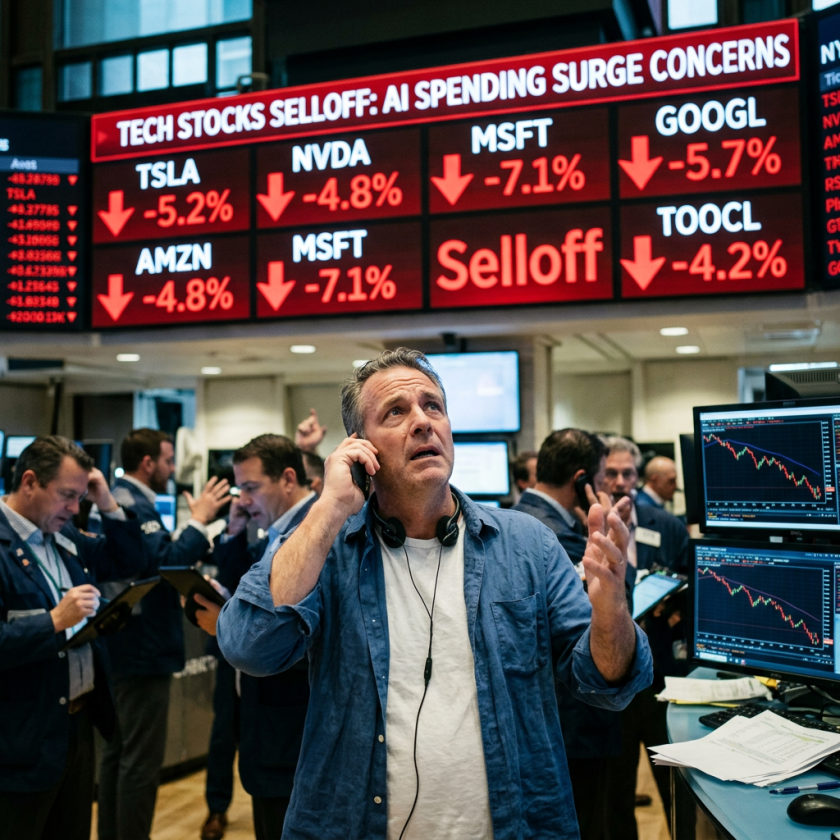
Wall Street has been running an arithmetic test on the most profitable companies in technology — and the numbers are arriving on schedule, just not the ones investors wanted. The Nasdaq Composite fell 4.6% during the week of June 23 as investor confidence in the AI investment cycle cracked for the first time since 2024, logging five consecutive losing sessions through Friday, June 27. This was not a macro shock or a rate surprise. It was a math problem that Epoch AI put on paper on June 16, 2026: the five largest cloud builders — Microsoft, Amazon, Alphabet, Meta, and Oracle — are spending on AI infrastructure 70% faster per year than their cash earnings are growing. Those two curves cross this summer.
The crossing point is the aggregate free cash flow of this group reaching zero — meaning the companies are collectively spending every dollar they earn from operations, and more, on capital expenditures. For a single company in a single quarter, that can represent a moment of bold ambition. For five of the largest corporations in American history doing it simultaneously, with no end to the spending growth in sight, it represents a structural shift in how the technology industry finances itself.
The $725 Billion Number and What It Buys
Combined 2026 capital expenditures across the four largest hyperscalers — Amazon, Alphabet, Microsoft, and Meta — have reached approximately $725 billion, a 77% increase from the roughly $410 billion spent in 2025. Amazon alone plans to spend $200 billion. Alphabet has guided to $180 to $190 billion. Microsoft is tracking toward $190 billion, and Meta has raised its guidance to $125 to $145 billion, citing higher memory-chip costs and additional data-center construction. Wall Street analysts at Evercore and Bank of America project that 2027 combined hyperscaler capital expenditure will clear $1 trillion.
The free cash flow drain is already visible in quarterly filings. Alphabet’s first-quarter 2026 free cash flow fell 47% year over year to $10.12 billion. Amazon’s trailing free cash flow has collapsed 95%, from approximately $38 billion to $1.2 billion. Morgan Stanley projects Amazon’s full-year 2026 free cash flow at negative $17 billion. Bank of America projects negative $28 billion. Barclays, in a note after Meta’s Q1 2026 earnings, wrote that analysts were now modeling negative free cash flow at Meta for 2027 and 2028, calling it “somewhat shocking” but “likely what we eventually see for all companies in the AI infrastructure arms race.”
According to Epoch AI’s analysis of SEC filings, aggregate operating cash flow across the five companies is growing at roughly 23% annually — a strong rate by almost any standard — while aggregate capital expenditure is growing at 70% annually. Those two curves cross around the third quarter of 2026. Oracle has already crossed, with capital spending exceeding operating cash flow by approximately $23.69 billion. Amazon is crossing now. Alphabet is projected to cross in early 2027, Meta around mid-2027, and Microsoft around late 2028.
Why Profits Stay Positive While Cash Runs Dry
The apparent paradox — companies that are profitable becoming cash-negative — is explained by a single accounting mechanism that most coverage of this story omits: depreciation.
When a hyperscaler spends $200 billion buying GPU servers and data-center equipment, that cash leaves immediately. But under standard accounting rules, the cost does not hit the income statement all at once. Instead, it is spread across the asset’s estimated useful life — typically four to six years for server hardware. A hyperscaler that spends $200 billion in one year may record only $30 to $50 billion in depreciation expense that year on its income statement, with the remainder deferred over the following years. The result: revenues go up, reported profits go up, and the income statement looks healthy — while the actual cash account is running dry.
This depreciation gap is the reason analysts can simultaneously say that all five hyperscalers remain profitable and increasingly so, and that their combined free cash flow is turning negative. Both statements are true. They describe the same spending at different accounting speeds. An investor who evaluates these companies using only reported earnings is seeing the same capital deployment as an investor using free cash flow — at a different frame rate.
The critical assumption buried in this mechanism is how long GPU hardware is expected to remain economically useful. A Goldman Sachs analysis published in May 2026 identified the useful life of AI chips as the single variable with the largest impact on cumulative capital requirements through 2031. Hyperscalers currently depreciate GPU servers over four to six years. But Nvidia has shifted to an annual product cadence — Hopper in 2022, Blackwell in 2024, Rubin in 2026, Rubin Ultra anticipated in 2027. Each generation delivers not incremental improvement but order-of-magnitude gains in efficiency and performance, making a six-year depreciation schedule increasingly difficult to justify on economic grounds.
Goldman’s sensitivity analysis found that shortening GPU useful life from five years to three would push total cumulative depreciation from roughly $3 trillion to approximately $4 trillion between 2026 and 2031 — a $1 trillion swing driven entirely by a single accounting assumption that does not appear on any product announcement or earnings call.
Investor Michael Burry has argued publicly that hyperscalers are using depreciation schedules that are too long, producing what he estimates as $176 billion in understated depreciation and overstated profits between 2026 and 2028. Amazon has already moved partway in that direction: in 2025, the company shortened the estimated useful life of a subset of its servers from six years to five, explicitly citing the accelerating pace of AI technology development, and took a $920 million accelerated depreciation charge as a result. In the same period, Meta extended its server useful lives to 5.5 years, booking a $2.9 billion reduction in depreciation expense. Same Nvidia GPU hardware. Opposite accounting conclusions. The divergence illustrates how much of the debate about AI company valuations is, at its core, a debate about a depreciation assumption.
Talent Departures Sharpened the June Selloff
The pure financial signal from the free cash flow crossover was amplified by qualitative events in rapid succession. In the days surrounding June 22, Noam Shazeer — a senior Google engineer and co-lead of the Gemini AI models — announced he was leaving for OpenAI. Nobel laureate John Jumper, a Google DeepMind researcher whose AlphaFold protein-folding system earned him the 2024 Nobel Prize in Chemistry, announced he was departing for Anthropic. The combination of a balance-sheet signal and a talent signal in the same week produced the sharpest rerating of Alphabet’s shares in recent memory.
Alphabet stock fell approximately 6% in the sessions surrounding June 22 to 23, with some sources reporting intraday declines closer to 10%. Amazon shed approximately 4%. The selloff was global. South Korea’s Kospi index fell 10% for the week, with Samsung and SK Hynix both declining more than 12% as markets priced tighter demand from hyperscalers whose cash generation is constrained. Germany’s DAX tumbled more than 1%. Micron Technology fell 13% in a single session before recovering after its earnings report.
As of June 26, the Nasdaq had logged five consecutive losing sessions, down 4.6% for the week. The index is still up roughly 10% year to date, and most analysts characterize the June move as a correction rather than a crash — a repricing of expectations, not a verdict on the underlying business.
Capital Markets Are Now the Balance Sheet
The clearest structural signal of the free cash flow crossover is not stock price moves — it is what has happened in the corporate bond market.
For the first three years of the AI buildout, hyperscalers financed their capital expenditures primarily from their own operating cash flows. That model ended in late 2024. Morgan Stanley’s tracking of the corporate bond market found that AI-related issuers had already raised approximately $236 billion in debt by May 31, 2026 — roughly four times the pace of the same period in 2025 — and the bank projects the 2026 total will approach $570 billion. The weight of Alphabet, Amazon, Meta, and Oracle in the Bloomberg US Corporate investment-grade bond index nearly doubled in the 12 months ending April 2026.
Moody’s has separately flagged that hyperscaler lease commitments not yet reflected on balance sheets — data-center leases signed but not yet commenced — total approximately $662 billion, a figure larger than these companies’ combined on-balance-sheet debt. Amazon disclosed in an SEC filing that it may seek to raise additional equity and debt, and in June 2026 secured a $17.5 billion credit line arranged by Citibank.
On June 1, Alphabet priced one of the largest equity offerings in corporate history: approximately $84.75 billion across common stock, capital stock, and mandatory convertible preferred shares, with an additional $10 billion Berkshire Hathaway private placement. This is a company that generated cash for two decades selling advertising — now selling shares to fund GPU infrastructure.
Cloud Revenue Growth Is the Bull Case
The counterargument is not that the spending is small — no credible bull denies the scale — but that it is early, and that the revenue ramp will eventually close the gap that capital expenditure has opened.
The demand side has genuine figures attached. Amazon Web Services grew 28% in the first quarter of 2026 to $37.59 billion, its fastest pace in 15 quarters. Microsoft CFO Amy Hood confirmed the company’s AI revenue has surpassed an annual run rate of $37 billion, up 123% year over year. Alphabet CFO Anat Ashkenazi reported that Google Cloud’s contracted backlog reached $462 billion in the first quarter — nearly double the figure from the previous quarter — and projected that just over 50% of that backlog would convert to recognized revenue within 24 months.
Microsoft has framed its constraint not as demand but as supply: the company expects to remain capacity-limited through 2026, with more customer orders than it can fill because power delivery to GPU clusters is the current bottleneck, not customer willingness to pay.
“If you’re going to pour all this money into AI, it’s going to reduce your free cash flow,” said Jake Dollarhide, CEO of Longbow Asset Management, whose firm holds Amazon as its largest position. “Do they have to go to the debt markets or short-term financing? Yeah. That’s why CEOs and CFOs are paid what they’re paid.”
The historical precedent offered by bulls is the AWS buildout itself. From 2010 to 2013, Amazon’s early cloud infrastructure investment produced quarters of compressed or negative free cash flow before the business compounded into the dominant profit engine it became. Under this framework, the free cash flow crossover of 2026 is the 2010 moment of the AI infrastructure cycle — necessary to endure, and eventually generative of the returns that justify current valuations.
What Investors Face Before Q2 Earnings
For index fund holders and 401(k) investors with significant exposure to Alphabet, Amazon, Microsoft, and Meta, the free cash flow crossover is most relevant as a valuation signal, not a solvency warning. All five hyperscalers remain profitable. The question is whether current share prices already reflect an AI revenue ramp that has not yet materialized at this scale of spending — and what multiple compression looks like if the ramp is slower than consensus expects.
J.P. Morgan Asset Management estimates that AI capital expenditure as a share of hyperscaler operating cash flow rose from 33% in 2023 to approximately 93% in 2026. Goldman Sachs analysts have noted that for hyperscalers to maintain their historical return on capital at current spending levels, they would need to generate roughly $1 trillion in annual profit — against the current analyst consensus of approximately $450 billion.
The next concrete test is Q2 2026 earnings, due beginning in late July, with Alphabet reporting around July 28. At that point, investors will have the most direct measurement yet of whether AI revenue is keeping pace with the capital expenditure curve — or falling further behind it. The answer will determine, at least for a quarter, whether the June 2026 correction was the rational price to pay for the platform shift the hyperscalers believe they are building.
Frequently Asked Questions
Why did Big Tech stocks sell off in June 2026?
The June 2026 tech selloff reflected investor concern that five major cloud companies — Microsoft, Amazon, Alphabet, Meta, and Oracle — are spending on AI infrastructure 70% faster per year than their cash earnings are growing. Research firm Epoch AI published an analysis on June 16 projecting that aggregate free cash flow across the group would reach zero by the third quarter of 2026. The move was sharpened by the departure of two prominent AI researchers from Google in the same week: Gemini co-lead Noam Shazeer to OpenAI, and Nobel laureate John Jumper to Anthropic.
What happens when hyperscaler capital expenditure exceeds operating cash flow?
When capital expenditure exceeds operating cash flow, free cash flow turns negative — meaning the company is spending more than it earns from operations. To continue increasing investment, companies must draw down cash reserves, borrow by issuing bonds, or raise equity by selling shares. All five hyperscalers have shifted toward debt financing since late 2024. Morgan Stanley projects AI-related bond issuance will approach $570 billion in 2026 alone, roughly four times the pace of 2025.
How does GPU depreciation affect how profitable these companies appear?
When a hyperscaler buys GPU hardware, the cash leaves immediately — hitting free cash flow — but the accounting expense is spread over the asset’s estimated useful life, typically four to six years. This means that companies can report growing profits on their income statements while generating little or negative free cash flow. The gap is determined largely by a single depreciation assumption: how long a GPU server remains economically useful. Nvidia’s annual chip release cadence has compressed the real useful life of AI hardware, creating a debate about whether current depreciation schedules are too optimistic and whether reported profits are overstated by as much as $176 billion across 2026 to 2028, as investor Michael Burry has argued.
Is the AI infrastructure investment boom sustainable?
The bull case is that current spending will produce cloud AI revenue that compounds over time, as happened when AWS built its foundational infrastructure a decade ago. The bear case is that current valuations already price in an optimistic revenue ramp that has not yet materialized at this scale. J.P. Morgan estimates hyperscalers would need to generate roughly $1 trillion in annual profit to justify current capital intensity at historical return-on-capital levels, against the current analyst consensus of approximately $450 billion. The answer will begin to clarify with Q2 2026 earnings in late July.
Enjoyed this article? Sign up for our newsletter to receive regular insights and stay connected.