
SOXX: China’s DUV Push May Be A DeepSeek 2.0 Moment

Executive Summary
On January 27, 2025, we had our first cold shower on the topic of AI, costs, and Chinese competition. Do you remember? A news article came out about a low-cost Chinese AI model. On that day alone, NVIDIA Corporation (NVDA) stock lost approximately $593 billion in market value. We were all thinking that if we just kept increasing the amount we spent, capex estimates would keep going up and the odds of us winning the AI race would get greater. DeepSeek, from Hangzhou DeepSeek Artificial Intelligence Co., Ltd. (DEEPSEEK) showed us otherwise.
Agar Capital, Bloomberg Terminal
On July 27, 2026, another piece of news shook the market, particularly the semiconductor sector. In short, according to The Information, a Chinese state-owned company has begun producing deep ultraviolet (DUV) immersion lithography machines. As you may know, these machines are essentially the industrial printers needed for semiconductor production, of which ASML currently has market dominance. Indeed, the stock reacted strongly, falling 8.5% in Amsterdam.
Agar Capital, Bloomberg Terminal
I continue to believe that SOXX is in a difficult situation. I maintain my Sell rating on the sector because I believe there is still room for downside, especially after a rally supported by high valuations and very aggressive AI spending expectations.
When I say “DeepSeek 2.0,” I am not suggesting that China has already caught up with ASML technologically. I do not think they have. But in financial markets, the story is different; everything revolves around what investors have priced in. In January 2025, DeepSeek challenged the notion that only American-based companies, which continue to invest increasingly large amounts of money, can create competitive AI models. Today, the same news related to DUV machines challenges the second assumption: China will forever remain dependent on Western equipment needed to produce semiconductors.
Although today, the number of Chinese-made machines is small and likely less productive than Western-made products, the market is projecting forward. If China were able to begin developing its own supply chain for manufacturing semiconductors, future estimates of growth, profit margins, and the multiple being paid to Western manufacturers might need to be adjusted.
Additionally, the chart of the Philadelphia Semiconductor Index (SOX) or ETF does suggest caution. The chart shows a potential bearish head-and-shoulders pattern with a weakening technical outlook.
The main risk to my Sell thesis is that hyperscalers continue to increase AI spending for longer and faster than currently expected. That would allow earnings for the industry to exceed current expectations and potentially preclude completion of the pattern. It appears many investors understand that growth cannot occur forever and a normalization is natural and healthier.
China’s “DeepSeek 2.0” Moment
DeepSeek wasn’t just significant in terms of its performance. It was more so for showing the world that alternative solutions did exist – even if they were smaller or at a different level than Western alternatives. This required a reconsideration of some assumptions — China wasn’t nearly as far behind as most people thought, America’s restrictions were not being entirely successful, and, perhaps most importantly, spending more capital didn’t automatically guarantee AI leadership.
The news about DUV machines could have the same effect. It doesn’t mean China has already caught up with ASML, as I said before. We don’t know at the moment, and I don’t think that’s the case. ASML maintains a gap with all the other companies, and it’s difficult to replicate the Dutch giant’s technology. However, in the markets, it’s not just a question of objectivity; it’s also a question of expectations and thinking about the future, as you obviously know. The question is whether it’s advancing faster than expected and whether Western dominance in chipmaking is really as unassailable as current valuations suggest.
In my opinion, this is the most interesting point. U.S. restrictions may slow China down in the short term, but at the same time, they push it to invest even more in its own technologies. The tighter the restrictions become, the stronger China’s incentive to develop domestic alternatives. This has already happened with AI models, CXMT’s memories, SMIC’s production capacity, and chip design software.
Now, the same process appears to be extending to the machinery needed to produce them, which represents one of the most complex links in the supply chain. Initially, Chinese equipment may be less efficient and less reliable. But Beijing could accept these limitations in exchange for something it considers more important: security of supply and less dependence on Western restrictions.
What Actually Happened in China?
By now we all know a lot about the semiconductor supply chain. At least in general terms. On one side are companies that design the chip: Nvidia, Advanced Micro Devices, Inc. (AMD), Broadcom Inc. (AVGO), and QUALCOMM Incorporated (QCOM), to name just a few. On the other side of the chain are the foundries (Taiwan Semiconductor Manufacturing Company Limited (TSM), Samsung Electronics Co., Ltd. (SSNLF) & (SMIC)) that actually produce the chips. Between them are all the design software, packaging, testing, and, most importantly, the manufacturers of the equipment needed to build the chips. And this is where ASML comes into the picture.
Semiconductor Ecosystem
To make a semiconductor, you need to print circuits many times over onto a silicon disk called a wafer. This process uses lithography machines, which project circuit patterns onto a light-sensitive layer on the wafer with extreme precision.
The lithography machines using deep ultraviolet light are known as DUV machines. In immersion DUV, a thin layer of ultrapure water is placed between the final lens and the wafer. This allows the concentration of the light onto the surface of the wafer to be greater than without immersion, permitting smaller and more dense circuits to be printed.
The EUV machines that ASML develops today have an even shorter wavelength than DUVs, but they also allow for finer details to be printed onto the wafer with fewer exposures and patterning steps. DUVs, however, remain essential for less advanced semiconductor product lines, memories, and many production stages. With multiple exposures, very highly sophisticated results can be obtained from these machines, but there will be a higher cost, longer lead times, and lower efficiency.
| Metric | Immersion DUV (ArFi) | EUV — Low NA | EUV — High NA |
|---|---|---|---|
| Wavelength | 193 nm | 13.5 nm | 13.5 nm, NA 0.55 |
| Typical Applications | Mature nodes and selected advanced layers, memory, packaging, and many chip layers | Leading-edge logic below 7 nm and advanced DRAM | Sub-2 nm logic and next-generation DRAM from 2026 onward |
| Exposures per Layer | 2–4 exposures, with multi-patterning required | Fewer exposures than DUV; single-patterning is possible for selected critical layers. | 1 exposure, with higher resolution |
| Estimated ASML System Cost | Approximately €80–90M | Approximately €230–260M | More than €350M |
| Throughput | 295–330 wafers per hour, based on the NXT:2150i | 220–230 wafers per hour, based on the NXE:3800E | More than 260 wafers per hour, based on the EXE:5200 |
| Technological Complexity | High; commercially proven since approximately 2004 | Extreme; ASML is the only global supplier | Extreme; ASML is the only global supplier |
| China’s Position Versus ASML Today | Around five domestically produced machines are reportedly planned for 2026; still unconfirmed and at an early commercial stage | No commercially viable domestic system; only prototypes have been reported | No publicly known domestic development program |
Source: Bloomberg.
According to The Information, a Chinese state-backed company has reportedly begun producing immersion DUV machines. Plans call for approximately five units in 2026 and approximately twenty units in 2027 deliverable to groups such as SMIC, Hua Hong, and CXMT. So far, the identity of the manufacturer has not been made public by any party yet.
Five machines do not change the global market. ASML delivers hundreds of DUV systems and has decades of manufacturing and operating experience in this field. Producing a prototype is very different from operating machines every day in a fab with competitive speed, reliability, uptime, and yields. But I would certainly not underestimate the signal. Five machines today have very little impact on the industrial revenues. But it could eventually become the beginning of a much more credible Chinese supply chain for semiconductors in five or ten years.
Why Did Semiconductor Stocks Fall — and Is the Market Overreacting?
The market doesn’t just look at today’s revenues. In disruptive cycles such as AI, however, future expectations can matter more than current revenues. Instead, the market attempts to forecast the amount of money a company will make in terms of profits going forward. The market is driven by forecasts; with regards to the impact of something new, like AI, the forecasts usually go farther and farther out. As they should. We may know that hyperscalers are spending a great deal of money, but we still have limited visibility into the revenue and returns generated by that spending. Yet, for some reason, the market has been willing to continue to invest in these companies — either directly or indirectly through lending — based solely on belief and expectation.
As a result of this belief, if there were some bad news that involved only five machines, billions of dollars in market value could disappear. The news itself is not important. What is important is that it raises the odds assigned to a bigger risk.
Imagine that until yesterday, investors believed that there was only a 5% chance that China would develop competitive lithography equipment within 10 years. And because of this news, that number goes up to 20%. This would require a revision down of expected earnings from ASML — regardless of whether it impacts 2026 revenues.
And so then the decline spilled over to the rest of the supply chain. A China that is less dependent on Western-made equipment could ultimately generate lower demand for Applied Materials, Inc. (AMAT), Lam Research Corporation (LRCX), and KLA Corporation (KLAC). An increase in Chinese production capability could also create additional supply of semiconductors, leading to price pressure, particularly for commodity-type memory/semiconductor products. Therefore, Micron Technology, Inc. (MU), Sandisk Corporation (SNDK), and Western Digital Corporation (WDC) declined as well.
The reaction was amplified by high valuations, crowded positioning, and already great success. SOXX was still up approximately 72% year-to-date. Any news that called into question the competitive advantages of a highly concentrated group of stocks like this one resulted in violent selling. Additionally, the technical backdrop was deteriorating prior to the announcement.
However, I do not believe this news should be seen as an immediate defeat for ASML. For me, the near-term risk is low, and I want to emphasize this. While Chinese technology is currently inferior, demand for lithography equipment far exceeds supply. Producing chips requires much more than simply building a lithography machine. Optics, light sources, vibration isolation systems, measurement tools, chemicals, and generations of industrial expertise are all required. Moreover, China does not yet have a commercially viable EUV tool.
Therefore, I see this as a symbolically significant event and a credible strategic warning, but not yet a serious near-term commercial threat.
The second risk is AI capex
I have written an extremely detailed and lengthy article about this threat. I would recommend reading my previous work (“Buy Hyperscalers, Sell Semiconductors”), which provides information on how consensus estimates show that Microsoft Corporation (MSFT), Alphabet Inc. (GOOG, GOOGL), Amazon.com, Inc. (AMZN), and Meta Platforms, Inc. (META) are projected to spend roughly $640 billion in 2026 and nearly $800 billion in 2027 compared with roughly $357 billion in 2025. That represents a huge acceleration from current spending rates, and already, many analysts’ earnings estimates for semiconductors include the expectation of continued increased spending.
Agar Capital, Bloomberg Terminal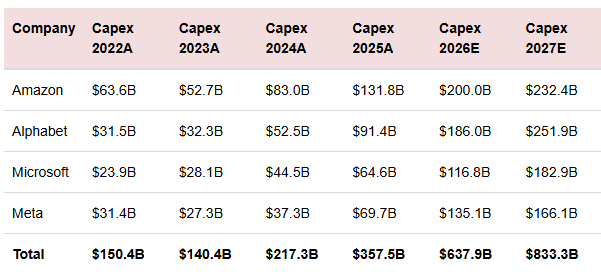
I believe the true danger here lies not in a sudden contraction of investment into AI. I do not expect this to occur. Rather, the greater danger exists in spending continuing to increase, however, at a rate less than what the market expects.
I view this distinction to be significant. While AI investments may be increasing, stock values of semiconductor companies can decrease since valuation reflects the expected amount of future growth (not merely direction). Therefore, should hyperscale companies reduce their expenditures or delay new projects while simultaneously requiring that the capital they invest produce clear returns on that capital, then the earnings estimates of the semiconductor industry could quickly face downward pressures.
Technical Analysis: Head-and-Shoulders
The SOXX chart clearly illustrates a typical bearish formation. A left shoulder developed in early June. Then a head began forming near the $656 price point. Finally, a right shoulder formed before the price dropped through the $600 price point. The neckline of the bearish head-and-shoulders pattern broke when it fell through the area where the price previously traded ($544-$546).
Agar Capital, TradingView
After the first drop-off, SOXX made a pullback to try to recover to $550-$560. In my mind, this pullback looked much like a retest of the “neckline,” rather than a new upside momentum. During this time period, buyers failed to maintain prices over prior levels of support. Now those levels have the potential to become resistance.
Now let’s calculate our theoretical target. To do this, we will need to determine the height of the pattern by determining how far up the price went from the bottom of the neckline to the top of the head. Based upon my calculations, the price decreased about $111 from the high ($656) to the neckline ($545). We can project this same distance down to find our target. So using this logic, subtracting the pattern height of approximately $111 from the $545 neckline produces a measured target near $434. As you can see from the chart, there is an indicator at $431 that indicates this price is our target.
As stated earlier, other indicators confirm that we are experiencing weakness. Our Relative Strength Index (“RSI”) is currently at 41; therefore, we are not yet oversold and may be able to fall even further. The Moving Average Convergence Divergence (“MACD”) is negative and below its signal line. Furthermore, our MACD Histogram is still showing bearish pressure. Additionally, volume has been increasing during these drops, indicating selling pressure and/or a distribution.
Short-term, the first psychological support is at $500. If we break below that, I’ll initially look at $480, followed by the $430-$435 area.
Risks
The Sell thesis for the semiconductor sector has significant risks. First, there are still numerous gaps with respect to the speed, reliability, and manufacturing capacity of DUV (Deep Ultraviolet) lithography systems produced by Chinese companies versus those produced by ASML. Second, five DUV machines will likely be insufficient to alter the competitive landscape in the near term. Third, China has not yet developed a commercially viable, mature EUV (Extreme Ultraviolet) lithography system.
Furthermore, there are risks associated with the potential demand for AI-related technologies remaining higher than initially estimated. Specifically, if open-weight Chinese models create an expanded market for AI, it may lead to increased demand for chipsets as well as networking and infrastructure products. As such, both Nvidia and Broadcom would likely continue to experience growth due to increasing AI workload demands. Additionally, declining bond yields may serve to maintain multiples for many equities, which would further reinforce these themes.
I would reconsider revising my Sell recommendation for SOXX if the stock price closes above $590, thus invalidating the formation of the right shoulder. Similarly, I would revise my Sell recommendation if I witnessed multiple rounds of positive, upside revisions to either Nvidia’s or Broadcom’s earnings estimates, hyperscaler capital expenditures that exceeded expectations, or if the Chinese DUV program did not produce multiple prototype systems within the next twelve-month period.
Bottom Line
I personally and candidly think that China’s advancements with its deep ultraviolet machines will have little effect in threatening ASML’s profits or the profit margins of the entire industry for at least the next year. Five DUV machines do not alter the economics of the semiconductor industry. Therefore, the technological advantages of the West are still quite large. While it is true that investors are thinking about what they expect to happen in 2026, they are beginning to ask themselves if the Western advantage will remain unchallenged. Investors look into the future and invest based upon “tomorrows,” not “todays.”
In my view, this is the most important issue. Valuation multiples for semiconductors include both high margin levels, technological superiority, and continued exponential growth in AI spending. The longer-term risk from China could pressure valuations, while any slowdown in AI capex could trigger earnings downgrades much sooner.
Additionally, the charts suggest some concern as well. As you can see from the chart provided below, there was a break of the neckline, which then followed a failure to recover. This makes the possibility of extending the decline valid. The first level of potential support would be near $480, and theoretically the head & shoulders target should be around $430-$435. If the price were to stabilize back over $550, this would begin to reduce the bearish sentiment; however, if the price were to move back up through $590, my read would be invalid.
Therefore, I continue to hold a Sell rating on SOXX. I am not suggesting that the AI cycle has come to an end, nor do I feel that there will be a sudden drop-off in chip demand. Rather, I believe that the risk/reward profile of the semiconductor sector has changed and no longer favors adding exposure.
“DeepSeek 2.0” isn’t yet a technology pronouncement. It’s an investor assumption that’s starting to be questioned.
Editor’s Note: This article discusses one or more securities that do not trade on a major U.S. exchange. Please be aware of the risks associated with these stocks.
Enjoyed this article? Sign up for our newsletter to receive regular insights and stay connected.