
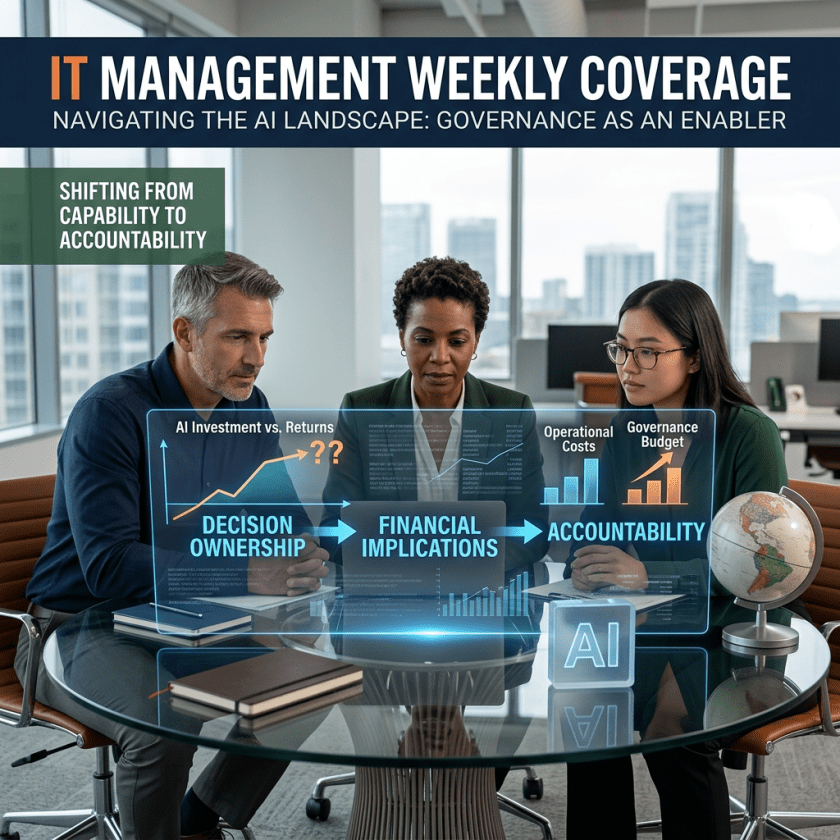
An editorial overview of the week’s key themes in IT Management
If there was a single sentence underneath this week’s IT Management coverage, it was this: the AI conversation has stopped being about capability and started being about accountability. Fourteen posts, and almost every one of them lands on the same uncomfortable question — who owns the decision, who pays for it, and who answers when it goes wrong.
Start with the architecture. The argument that the next evolution of AI will rely on context layers is easy to read as a vocabulary debate, but the substance is control: who owns enterprise meaning, how it is governed, and whether a model can lean on it safely. That is a platform and lock-in decision with a long tail, and it should not be made by whoever integrates first. Sitting directly alongside it, the reminder that your AI strategy already made a risk decision whether or not anyone signed off on it. Adoption pressure pushes organisations into higher-risk use cases before governance, workflows and accountability have caught up. The choice is not only where to deploy, but how much operational and decision risk the business is willing to carry.
Dependency is the other half of that exposure. OpenAI’s model slowdown offers CIOs a lesson in AI planning that has nothing to do with one vendor’s roadmap. Delays, policy shifts and capability changes are now ordinary events, and roadmaps, contracts and architectures need to absorb them without cracking the business plan behind them.
The consequences are no longer contained inside IT. This week’s finding that AI errors reach boards and investors moves experimentation into disclosure territory. Once a model touches financial reporting or investor communications, traceability and documented review stop being best practice and start being the thing you have to produce on demand. Which makes portfolio discipline urgent rather than tidy. The case that there are too many AI use cases and too little impact points at weak data foundations and thin investment discipline rather than a shortage of ideas — the scarce resources are architecture, change capacity and operational attention, and the harder skill is stopping things.
Money made the loudest noise this week. Two pieces circled the same shift from different angles: how AI agents broke traditional SaaS pricing exposes a misalignment deeper than stale seat licensing — software spend, governance and accountability have drifted apart — while the SaaS pricing reset treats seats, tokens and outcomes as an architecture problem rather than a sourcing exercise. The practical work is joining workflow telemetry to entitlement design and contract terms, so renewals reflect how work actually happens instead of preserving a headcount fiction. Usage-based pricing earns its place where it improves visibility; where it just makes costs harder to predict, it is a downgrade dressed as modernisation.
The internal mirror of that is budgeting, and clawing out of the AI budgeting bog makes the case that CIOs need to separate foundational investment, usage-based cost and vendor AI price increases as distinct lines. Blend them and ROI claims become unfalsifiable — and unfalsifiable numbers are exactly what boards stop trusting first.
Where the value actually shows up is a matter of scope. AI’s real power is transforming workflows, not just tasks: shaving minutes off individual work rarely survives contact with a P&L, while redesigning cross-functional flows does — provided the governance, integration and operating model let agents act safely across systems. The commercial version of the same idea appears in unlocking hidden revenue streams with market models, which is less a pricing novelty than a new operating model for revenue decisions, dependent on real-time data integration and on whether the organisation is prepared to trust automated commercial action at scale.
Resilience got its own reality check. The first two hours after an attack set the tone, and the determining factor is rarely technical heroics — it is whether decision authority, recovery validation and cross-functional escalation are clear enough to contain damage without destroying evidence or compliance standing. That is rehearsal work, not tooling work.
Three pieces looked further out. Kids outlearn AI and we still don’t know why points at a possible ceiling on scale-based AI economics; more data-efficient approaches would change who can build useful models, particularly for niche domains and smaller languages. The Forrester AI disruption model reframes the “SaaSpocalypse” question usefully — not whether licence counts shrink, but which layers of the stack become defensible, replaceable or strategic. And a day at a robot carnival in Shanghai is worth reading past the spectacle: ecosystem depth, policy support and social normalisation are what turn embodied AI into practical automation targets.
The through-line for the week is unglamorous but clarifying. Contracts, budget lines, escalation paths, ownership of enterprise meaning — the constraints on AI value in 2026 are managerial, not technical. The organisations pulling ahead are the ones treating governance as the enabling layer rather than the brake.
Full post index for this week:
- The Next Evolution Of AI Will Rely On Context Layers · August 28
- Your AI Strategy Already Made A Risk Decision. Have You? · August 28
- OpenAI’s model slowdown offers CIOs a lesson in AI planning · August 28
- AI Errors Reach Boards And Investors, Study Shows · August 27
- Too Many AI Use Cases, Too Little Impact · August 27
- How AI agents broke traditional SaaS pricing · August 27
- The SaaS Pricing Reset: What AI Agents Mean for Seats, Tokens, Outcomes, and Renewal Strategy · August 27
- AI’s real power: Transforming workflows, not just tasks · August 27
- Incident response: Why the first two hours after an attack set the tone · August 27
- Unlocking hidden revenue streams with market models · August 27
- Clawing out of the AI budgeting bog · August 27
- Kids outlearn AI—and we still don’t know why · August 27
- Beyond The “SaaSpocalypse”: Introducing The Forrester AI Disruption Model · August 26
- I spent a day at a robot “carnival” in Shanghai. Here’s what I saw. · August 26
Browse the full IT Management archive at genesis-aka.net/information-technology/management/
Enjoyed this article? Sign up for our newsletter to receive regular insights and stay connected.