
The real value here is not simply “more load balancing,” but a control-plane pattern that lets VMware Engine workloads be fronted by Google Cloud services without forcing a wholesale redesign of the application tier. Traffic Director centralizes policy, while Envoy and hybrid network endpoint groups expose GCVE backends to native load balancers. That matters because practitioners get a managed path to scale web services, attach security and delivery features, and preserve operational continuity during migration, rather than stitching together ad hoc networking exceptions.
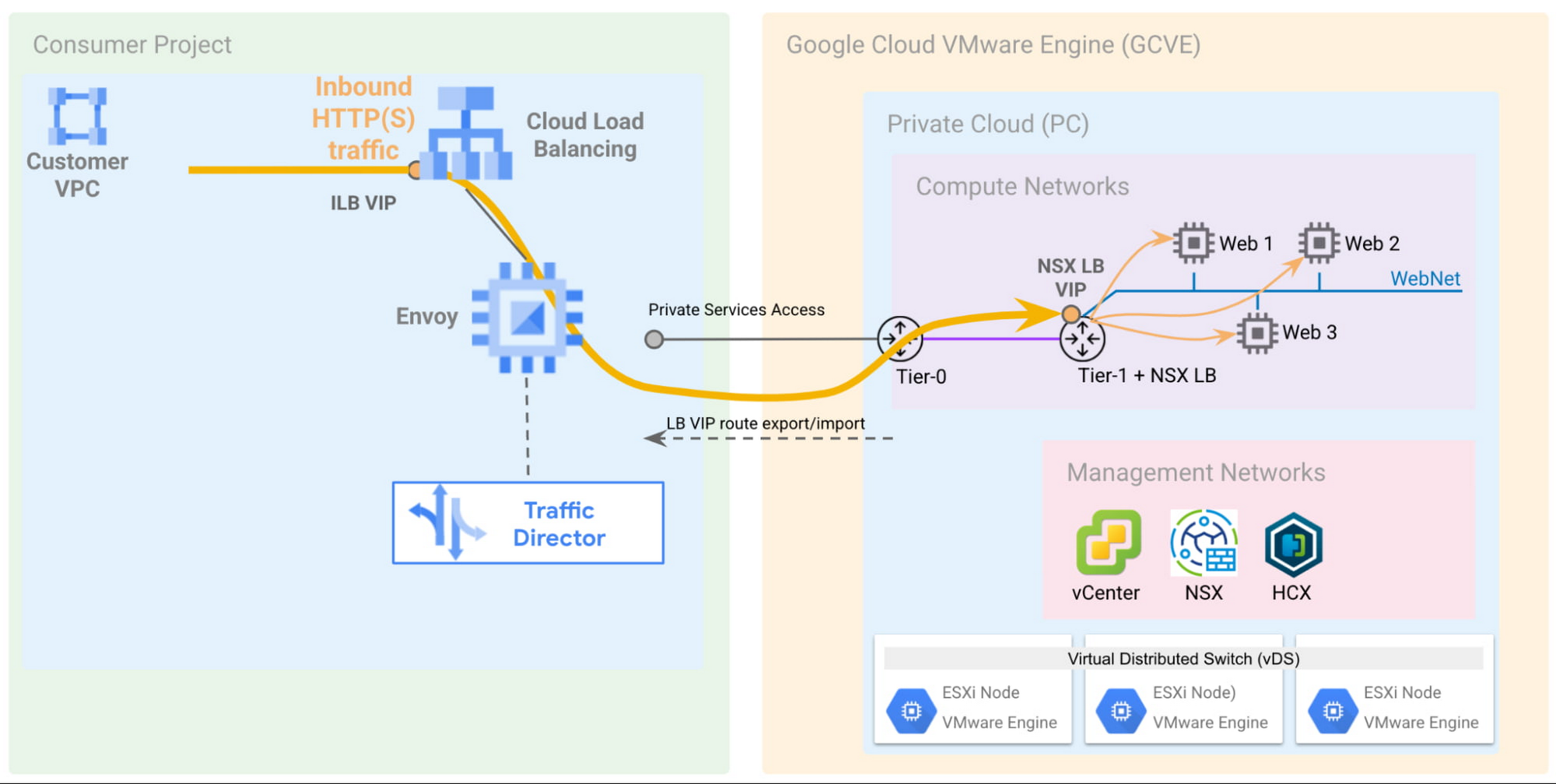
Technically, the architecture hinges on how traffic reaches the Envoy dataplane. In the external case, an HTTP(S) load balancer forwards requests to Traffic Director-managed proxies; backend endpoints can be explicit VM IP and port pairs, or hidden behind an NSX Tier-1 load balancer with routes exported through VPC peering. The internal variant swaps only the front-end load balancer. This separation is useful operationally because it keeps traffic policy in one place while still supporting private addressing, VIP exposure, and protocol-specific choices.
The tradeoff is added architectural choice, which is often where implementation fails in practice. L4 mode has documented restrictions, including a single backend service per target proxy, and the NSX load balancer path introduces another layer that can obscure failure domains if it is not designed carefully. The brief’s benefits—global reach, Cloud Armor, CDN, BYOIP, certificate lifecycle management—are meaningful, but they are conditional on the exact load-balancer combination and backend exposure model. Practitioners should treat the pattern as powerful, not automatic.
- Certificate Authority integration, for full lifecycle management of SSL certificates.
- DDoS protection with Cloud Armor, helps protect your applications and websites against denial of service and web attacks.
- Cloud CDN, for cached content delivery.
- Intelligent anycast with a Single IP and Global Reach, for improved failover, resiliency and availability.
- Bring Your Own IP (BYOIP), to provision and use your own public IP addresses for Google Cloud resources.
- Diverse backend types integration in addition to GCVE, such as GCE, GKE, Cloud Storage and serverless.
Scenario #1 – External load balancer
The following diagram provides a summary of the GCP components involved in this architecture: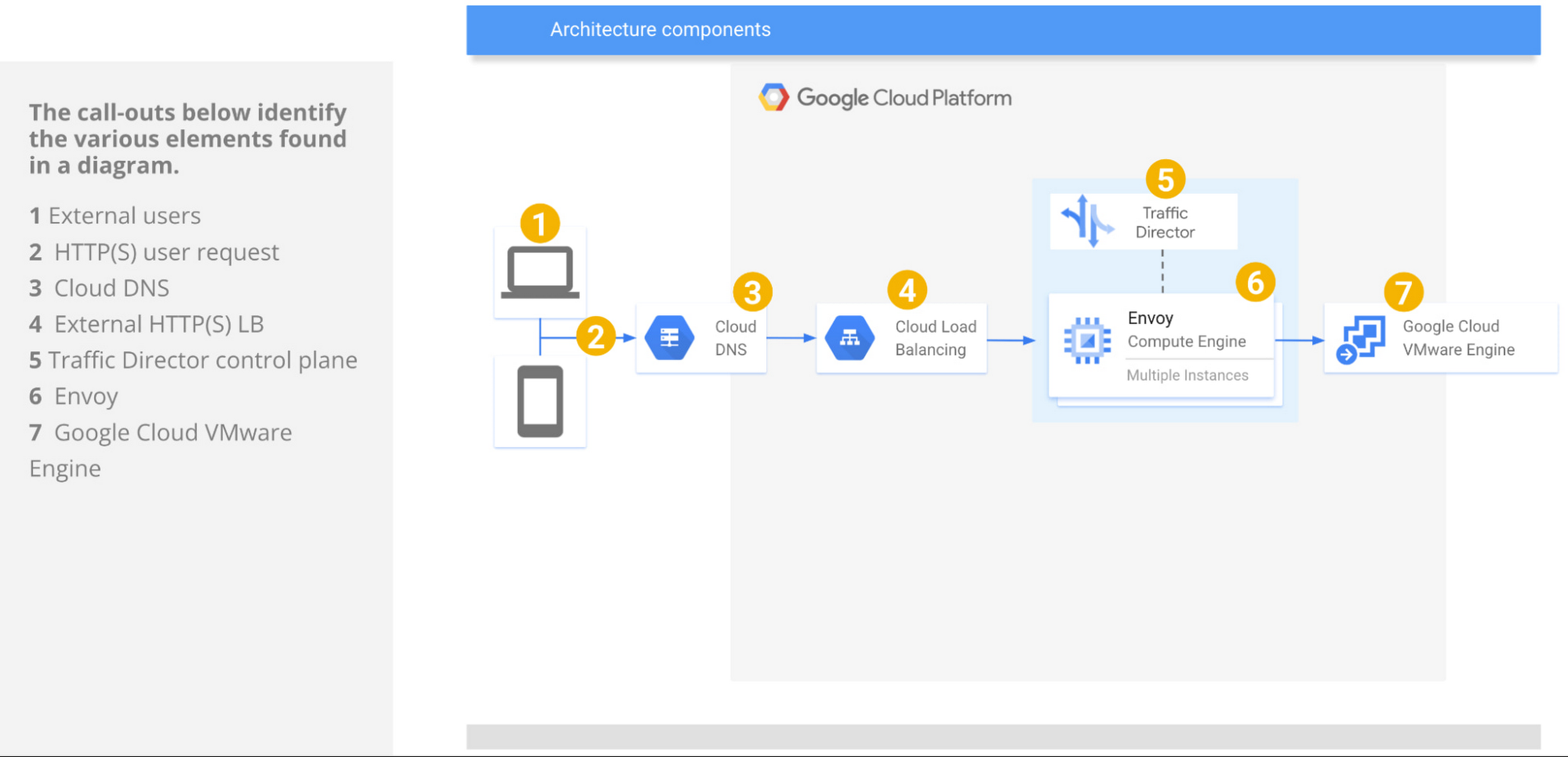

- Only VIP routes are announced, allowing the use of private IP addresses in the web tier, as well as overlapping IP addresses in case of multi-tenant deployments.
- Internal clients (applications inside of GCP or GCVE) can point to the VIP of the NSX Load Balancer, while external clients can point to the public VIP in front of a native, GCP external load balancer.

Scenario #2 – Internal load balancer
In this scenario, the only change is the load balancing platform used to route requests to Traffic Director-managed Envoy proxies. This use case may be appropriate in certain situations, for instance, whenever the users want to take advantage of advanced traffic management capabilities not supported without Traffic Director, as documented here. The Envoy-managed proxies controlled by Traffic Director can send traffic directly to GCVE workloads:
Conclusion
With the combination of multiple GCP products, customers can take advantage of the various distributed network services offered by Google, such as global load balancing, while hosting their applications on a Google Cloud VMware Engine environment that provides continuity for their operations, without sacrificing availability, reliability or performance. Go ahead and Original Postrivate-cloud-networking-for-vmware-engine" target="_blank" rel="noopener">review the GCVE networking whitepaper today. For additional information about VMware Engine, please visit the VMware Engine landing page, and explore our interactive tutorials. And be on the lookout for future articles, where we will discuss how VMware Engine integrates with other core GCP infrastructure and data services.Enjoyed this article? Sign up for our newsletter to receive regular insights and stay connected.