
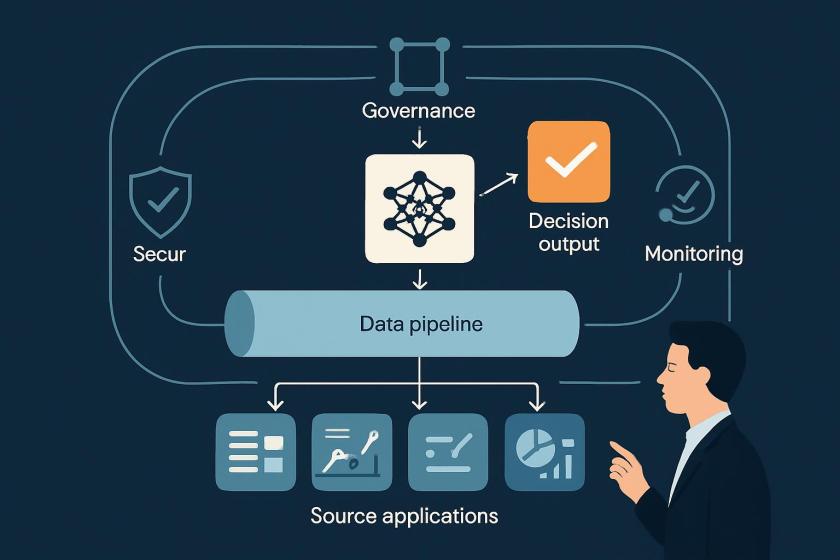
For technical teams, the real challenge is not whether AI can add value, but how it is introduced into existing systems without creating a brittle sidecar. The most durable deployments are usually those that fit current application, data, and identity layers rather than forcing a separate workflow. That means defining where models will be called, what latency is acceptable, and which business processes remain human-approved.
AI also changes the architecture of decision-making. Models depend on the quality, freshness, and lineage of the data they consume, so integration work often matters more than model selection. Teams need clear interfaces between source systems, feature pipelines, monitoring, and downstream applications. Without that discipline, organizations may gain automation speed while accumulating hidden technical debt in duplicated logic, inconsistent outputs, and opaque exception handling.
Operationally, the main trade-off is between scale and control. AI can process large volumes quickly, but production use requires guardrails for access, logging, versioning, fallback behavior, and review paths when predictions are uncertain. Security and privacy controls are especially important when AI touches regulated or sensitive data, because the model layer can become a new surface for leakage, misuse, or compliance gaps.
For decision-makers, the practical question is where AI meaningfully changes throughput, quality, or user experience without increasing support burden. Successful programs tend to start with narrow workflows, measurable service-level expectations, and an ownership model that spans product, data, infrastructure, and governance. In that sense, AI adoption is as much an operating-model shift as a technology upgrade.
Healthcare: Precision Meets Compassion
AI is reshaping healthcare by making it faster, smarter, and more personalized.- Predictive diagnostics: AI models analyze medical images and patient data to detect diseases like cancer and Alzheimer’s earlier than traditional methods.
- Personalized treatment: Algorithms tailor therapies based on genetic profiles, improving outcomes and reducing side effects.
- Operational efficiency: AI streamlines hospital workflows, automates administrative tasks, and reduces wait times.
Finance: Smarter, Safer Transactions
AI is a game-changer in financial services, enhancing security and decision-making.- Fraud detection: AI monitors transactions in real time, flagging anomalies and preventing fraud.
- Algorithmic trading: AI systems analyze market trends and execute trades faster than human traders.
- Credit scoring: AI evaluates creditworthiness using alternative data, expanding access to loans.
Manufacturing: Efficiency and Quality Control
AI is optimizing production lines and reducing downtime.- Predictive maintenance: AI forecasts equipment failures, preventing costly breakdowns.
- Quality assurance: Vision systems detect defects with higher accuracy than human inspectors.
- Supply chain optimization: AI analyzes demand patterns and adjusts inventory in real time.
Retail & Marketing: Hyper-Personalization
AI helps businesses understand and serve customers better.- Product recommendations: AI suggests items based on browsing and purchase history.
- Customer service: Chatbots handle queries 24/7, improving satisfaction and reducing costs.
- Market analysis: AI identifies trends and consumer behavior for targeted campaigns.
Why AI Is So Important
- Scalability: AI handles massive data volumes and tasks beyond human capacity.
- Speed: Decisions and actions happen in milliseconds.
- Consistency: AI systems don’t fatigue or make emotional errors.
- Innovation: AI unlocks new possibilities — from autonomous vehicles to drug discovery.
Ethical Considerations
Despite its benefits, AI raises concerns:- Bias in algorithms
- Data privacy
- Job displacement
- Transparency and accountability
Enjoyed this article? Sign up for our newsletter to receive regular insights and stay connected.