
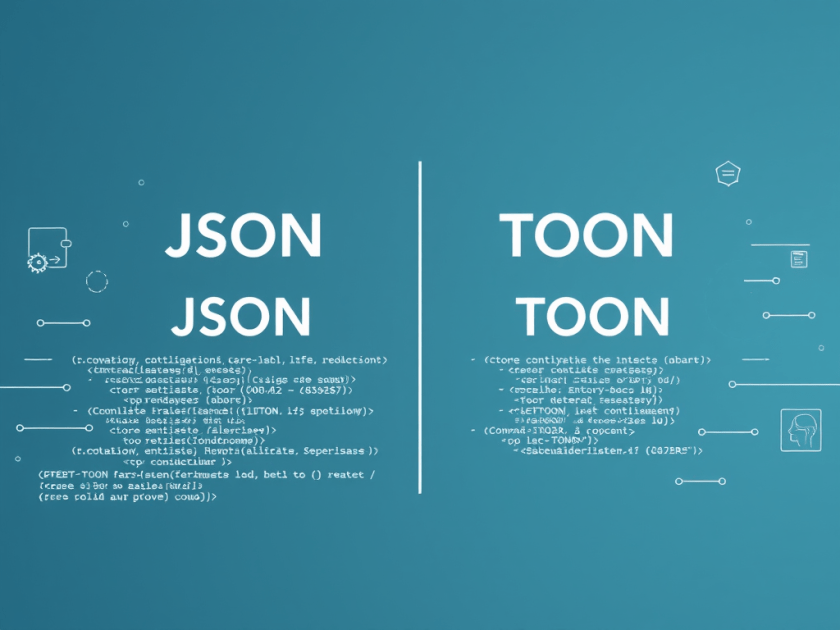
TOON’s significance is not that it invents a new syntax trick; it reframes structured exchange for language-model systems that routinely fail on brittle punctuation. JSON remains excellent for APIs and backend plumbing, but its brackets, commas, and quotes become liabilities when outputs must stay valid across long, multi-step generations. TOON answers that mismatch by favoring indentation and minimal symbols, making structure easier to read and less likely to collapse under generation errors. For practitioners, the appeal is operational: fewer malformed outputs, less repair code, and clearer reviews.
The mechanism is straightforward: TOON encodes hierarchy through spacing rather than dense delimiters, so nested tasks, prompts, and configurations read more like instructions than serialized data. That matters because sequential text generation is where language models are weakest, especially when they must preserve closing symbols and nested arrays over extended passages. In practical terms, TOON is better suited to agent pipelines, structured prompts, and model configuration drafts, where humans need legibility and systems need a format with fewer syntactic failure points than JSON typically imposes.
The limitation is equally clear: TOON is not positioned to displace JSON in existing software infrastructure, because APIs, browsers, databases, and cloud services are already built around it. Its real value sits one layer higher, in the interaction layer where humans and language models collaborate on instructions and intermediate logic. That makes the claim of universality overblown. The more credible conclusion is narrower and stronger: TOON could become a practical working format for structured model workflows, while JSON keeps its role in production interchange.
Why We Needed Something Beyond JSON
JSON was built for the web. It was perfect for REST APIs, browser environments, and JavaScript-based data exchange. But it was not designed for:- long prompts
- chain-of-thought reasoning
- multi-step AI agents
- nested instructions
- evolving workflows
- human-AI collaboration
{
 "name": "Alok",
 "age": 23,
 "skills": [
 "Python"
 "Machine Learning",
 ]
}
…you know the frustration.
Meanwhile, AI prompts and agent workflows are getting more complex. Developers need formats that prioritize clarity, readability, and reliability, not strict punctuation.
This is where TOON enters the conversation.
What Exactly Is TOON?
TOON is a clean, indentation-based data-notation format designed with two goals:- Make structured information readable for humans.
- Make structured information easy for AI models to generate and understand.
- indentation
- spacing
- minimal punctuation
- natural organization
JSON
{
 "user": {
 "name": "Alok",
 "skills": ["Python", "Deep Learning"]
 }
}
TOON
user:The meaning is identical, but the readability is incomparable.
name: Alok
skills:
- Python
- Deep Learning
Why TOON Feels Naturally “AI-Native”
Large language models process text sequentially. Their biggest weaknesses often appear when they must:- remember closing braces
- manage nested symbols
- maintain strict syntax
- generate long structured outputs
- agent workflows
- task decomposition
- structured prompts
- reasoning steps
- chain-of-thought formats
- LLM-generated configurations
TOON in Real Life: Where It Actually Helps
1. AI Agent Pipelines
Modern agents perform multiple steps:- search
- scrape
- analyze
- summarize
- rewrite
- validate
steps:
 - role: search
 query: what is toon notation?
- role: summarizeReadable. Flexible. AI-safe.
style: concise - role: rewrite
tone: friendly
2. Complex AI Prompts With Structure
If you’re building an AI that debates beliefs, diagnoses problems, or generates long multi-part answers, TOON lets you define structure without fighting syntax.debate_task:It reads like instructions, not code.
belief: AI will replace most jobs
strategy:
- challenge assumptions
- provide evidence
- ask guiding questions
3. ML Model Configuration
Deep learning configurations in JSON are notoriously painful to manage. TOON keeps the meaning but removes the friction.model:
type: CNN
layers:
- conv: 32 filters
- conv: 64 filters
- dense: 128 units
training:Even a beginner can understand this instantly.
epochs: 25
batch_size: 64
optimizer: Adam
How TOON Compares to JSON, YAML, and Others
Some might say TOON looks similar to YAML. The difference lies in purpose. YAML was built for DevOps and system-level configuration. JSON was built for browser-based data exchange. TOON is being shaped specifically for AI reasoning, prompt structuring, and LLM workflows. In other words:- JSON is for machines.
- YAML is for servers.
- TOON is for humans and AI working together.
Is TOON Going to Replace JSON?
Most likely, no — and it doesn’t need to. JSON is too deeply embedded in software ecosystems to be replaced. It runs APIs, browsers, cloud services, and databases. TOON doesn’t compete with that world. Instead, it supports the world above it — the AI interaction layer. Think of it like this: HTML didn’t get replaced.But Markdown became the preferred writing format. Similarly:
- JSON will continue powering the backend.
- TOON may become the preferred format for AI prompts and agent logic.
Why TOON Might Shape the Future of AI Interaction
The rise of AI agents, LLM-powered apps, and reasoning-focused models creates a need for a format that balances structure with readability. We’re moving toward systems where:- Humans write structured instructions
- AI expands or modifies them
- systems exchange, update, and interpret them
A Format Built for the Next Era
TOON is more than a new syntax format — it reflects a deeper shift in how we build and communicate with intelligent systems. It is simple, expressive, forgiving, and aligned with the natural way humans write instructions. It allows us to structure information without drowning in brackets. And it allows LLMs to operate with fewer mistakes and more clarity. If JSON was the perfect format for the age of the web, TOON may become the perfect format for the age of AI. And in a world moving rapidly toward agentic systems, reasoning engines, and human-AI collaboration, TOON feels not just useful — but inevitable.Enjoyed this article? Sign up for our newsletter to receive regular insights and stay connected.