
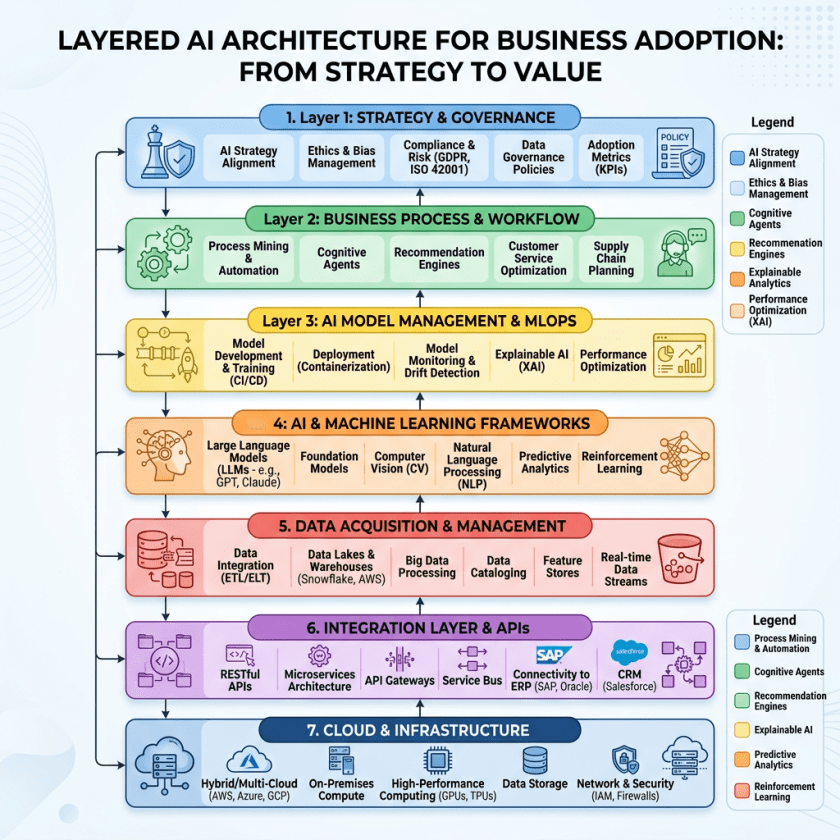
The Deconstruction of the AI Stack: Moving Past the Hype to the Architecture of Enterprise Value
The current corporate landscape is flooded with acronyms. Business leaders are constantly bombarded with terms like ML, NLP, LLMs, Agents, and Bots, often used interchangeably by vendors eager to capitalize on the generative AI boom.
This linguistic confusion is creating a massive strategic blind spot.
In June 2026, simply buying “AI” is no longer a viable corporate strategy. To achieve true operational ROI and avoid costly implementation failures, enterprise leaders, technical architects, and strategists must understand the literal architecture of the technology they are deploying.
Artificial Intelligence is not a single monolith. It is a deeply interconnected, layered hierarchy. To successfully navigate the early-stage adoption phase, you must learn to deconstruct the AI stack — shifting your perspective from viewing AI as a conversational novelty to treating it as a structured engineering ecosystem.
Deconstructing the Stack: The Six Levels of Intelligence
To build actionable workflows, we must first unpack the technical definitions and relationships that define the modern intelligent ecosystem.
THE ENTERPRISE AI HIERARCHY

       [ Artificial Intelligence ]  <-- The Broad Vision
                 │
                 ▼
       [ Machine Learning (ML) ]   <-- The Data Engine
                 │
                 ▼
       [ Deep Learning (DL) ]      <-- The Neural Network Layer
                 │
                 ▼
   [ Natural Language Processing ] <-- The Human Interface
                 │
                 ▼
       [ Large Language Models ]   <-- The Core Brain
                 │
                 ▼
       [   AI Autonomous Agents  ] <-- The Decision Framework
                 │
                 ▼
       [    AI-Powered Bots    ] <-- The Task Executor
1. Artificial Intelligence (AI): The Vision
Artificial Intelligence is the overarching field of computer science dedicated to creating systems capable of performing tasks that traditionally require human intelligence — such as reasoning, learning, perceiving, understanding language, making decisions, and solving complex problems. It is the broad goal; the subfields below are how we actually achieve it.
2. Machine Learning (ML): The Engine
Instead of manually programming rigid, conditional “if/then” rules, Machine Learning systems learn patterns from massive datasets and iteratively improve their performance over time through exposure and experience. Algorithms dynamically adjust their internal parameters based on training data to make predictions or data-driven decisions.
- Supervised Learning: Training models on labeled data to map inputs to specific outputs.
- Unsupervised Learning: Finding hidden structures, clusters, or patterns within unlabeled data.
- Reinforcement Learning: Training systems through an active trial-and-error reward system.
The Structural Evolution: Early AI relied heavily on hand-crafted symbolic logic. The shift to ML changed the paradigm entirely, turning AI into a data-driven science. Deep Learning — a specialized subset of ML using multi-layered artificial neural networks — is what powers modern breakthroughs in high-dimensional data like images, audio, and text.
3. Natural Language Processing (NLP): The Interface
NLP is a specialized branch of AI and ML focused on enabling computers to understand, interpret, generate, and interact with human language. It bridges the gap between digital systems and human communication, transforming unstructured text or speech into structured data. Without NLP, AI applications would be entirely restricted to numbers and rigid databases.
4. Large Language Models (LLMs): The Generative Brain
LLMs (such as the GPT series, Claude, Grok, and Llama) are an advanced application of Deep Learning designed specifically to dominate NLP tasks. Trained on massive datasets using transformer architectures, their core mechanism is deceptively simple: predicting the next token in a sequence.
However, scaling these models has unlocked emergent capabilities — such as contextual reasoning, code generation, and analytical cross-referencing — that smaller models lack. They do not “think” or possess consciousness; they are highly sophisticated, multi-dimensional pattern matchers.
5. AI Agents: The Autonomous Strategist
AI Agents represent the critical shift from passive text generators to active, goal-oriented software. Powered by an LLM acting as the central “brain,” an agent can:
- Perceive: Monitor its environment via APIs, integrated tools, and active memory pools.
- Reason and Plan: Utilize advanced orchestration frameworks (like ReAct, LangChain, or CrewAI) to break down an overarching corporate goal into distinct, logical steps.
- Act: Autonomously interact with external software, browse the web, execute code, query databases, and manage communication channels.
6. Bots: The Applied Execution Layer
In an enterprise context, a bot is the user-facing interface or specialized application where this entire stack becomes a practical reality. While legacy bots were simple, frustrating, rule-based scripts, modern AI-powered bots combine NLP for intent recognition, an LLM for natural communication, and agent capabilities to execute backend operations (such as processing an e-commerce refund or provisioning an internal server).
From the Trenches: Architecture Over Acronyms
Four years ago, I anticipated that the corporate world would become paralyzed by the sheer velocity of AI jargon. While others were treatining ChatGPT as a playground for copywriting, I spent four years analyzing the underlying technical mechanics of the stack — specifically how data flows from basic ML models up into autonomous agent workflows.
I leveraged this architectural clarity to execute a comprehensive, strategic rebranding of my business, WORD MECCA.
I didn’t just plug an API into our business and call it a day. I re-engineered our entire backend workflow by systematically aligning each layer of the AI stack to our business operations. We used deep data patterns to identify operational inefficiencies, deployed LLMs to handle initial content mapping, and built custom agent loops to automate the structural auditing of dense technical text.
WORD MECCA's Enterprise Documentation Pipeline:
[Raw System Data] ➔ [NLP Intent Analysis] ➔ [LLM Structural Mapping] ➔ [Agent Tool Execution] ➔ [Actionable Corporate SOP]
This structural evolution transformed WORD MECCA from a traditional content agency into an elite provider of artificial intelligence integration consultation through actionable documentation.
We realized that companies do not fail with AI because the technology is broken; they fail because they do not have the internal documentation, architectural clarity, and governance frameworks required to guide these tools safely. We step in to map out the entire stack, providing enterprise teams with the literal playbooks needed to turn raw algorithms into scalable business value.
The Strategic Blueprint: Orchestrating the Stack for Enterprise ROI
When you deploy an automated solution in your organization, data flows fluidly across this entire hierarchy in real-time. Understanding this flow is the key to transitioning from a “chatbot” experiment to an indispensable digital workforce.
┌────────────────────────────────────────────────────────────────────────┐
│                        THE ENTERPRISE DATA FLOW                        │
│                                                                        │
│  [User Request] ──> [NLP/LLM Interface] ──> [Agent Reasoning Loop]     │
│                             │                         │                │
│                             ▼                         ▼                │
│  [Underlying ML Models] <───┴─── [Bot Interface] <─── [Tool Execution] │
└────────────────────────────────────────────────────────────────────────┘
When an executive inputs a prompt, the NLP/LLM layer interprets the human intent. The AI Agent then builds an execution plan, utilizing memory and specialized tools. Finally, the Bot interface delivers the completed action back to the user — with every single step continuously optimized by underlying Machine Learning models.
Senior-Level Verdict: Strategic Recommendations for Early-Stage Adoption
As a subject matter expert operating at the intersection of information architecture and artificial intelligence, here is your strategic roadmap for managing this early-stage adoption phase:
- Audit Your Vendor Stack Pitches: Stop accepting “AI-powered” as a sufficient explanation during software procurement. Demand that vendors specify exactly where they sit on the stack. Are they selling you a simple rule-based bot wrapped in marketing hype, or a true LLM-driven agent framework with long-term memory and tool integration?
- Build the Documentation Before the Automation: You cannot automate a process that your team does not understand. Before deploying autonomous agents, use clear, actionable technical documentation to define your current manual workflows. If your standard operating procedures (SOPs) are broken, your AI agents will simply execute bad processes faster and at a higher cost.
- Focus heavily on Multimodal and Agentic Workflows: The industry is moving rapidly away from standalone text boxes. The competitive edge in 2026 belongs to organizations building multimodal architectures (combining text, vision, and data streams) that leverage agent frameworks to act autonomously across legacy corporate software.
- Establish Strong Governance at the Foundation: Because LLMs are pattern matchers rather than thinking entities, they require rigid structural guardrails. Invest in building data governance policies, security compliance standards, and validation layers to audit AI outputs before they impact your clients or core codebase.
The current paradigm shift is ruthless to organizations that treat AI like magic. True operational leverage comes from treating it like an engineering discipline. By mastering the relationships between ML, LLMs, and autonomous agents, you can build a resilient, highly optimized corporate infrastructure that turns the promise of artificial intelligence into verifiable business reality.
by Suzanne Medes
AI Strategist and Technical Writer
Enjoyed this article? Sign up for our newsletter to receive regular insights and stay connected.