
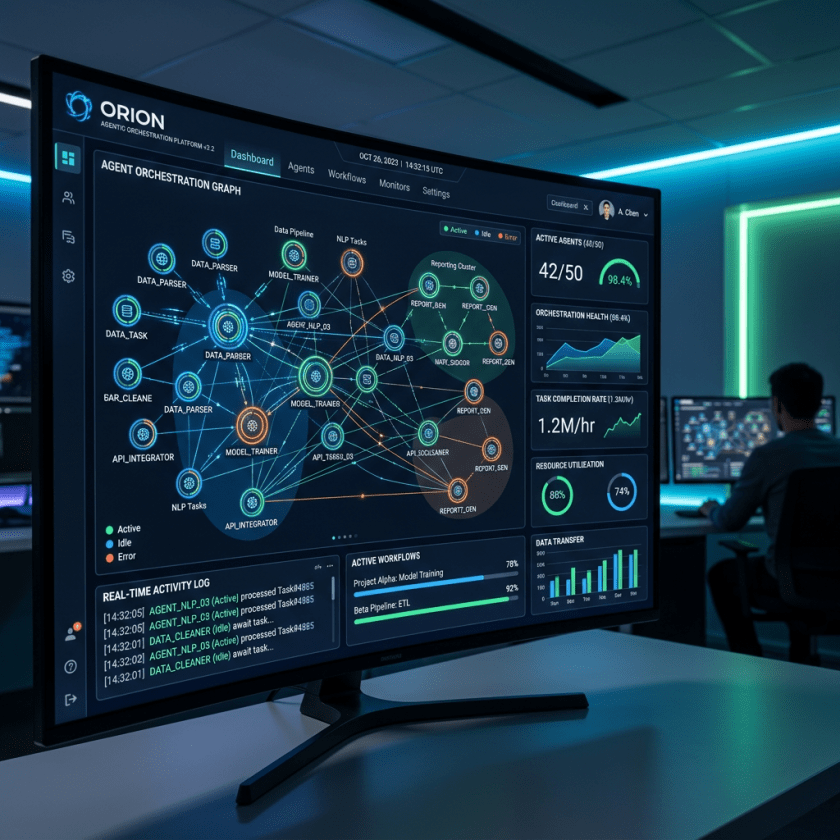
IBM Bob’s update matters less as a coding-assistant feature list than as an enterprise control plane problem. Once agentic tools start chaining model calls, tool invocations and long-running sessions, the hard part is no longer prompting quality; it is deciding where orchestration lives, how much context is retained, and which actions can be audited after the fact.
That shifts implementation concerns into the platform layer. Teams adopting a system like Bob need to think about identity, role separation, tool permissions and execution boundaries as first-class architecture components. Multi-agent workflows can improve throughput, but only if subagents are isolated well enough to prevent context bloat and if shared outputs are promoted back into the main workflow without losing traceability. Otherwise, the promised efficiency gains can be offset by debugging complexity and hidden failure modes.
The other operational change is financial governance. Cost dashboards only help if engineering, procurement and platform teams agree on chargeback or showback rules, acceptable model choices and alert thresholds for anomalous consumption. Without that operating model, token visibility becomes another report that is interesting after the budget is exceeded. For enterprises with legacy estates, this matters even more: modernization workloads are lumpy, dependency-heavy and difficult to benchmark, so cost controls need to be tied to project scope rather than raw seat counts.
Security is the final architecture constraint. Agentic tooling that can read repositories, run commands and traverse dependencies expands the attack surface around prompt injection and privilege misuse. The practical takeaway is to treat these systems like privileged automation: narrow allowlists, sandboxed execution, least-privilege roles and version discipline. In that sense, Bob’s new governance features are not optional extras; they are the minimum viable operating requirements for making enterprise AI sustainable.
On July 9, IBM expanded its Bob agentic development platform with formal multi-agent orchestration, isolated subagents, and a built-in cost analytics dashboard called Bobalytics — a set of additions timed precisely to the moment when unpredictable AI token costs have become a procurement crisis for enterprise engineering teams. Three premium packages targeting COBOL mainframes, IBM i environments, and Java modernization round out an update that repositions Bob from an AI coding assistant to a governed orchestration layer for the full software development lifecycle.
The announcement lands one day after a Microsoft evaluation found that upgrading from one generation of AI model to the next multiplied token consumption by a factor of 10 to 12 in complex agentic coding scenarios — with one test run consuming 69 million tokens in a single task. In parallel, GitHub’s June 1 shift to token-based billing for its 4.7 million paid Copilot subscribers generated projections of cost increases between 10x and 50x for developers running agentic sessions. The economics of enterprise AI tooling are, in the words of the engineering teams now dealing with them, no longer a technical problem but a budget problem.
Subagents Solve the Problem That Makes Agentic AI Expensive
The structural reason agentic AI workflows become expensive as they scale is a quirk of how large language models work. Every exploratory step an agent takes — reading a file, running a search, tracing a function, generating an intermediate result — accumulates in the model’s context window. Each subsequent inference call then processes that entire accumulated history, not just the new step, because the transformer architecture that underlies every major LLM attends to every prior token when generating its next output. The computational cost scales roughly with the square of the sequence length. As workflows grow longer, the cost per step compounds, and an eight-hour development session can run up token charges that would have seemed implausible when the team licensed the tool.
Bob’s new subagents address this directly. Each subagent receives only the inputs it needs for its specific subtask — a codebase section to analyze, a dependency graph to traverse, a set of test cases to generate — and performs its work inside an isolated context window. Only the result returns to the main workflow; the intermediate steps and accumulated context stay inside the subagent and are discarded. IBM’s product page cites a roughly 40% reduction in AI compute spend from task-aware model routing combined with subagent isolation, though this figure is IBM-stated and has not been independently audited.
Combined with parallel tool calling — Bob can now issue requests to multiple tools simultaneously in a single turn, rather than waiting for each to return sequentially — the subagent architecture is designed to reduce both the cost and the latency of multi-step development work. For a team running simultaneous dependency analysis, test generation, and documentation drafts across a large codebase, the ability to divide and conquer rather than queue represents a meaningful architectural shift.
Bobalytics: Visibility Into What AI Is Actually Costing
Enterprise AI tooling has had a consistent blind spot since the earliest enterprise deployments: teams could see what the AI produced, but not what it cost them to produce it, broken down in a way that procurement could act on. When individual developers manually selected models — optimizing in the moment for speed, quality, or cost — the aggregate spend at team or department scale became difficult to forecast, justify, or cap.
Bobalytics, the analytics dashboard IBM released alongside the multi-agent update, is designed to close that gap. It provides three distinct visibility layers: an administrator view covering seat usage, consumption metrics, governance controls, and activity logs; a manager view showing team-level adoption patterns, which workflows are delivering measurable value, and where usage is high but outcomes are unclear; and a cost attribution layer that identifies spend spikes and traces them to specific projects, workflows, and model invocations.
"The goal is to help enterprises understand not only how much AI is being used, but if it’s creating meaningful value," IBM’s VP of Bob Michael Kwok told InfoWorld.
The timing of Bobalytics reflects an industry inflection that has been building for months. Uber reportedly consumed its entire 2026 AI coding tools budget in four months after actively pushing adoption through internal leaderboards. Amazon pushed teams to "tokenmaxx" — maximize token usage — while Microsoft’s own internal evaluations documented token costs multiplying into ranges that made model upgrades economically ambiguous despite lower per-token rate cards. Goldman Sachs has forecast a 24-fold increase in token consumption by 2030 as agentic AI scales across enterprise workflows. Gartner’s Will Sommer put it directly: teams should not mistake falling token prices for falling enterprise AI costs, because agentic models require far more tokens per task than standard models, and consumption growth can outpace unit-cost declines.
Bob’s model routing already addressed part of this by selecting the most cost-appropriate model for each task type — running IBM’s own Granite small language models for straightforward completions rather than routing every interaction through a frontier model. Bobalytics makes the resulting economics visible and auditable rather than leaving them as a figure that appears at the end of the billing cycle.
What Does IBM Bob’s Agentic Architecture Actually Look Like?
Bob routes each task across a pool that includes Anthropic Claude, Mistral open-source models, IBM’s own Granite small language models, and specialized fine-tuned models for code reasoning, security scanning, and next-edit prediction. The platform selects from this pool based on the accuracy, performance, and cost profile required for the specific task — a code review requiring compliance documentation goes to a different model than a function completion or a test stub generation. The developer does not choose; Bob chooses.
This is the feature that RedMonk senior industry analyst Kate Holterhoff identified as both Bob’s primary differentiator and its primary credibility risk at the time of Bob’s general availability in April. Multi-model routing "eliminates the paralysis of choice that comes from switching models between tasks," she told The Register, but "developers can be suspicious of black box tools" — platforms that do not surface which model handled which task or why. For enterprise teams with audit requirements, the question of which model produced which output is not a philosophical nicety but a compliance necessity.
IBM’s response is the governance layer Bob embeds across the workflow: BobShell, the platform’s CLI, generates self-documenting audit trails of agent actions. Role-based modes — Architect, Developer, Security Engineer — scope what actions each agent can take. The Bobalytics dashboard provides consumption logs that procurement teams can query by project. Whether these governance layers satisfy specific regulatory environments will depend on the enterprise’s compliance requirements; IBM does not claim that Bob is pre-certified for specific regulated frameworks.
Security Track Record
One aspect of Bob’s development history that procurement teams evaluating the platform should review is its pre-GA security record. In January 2026, researchers at PromptArmor published findings that IBM Bob’s CLI, when used in beta, was vulnerable to prompt injection attacks enabling malware execution. The specific mechanism: if a user had configured "always allow" for even a single trusted command, a malicious actor could inject process substitution commands that bypassed Bob’s safeguards and executed an arbitrary shell script payload, potentially enabling ransomware delivery, credential theft, or device takeover. The IDE was separately vulnerable to a zero-click data exfiltration attack via markdown image rendering.
IBM said at the time that it had not been directly notified and committed to remediation before general availability. A June 2, 2026 Original Postages/security-bulletin-multiple-vulnerabilities-ibm-bob-1">IBM’s security bulletin listed multiple CVEs patched in Bob version 1.0.3, including a CVSS 9.9-rated proxy bypass vulnerability and an addressed path traversal vulnerability. IBM strongly recommended upgrading to v1.0.3.
These findings are consistent with a known category of risk in agentic software: AI agents with broad file-system and network access running inside developer environments create a large attack surface for prompt injection. IBM’s governance features are partly a response to exactly this risk profile. Enterprise security teams integrating Bob should verify they are running v1.0.3 or later and apply the principle of least privilege to agent tool access — narrow allowlists, no wildcard command approvals, and sandboxed execution environments for extended agentic sessions.
Premium Packages: Three Legacy Environments Nobody Else Is Touching
The July 9 announcement introduced three premium packages that extend Bob into territory that the broader AI coding tool market has largely avoided.
The IBM Z package brings AI-native modernization to COBOL and PL/I code running on IBM Z mainframe systems, along with Job Control Language analysis. This is not a niche: over 200 billion lines of active COBOL code are estimated to be in production globally, concentrated in banking, insurance, and government. Roughly 95% of ATM transactions and 43% of banking systems run on COBOL-based mainframe infrastructure. The challenge for every organization maintaining these systems is not that COBOL is broken — it is, by most measures, extremely reliable — but that the engineers who built it are approaching retirement, the accumulated business logic is undocumented, and the institutional knowledge required to safely change a 40-year-old payment processing system exists only in the heads of a shrinking cohort of practitioners. IBM’s Z package offers an Architect mode for understanding application structure and dependencies before any changes are made, and a Code mode for generating standards-aligned COBOL that preserves the environment’s constraints.
The IBM i package brings the same AI-native workflow to IBM i environments, which have powered mission-critical operations at enterprises worldwide for decades with similarly shallow pools of available practitioners. The Java Modernization package targets migration to Java 25, large-scale code refactoring, and dependency analysis across enterprise Java portfolios accumulated over two to three decades — a workload that represents significant risk even when done carefully by experienced teams.
All three packages deliver what IBM describes as pre-built, customizable workflow sequences: repeatable series of tasks that remain consistent and auditable regardless of which engineer runs them. The auditability claim is meaningful for large modernization programs where variability between team members is a primary source of regression risk.
How Does IBM Bob Compare to Competing Enterprise AI Coding Tools?
The AI coding assistant market registered $12.8 billion in revenue in 2026, with GitHub Copilot at 4.7 million paid subscribers, Cursor at $2 billion in annual recurring revenue, and Claude Code at the top of developer satisfaction rankings in a JetBrains survey. But the market structure matters for understanding what IBM Bob is competing against.
The dominant AI coding tools accelerate individual developer velocity. GitHub Copilot’s primary strength is inline code completion and deep integration with GitHub’s version control and review workflow. Cursor is an IDE replacement built for AI-first individual editing sessions. Amazon Q Developer is AWS-native, excelling at infrastructure management tasks for teams building on AWS. None of them were built around enterprise SDLC governance as a primary design requirement, and none of them have targeted COBOL mainframes, IBM i environments, or structured legacy modernization workflows as product strategy.
IBM Bob’s competitive positioning is different in kind rather than in degree. It is not trying to win on inline completion speed — the RedMonk analysis implies that individual developers may reasonably be skeptical of black-box model selection. It is trying to win on cost governance, multi-environment coverage, and the legacy integration that no competitor has prioritized. Whether that positioning proves durable depends in part on how quickly the dominant players build or acquire the legacy-environment integrations IBM is offering, and in part on whether the reference deployments IBM is citing hold up as representative of what teams in production environments can reliably achieve.
Reference Deployments: What IBM Is Claiming and What Should Be Verified
Jack Henry, the financial technology provider, has used Bob on its RPG codebase — a high-level language with decades of presence in IBM midrange financial services systems. Kevin Sligar, Jack Henry’s Chief Technical Architect, said the platform had enabled developers to accelerate RPG development workflows, improve code quality, and surface deeper knowledge of accumulated legacy system logic. This is a qualitative characterization from a named customer, not a controlled benchmark.
The more dramatic figure comes from Blue Pearl, a cloud services company whose CEO Saireshan Govender described a legacy modernization project originally scoped at nine months of work from 14 engineers that, after introducing IBM Bob, was completed in three days. IBM also cites a 30-day Java upgrade completed in three days at its Think 2026 conference in May, with over 160 engineering hours saved.
These numbers deserve scrutiny proportional to how compelling they appear. The independent analysis posted by The Daily Brief in May 2026 noted that IBM’s productivity figures are self-reported, IBM-internal, and not independently audited. The specific projects cited may have been unusually well-suited to AI-assisted workflows — projects with clear structure, good documentation, and contained scope — rather than representative of the messy, underdocumented legacy modernization work most enterprises actually face. Enterprise AI early adopters have learned that vendor-cited benchmarks, however specifically attributed, should be treated as ceilings rather than expectations until independent evidence exists of replication at scale.
The central question IBM needs to answer in the next two procurement cycles is whether the structured, repeatable workflow sequences Bob provides can consistently achieve these results across diverse teams and diverse codebases — not just in showcase deployments. An independently audited benchmark for a specific workload class (for example, a documented COBOL migration of a defined scale under defined conditions) would provide significantly more procurement signal than additional named customer quotes.
Frequently Asked Questions
What is IBM Bob and how is it different from GitHub Copilot or Cursor?
IBM Bob is an enterprise agentic development platform that routes tasks across multiple AI models — including Anthropic Claude, Mistral open-source models, and IBM’s Granite small language models — based on the cost, accuracy, and performance requirements of each task. Unlike GitHub Copilot, Cursor, or Amazon Q Developer, which are built primarily around individual developer velocity and inline code completion, Bob is designed as a governance and orchestration layer for the full software development lifecycle. Its primary differentiators are multi-model cost optimization, built-in audit trails, and targeted support for legacy environments (COBOL/IBM Z, IBM i, Java) that no competing tool addresses as product strategy.
How does IBM Bob reduce AI computing costs compared to using a single frontier model?
Bob uses two complementary mechanisms. First, task-aware model routing selects the cheapest model capable of handling each specific task — routing straightforward completions to IBM’s Granite small language models and reserving frontier models for complex reasoning. Second, isolated subagents handle multi-step workflow tasks in separate context windows, preventing the context window bloat that compounds token costs across long development sessions. IBM claims approximately 40% AI compute cost reduction from these combined approaches, though this figure is self-stated and not independently audited. The Bobalytics dashboard provides per-project, per-team cost attribution so organizations can verify whether they are achieving similar results in their own environments.
Can AI tools like IBM Bob actually modernize COBOL systems safely?
AI-assisted COBOL modernization remains a high-risk undertaking even with the most capable platforms. The core challenge is undocumented business logic — decades of accumulated decisions encoded in code that has no specification document, no test suite, and no remaining practitioners who remember why specific branches exist. IBM Bob’s IBM Z package includes an Architect mode designed to build a structural understanding of a COBOL application before any changes are made, which addresses the first-principles risk. Whether AI-generated code can reliably preserve the exact semantics of complex mainframe business logic at scale, under real audit requirements, has not been independently verified for any platform at the time of this writing. Any organization using AI-assisted COBOL modernization should run parallel validation against production data volumes before committing to migration.
What security risks should enterprise teams know about before deploying IBM Bob?
Security researchers at PromptArmor identified vulnerabilities in IBM Bob prior to its general availability launch in January 2026, including a prompt injection attack on the CLI that could enable malware execution and a zero-click data exfiltration vulnerability in the IDE. IBM addressed these and additional vulnerabilities in a June 2026 security bulletin; teams should verify they are running Bob version 1.0.3 or later. More broadly, any agentic AI tool with broad file-system and network access creates a prompt injection attack surface. Best practices include restricting tool permissions to the minimum required for each workflow, avoiding "always allow" configurations for shell commands, using sandboxed execution environments for extended sessions, and treating agent actions in audit logs with the same scrutiny applied to any privileged automated process.
Enjoyed this article? Sign up for our newsletter to receive regular insights and stay connected.