
For ETF investors, the week’s bigger lesson is not about any single theme, but about how portfolio building blocks behave when the market narrative changes faster than the labels attached to them. When a strategy becomes crowded, the first risk is often not a headline drawdown but a hidden rise in concentration. That applies equally to thematic equity sleeves, country allocations, and any benchmark that quietly concentrates exposure in a handful of issuers, sectors, or balance-sheet risks.
That is why index construction matters as much as the story the index is meant to capture. A fund can be inexpensive and still be a poor implementation choice if its methodology loads too heavily on the same names or assumes market capitalization is a sufficient proxy for investability. Investors comparing ETFs can benefit from looking beyond the label to the rules: what gets included, how weights are set, how often the basket is rebalanced, and whether liquidity or credit filters are part of the design.
The same discipline applies to thematic allocations. Themes can serve as satellite positions inside a broader core, but they work best when their role is explicit. If a theme already overlaps with existing large-cap, sector, or factor exposures, adding more of it may increase portfolio sensitivity without adding much diversification. In practice, the question is less “Is the theme compelling?” and more “What does it change in the overall mix?”
For long-term investors, the useful takeaway is process. Periodic rebalancing, clear position sizing, and scrutiny of benchmark methodology can matter more than chasing the latest narrative. ETFs are often used because they simplify access; the challenge is making sure they also simplify portfolio decisions rather than merely packaging new sources of concentration risk.
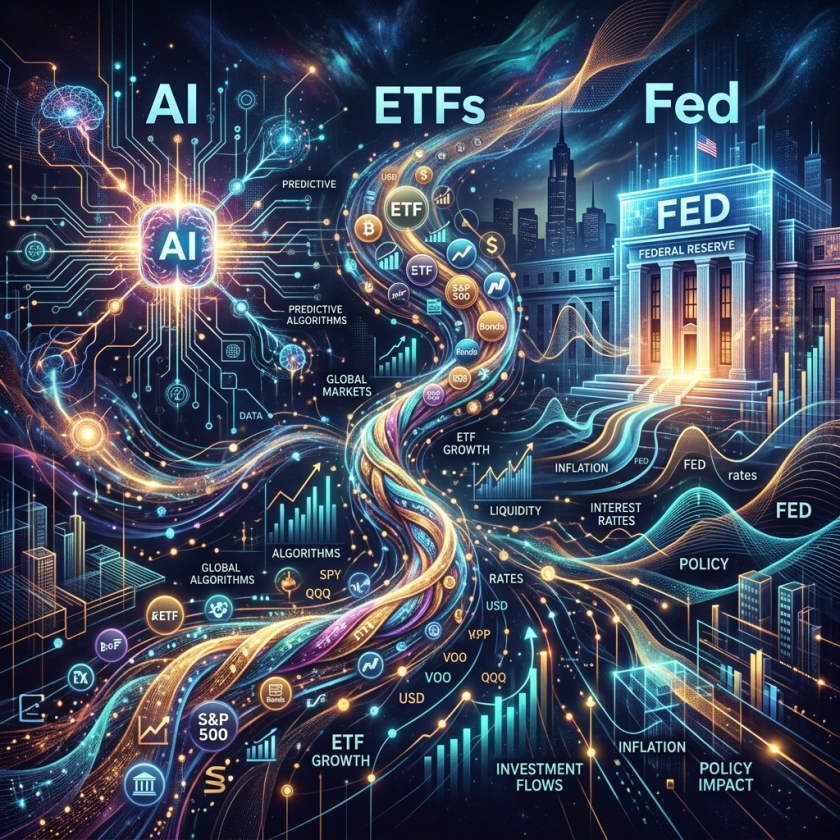
An editorial overview of the week’s key themes in Investment
This was a week in which the market’s established frameworks came under quiet but persistent pressure. The most consequential story concerned the very foundation of the AI trade: reporting shows that Big Tech AI spending has topped $725 billion, with aggregate free cash flow projected to hit zero by this summer. Capital expenditure is now growing roughly 70% faster than cash earnings, and the mismatch has already triggered a tech-stock selloff as investors reassess whether the current pace of AI infrastructure buildout is sustainable. It is the kind of number that forces a portfolio-level question: how much of this year’s equity gains have been a function of spending that cannot keep accelerating indefinitely?
That question about capital allocation dovetailed with a broader rethink of where growth capital should actually go. At the industry’s midyear gathering, advisors reported that thematic ETFs are finding a strategic home in client portfolios well beyond AI alone — 73% now carry a dedicated thematic allocation spanning memory, robotics, and space exploration, with vehicles like DRAM, ROBO, and UFO cited as examples. That diversification impulse showed up concretely in the energy sector too, where commercial small modular reactor deals are boosting nuclear-focused ETFs like NUKZ. Elementl Power’s utility-scale project in Southeast Ohio, built on GE Vernova’s BWRX-300 design, and BWXT’s expanding mPower reactor line for land and maritime use, both point to nuclear moving from a speculative theme to a commercially anchored one — exactly the kind of allocation advisors say they’re now making room for alongside, not instead of, AI exposure.
Structural questions weren’t confined to equities. On the policy side, Fed Chair Kevin Warsh is repositioning the central bank around a renewed commitment to the 2% inflation target, emphasizing credibility and independence even as he signals openness to institutional innovation. It’s a leadership stance that markets will be pricing for months, since it touches everything from rate-path expectations to the credibility premium built into long-duration assets. Fixed income itself came under its own scrutiny this week: TMX VettaFi argues that traditional benchmarks are broken and need remedying, proposing smart-beta frameworks that weight structural liquidity and credit quality over the debt-heavy construction of legacy indexes. The pitch is that investors can reduce default risk systematically, without paying active-management fees, simply by fixing how the benchmark itself is built.
Even index classification rules faced a challenge. South Korea’s KOSPI climbed 112% in 2026, making it the best-performing major index in the world, yet MSCI continues to classify the country as an Emerging Market. MSCI’s own leadership points to won liquidity and currency trading restrictions as the sticking points, though a trading reform expected this July could finally force a reclassification. It’s a reminder that index membership can lag market reality by years, with real consequences for the passive flows that track those benchmarks.
Taken together, the week’s stories share a common thread: the frameworks investors have relied on — cash-flow assumptions behind AI valuations, benchmark construction in fixed income, market classification systems, even the Fed’s own reaction function — are all being re-examined at once. None of these are crisis signals on their own, but they compound. A market questioning its AI spending assumptions, its bond benchmarks, and its index rules simultaneously is a market in the process of resetting its priors, and portfolios built on last year’s assumptions may need a second look.
Investors heading into the second half of the year would do well to treat this week’s stories as connected rather than isolated. The AI cash-flow squeeze, the shift toward thematic and nuclear diversification, the Fed’s recalibrated posture, and the rebuilding of fixed income benchmarks all point toward a market in the middle of updating its own rulebook — and South Korea’s classification limbo is a fitting emblem of how slowly official frameworks can catch up to fast-moving reality.
Full post index for this week:
- Repositioning the Fed · July 3, 2026
- South Korea Has the World’s Hottest Stock Market: Why Does MSCI Still Call It ‘Emerging’? · July 3, 2026
- Big Tech AI Spending Tops $725 Billion: Free Cash Flow Hits Zero This Summer · July 3, 2026
- Midyear Symposium: Making a Strategic Home for Thematic ETFs · July 3, 2026
- Advanced Nuclear Power Projects: Commercial SMR Deals Boost NUKZ · July 3, 2026
- Benchmarks Are Broken: Remedying Fixed Income · July 3, 2026
Browse the full Investment archive at genesis-aka.net/investment/
Enjoyed this article? Sign up for our newsletter to receive regular insights and stay connected.