

Building robust and efficient machine learning (ML) solutions is more critical than ever. AWS offers a structured approach to designing and operating ML workloads through its Well-Architected Framework. This guide walks you through the key concepts, principles, and best practices to help you architect effective ML solutions on AWS.
The Six Pillars of the AWS Well-Architected Framework
The AWS Well-Architected Framework consists of six pillars that ensure optimal performance, security, and cost-efficiency of cloud-based systems. Each pillar plays a crucial role in developing a well-rounded machine learning solution.
1. Operational Excellence
This pillar focuses on managing and improving systems to deliver business value. In the context of machine learning, operational excellence involves continuously monitoring the performance of your models and refining processes to enhance their accuracy.
2. Security
Security is paramount for any cloud-based workload. Protecting sensitive data, such as training data for ML models and the algorithms themselves, is essential. Best practices include implementing strong identity and access management (IAM) controls and robust data encryption.
3. Reliability
Reliability ensures that systems can recover from failures and continue to operate without significant disruptions. In machine learning, reliability means your models should be able to update or retrain without interrupting production, and their performance should remain consistent over time.
4. Performance Efficiency
Performance efficiency revolves around optimizing the use of computing resources. In ML, this includes selecting the right tools, instance types, and data processing techniques to maximize model performance while minimizing computational costs.
5. Cost Optimization
Cost optimization is about minimizing unnecessary expenses while maintaining performance. Automating parts of the ML lifecycle, such as data processing and model deployment, can significantly reduce costs while boosting efficiency.
6. Sustainability
Sustainability, a recently introduced pillar, emphasizes minimizing the environmental impact of cloud workloads. Machine learning can be resource-intensive, so it’s important to choose energy-efficient AWS regions and optimize resource usage to reduce your carbon footprint.
Understanding the Machine Learning Lifecycle
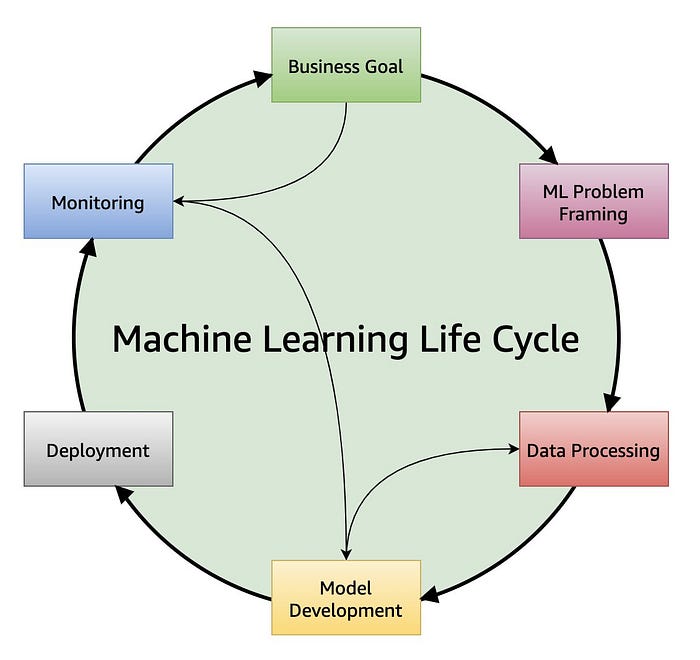
Machine learning is an iterative process consisting of multiple stages, each of which plays a critical role in building effective ML solutions. The key phases of the ML lifecycle are as follows:
Phases of the ML Lifecycle
Business Goal Identification:
- Objective: Define the business problem and its value.
- Outcome: Clear objectives and success criteria.
ML Problem Framing:
- Objective: Translate the business problem into an ML problem.
- Outcome: Defined predictions and performance metrics.
Data Processing:
- Objective: Prepare data for model training.
- Key steps: Data collection; Data preprocessing; Feature engineering
Model Development:
- Objective: Build and fine-tune the ML model.
- Key practices: Model training; Hyperparameter tuning; Evaluation
Model Deployment:
Objective: Deploy the model for production use.
Outcome: An operational model making real-time predictions.
Model Monitoring:
Objective: Ensure the model continues to perform well over time.
Outcome: Sustained performance and reliability.
Feedback Loops in the ML Lifecycle
The ML lifecycle is not strictly linear. Feedback loops allow continuous improvement. For example, model monitoring may reveal issues that necessitate revisiting data processing or model development.
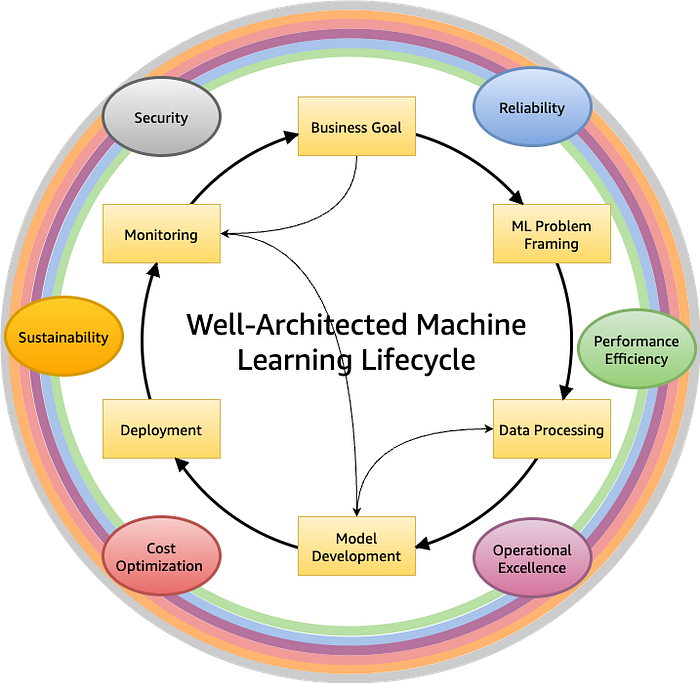
When applying the AWS Well-Architected Framework to the ML lifecycle, each pillar influences various phases of the process. This integrated approach ensures that ML solutions are not only effective but also secure, reliable, and efficient.
Integration of the Six Pillars into ML Phases:
- Operational Excellence: Applied throughout to ensure smooth operations.
- Security: Critical during data processing, model development, and deployment.
- Reliability: Ensures models are robust and handle failures effectively.
- Performance Efficiency: Optimizes resource use during model training and deployment.
- Cost Optimization: Reduces expenses throughout the lifecycle.
- Sustainability: Minimizes environmental impact at each phase.
Well-Architected ML Design Principles
To build effective ML solutions, certain design principles should guide the development process:
Key Design Principles
- Assign Ownership: Allocate clear responsibilities to team members with the right skills.
- Provide Protection: Implement security measures to safeguard data and models.
- Enable Resiliency: Use version control and traceability to recover from failures.
- Enable Reusability: Develop modular components to save time and resources.
- Enable Reproducibility: Ensure all components are version-controlled for consistency.
- Optimize Resources: Balance performance and cost through trade-off analyses.
- Reduce Cost: Automate processes and optimize workflows to minimize expenses.
- Enable Automation: Utilize CI/CD pipelines to streamline operations.
- Enable Continuous Improvement: Regularly monitor and refine ML workloads.
- Minimize Environmental Impact: Set sustainability goals and optimize resource usage.
Best Practices for Well-Architected Machine Learning
The machine learning lifecycle involves a series of interconnected steps crucial for building, deploying, and maintaining models. These steps, as well as supporting processes, are highlighted in Figure bellow.

Core Steps in the ML Lifecycle:
- Identify Business Goal: Clearly define the business objectives.
- Frame ML Problem: Translate the business goal into a specific ML task.
- Collect Data: Gather relevant data needed for model training.
- Pre-process Data: Clean and prepare the data for analysis.
- Engineer Features: Create features that enhance model performance.
- Train, Tune, Evaluate: Develop the model, adjust parameters, and assess its performance.
- Deploy: Put the model into production for real-world use.
- Monitor: Continuously check the model’s performance and make adjustments as needed.
Supporting Processes
- Prepare Data: Ensures data is clean and ready for model training.
- Process Data: Maintains a continuous flow of quality data throughout the lifecycle.
Conclusion
The AWS Well-Architected Framework offers a comprehensive approach to designing and deploying machine learning solutions that are secure, reliable, and cost-efficient. By applying the framework’s six pillars and following best practices, you can ensure that your ML workloads are both effective and sustainable.
For more detailed guidance, refer to the AWS Well-Architected Machine Learning Lens.
Enjoyed this article? Sign up for our newsletter to receive regular insights and stay connected.