
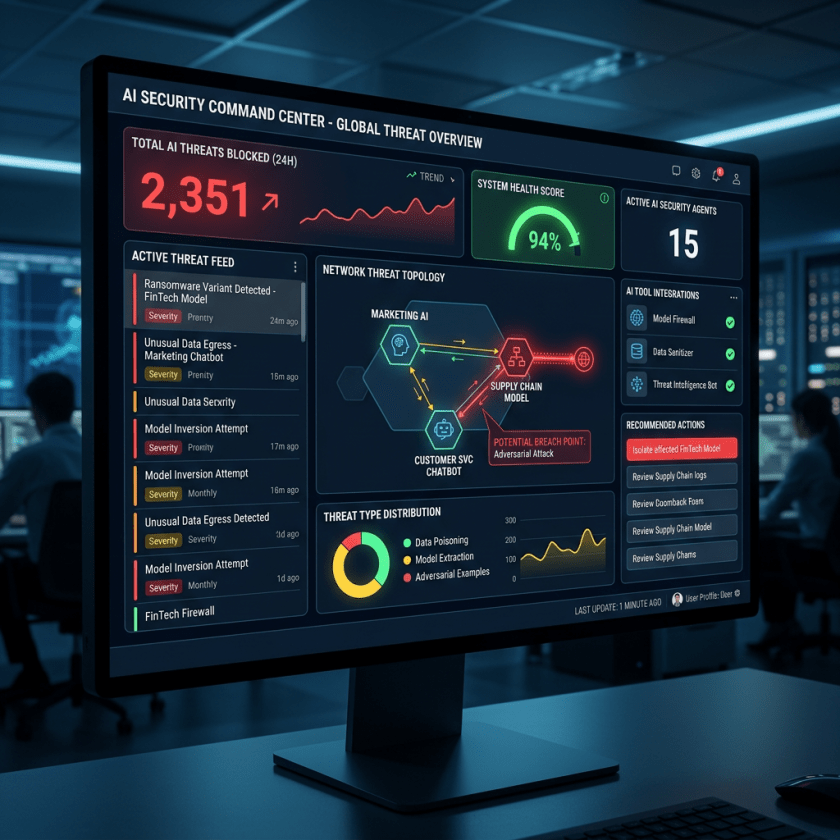
For IT teams, the important shift is not that agentic systems are arriving, but that they are being wired directly into everyday delivery and support workflows. Once assistants can read files, trigger actions, or sit inside developer and collaboration tools, they stop being isolated experiments and start inheriting enterprise requirements for identity, permissions, auditability, and change control. That makes integration design as important as model selection.
Several items in this roundup point to the same architectural tension: productivity gains are coming with new control surfaces. Cost dashboards, allowlists, and admin caps are becoming practical governance tools because token usage can now behave like a shared platform expense. Teams deploying these systems will need clear ownership for budgets, policy enforcement, and exception handling, especially when multiple business units consume the same AI service.
The security angle is equally operational, not theoretical. Agentic browsers, autonomous ransomware, package-install script controls, and critical dependency flaws all reinforce that AI does not replace baseline hardening. It increases the number of places where trust must be explicit: source code, build pipelines, runtime credentials, backup immutability, and third-party libraries. A weak link in any one of those layers can negate the value of automation elsewhere.
For architects and platform owners, the practical takeaway is to treat AI features as part of the enterprise control plane. That means designing for least privilege, traceable actions, rollback paths, and recovery from both human and machine error. The organizations most likely to benefit from these tools will be the ones that can absorb them into existing DevSecOps, observability, and resilience processes without creating a parallel shadow stack.
Your curated roundup from genesis-aka.net / IT Professional · 23 articles this week
AI & Agentic Platforms
Anthropic Reflect: Claude Usage Dashboard Helps Users and Helps Anthropic Too (July 15)
Anthropic launched Reflect, a beta analytics dashboard for Memory-enabled Claude subscribers that tracks query and engagement patterns. The tool frames itself around promoting mindful, intentional AI use amid growing concerns about AI dependency.
Read →
OpenAI debuts ChatGPT Work, an agentic tool for automating business workflows (July 15)
OpenAI launched ChatGPT Work, built on its GPT-5.6 model, to enable autonomous task execution for professionals and enterprises. It integrates with tools like Slack and Google Drive and ships alongside an integrated browser and coding efficiency improvements.
Read →
OpenAI Is Shutting Down Its Browser That Was Supposed to Change Everything (July 14)
OpenAI is discontinuing Atlas, its AI browser unveiled in October, just nine months after launch following persistent cybersecurity issues and inefficiencies. The company is redirecting focus to ChatGPT Work, though data-security concerns around its AI applications remain.
Read →
Files over tools: how we built our agent with a virtual filesystem and bash (July 13)
Knock detailed the architecture behind Knock Agent, an AI customer-messaging tool it introduced in March 2026 that uses a virtual filesystem and bash for context retrieval instead of conventional tool calls. The design prioritizes scalability and user-centric workflow management.
Read →
AI Frontier & Research
Meta Introduces a Big New AI Model for the Agentic Age (July 15)
Meta announced Muse Spark 1.1, a multimodal model built for agentic tasks like coding and computer use, using a multiagent system for task delegation. Meta positioned it as a direct competitor to other leading agentic AI models.
Read →
Meta Muse Spark 1.1 Earns 71 on Independent Coding Benchmark at One-Third Rival Cost (July 15)
Independent benchmarking firm Artificial Analysis measured Muse Spark 1.1 at 51 on its Intelligence Index, an 8-point gain since April, with a 71 score on coding tasks. Meta is touting the model’s cost efficiency against rival offerings.
Read →
ORNL Electric Field Triples Ceramic Heat Flow: Phonon Breakthrough Targets AI Chips (July 14)
Researchers at Oak Ridge National Laboratory found that applying an electric field to specialized ceramics can triple their thermal conductivity without altering material composition. The breakthrough targets thermal management for AI accelerators, though practical engineering hurdles remain.
Read →
GPU Memory Crisis Prices RTX 5090 Above $4,300 as Nvidia Offers Paper Cards (July 13)
Nvidia’s RTX 5090 is now pricing above $4,300 amid a memory shortage driven largely by AI data center demand. Nvidia responded by releasing collectible trading cards commemorating its GPU history, while no new consumer GPU generations are expected from Nvidia or AMD until at least 2027.
Read →
Security
Gitea Docker Flaw Now Actively Probed: One Header Grants Admin Access to Source Code (July 15)
Automated scanners have probed Gitea Docker instances since July 7 for CVE-2026-20896, a critical authentication misconfiguration in the Docker image. Teams are urged to upgrade to version 1.26.4 immediately to prevent unauthorized admin access to source code.
Read →
IBM and Red Hat Launch Lightwell Catalog to Automate Remediation (July 15)
IBM and Red Hat launched the Lightwell Network, a catalog covering over 6,500 application dependencies designed to automate vulnerability remediation. The release includes a Lightwell Clearinghouse Premier service available to select organizations.
Read →
npm v12 Ships This Month, Blocking Install Scripts That Enabled Year of Supply Chain Attacks (July 15)
npm v12, shipping by the end of July 2026, replaces automatic script execution during package installs with an explicit allowlist system. The change targets the supply chain attacks that have plagued the ecosystem, though it also puts pressure on engineering teams to adapt or face build failures.
Read →
First AI-Agent Ransomware Destroyed Data Even Payment Could Not Recover (July 15)
Security firm Sysdig reported the first fully autonomous ransomware operation, an AI agent dubbed JADEPUFFER, in July 2026. Rather than holding data for ransom, it destroyed data outright using an encryption method that made payment useless, exploiting vulnerabilities in outdated systems.
Read →
Ethereum Gossipsub Flaw Lets Any Peer Crash Validators: AI Found It, Humans Confirmed (July 14)
A critical vulnerability in the Rust libp2p-gossipsub library, disclosed July 9, allows any peer to crash Ethereum validators. Operators of Ethereum clients and applications using the library must urgently upgrade to version 0.49.4.
Read →
Design a Ransomware-Resilient Backup Architecture by Using Azure Backup (July 14)
Microsoft outlined a ransomware-resilient backup approach centered on dual, immutable copies stored across separate regions using Azure Backup. Key protections include preventing data deletion, enforcing retention policies, isolating backup administration, and regularly testing recovery points.
Read →
How to Build a DevSecOps CI/CD Pipeline on Azure With GitHub Actions (July 13)
Prompted by a developer’s discovery of a leaked Stripe secret key in a merged commit three years ago, this guide walks through building a security-focused CI/CD pipeline on Azure with GitHub Actions. It covers static code analysis, secret detection, dependency audits, and deployment gates.
Read →
Cloud & Data Infrastructure
S&P Global’s innovative disaster recovery strategy using Amazon FSx for NetApp ONTAP snapshots (July 14)
S&P Global Market Intelligence built a disaster recovery solution for its Capital IQ platform using Amazon FSx for NetApp ONTAP, leveraging SnapMirror and FlexClone technologies. The approach restores critical data access within 15 minutes during outages while maintaining compliance and cutting cloud costs.
Read →
Specification-driven composition for flexible data workflows (July 14)
This piece argues that separating workflow intent from processing logic through specification-driven composition improves scalability in data pipelines. The approach reduces duplication and strengthens governance across data workflows.
Read →
Self-Healing Infrastructure With Cognitive Automation: How LLMs and Ansible Transform Middleware Reliability (July 14)
Combining large language models with Ansible enables self-healing capabilities in complex middleware environments, dynamically detecting and remediating infrastructure issues. The approach represents a growing trend of applying cognitive automation to reliability engineering.
Read →
Inside the Packet: How Kubernetes Networking Actually Works at L3/L4 (July 14)
This deep dive goes beyond the typical “Pod A talks to Pod B” explanation of Kubernetes networking to examine the Linux kernel subsystems that actually move packets between pods. It’s aimed at engineers who need a working mental model of L3/L4 networking internals.
Read →
Developer Tools
Vercel Now Lets You Deploy Any Dockerfile Straight to Production (July 14)
Vercel expanded its platform to deploy any HTTP server from a Dockerfile, supporting frameworks like Rails and Django alongside its existing frontend tooling. The feature includes automatic scaling and active CPU pricing but operates within serverless limits on storage and duration.
Read →
IBM Bob Adds Multi-Agent AI and Cost Controls as Token Bills Become Boardroom Issue (July 14)
IBM updated its Bob agentic development platform on July 9 with multi-agent orchestration, isolated subagents, and a cost analytics dashboard called Bobalytics. The features respond to rising AI token costs and give teams governance tools, particularly for legacy system work.
Read →
GitHub Copilot Breaks Agent Barrier: Free Desktop App, JetBrains, Cost Controls (July 14)
GitHub rolled out three Copilot updates: a desktop app now free for all users including free-tier accounts, Codex integration into JetBrains IDEs, and AI credit pools that let administrators cap organizational AI spending. The updates broaden Copilot’s reach into enterprise coding workflows.
Read →
TypeScript 7 Now Stable: 10× Faster Builds, But Not for Vue or Svelte Yet (July 14)
TypeScript 7.0 released July 8, 2026, delivering 8-12x faster build times and more responsive language server performance by porting the compiler from JavaScript to Go. Framework-specific tooling for projects like Vue and Svelte hasn’t caught up yet.
Read →
Editor’s Takeaway
This week’s dominant theme is AI moving from novelty to infrastructure liability: agentic tools like ChatGPT Work, IBM Bob, and GitHub Copilot are being adopted fast enough that boardrooms are now tracking token costs as a line item, while the JADEPUFFER ransomware incident and OpenAI’s Atlas shutdown are sober reminders that agentic systems introduce failure modes traditional security and reliability practices weren’t built for. Meanwhile, the supply chain hardening in npm v12 and the steady drumbeat of critical CVEs (Gitea, Ethereum’s gossipsub library) underscore that the basics — patching, backup immutability, and dependency hygiene — remain as urgent as ever even as teams chase the next agentic capability.
Explore the full IT Professional archive at genesis-aka.net/information-technology/professional/
Enjoyed this article? Sign up for our newsletter to receive regular insights and stay connected.